In shortMostly ordinary Christian families. San Callisto alone accounts for an estimated half a million burials, dozens of martyrs and 16 popes, nine of them together in its Crypt of the Popes. Priscilla, out on Via Salaria, has seven popes among thousands of graves. Domitilla's semi-underground basilica is dedicated to the martyrs Nereus and Achilleus and to St Petronilla, and the crypt of St Cecilia at San Callisto has stood empty since 821.
about 500,000burials at San Callisto
16popes at San Callisto
9popes in one crypt
7popes at Priscilla
Who is buried in the catacombs of Rome
San Callisto, on the Via Appia Antica, carries the big number. Its own site counts around half a million Christians laid in these galleries, among them dozens of martyrs and sixteen popes. The complex served as the official cemetery of the Church of Rome through the third century, which is why so much of the early clergy of the city ended up under the same roughly 90 acres of field.
Priscilla, north of the centre on Via Salaria, is the other clerical address: thousands of burials and seven popes on two levels rather than four. Domitilla's route is built around the only semi-underground basilica in Rome, dedicated to the soldier-martyrs Nereus and Achilleus and to St Petronilla.
Santi Marcellino e Pietro, out on Via Casilina, covers about 18,000 m² and holds an estimated 15,000 third-century burials. The Pontifical Commission for Sacred Archaeology lists seven Roman catacombs open to the public in all, and the famous names in them amount to a handful of graves inside a cemetery of anonymous wall slots.
What the burials themselves look like
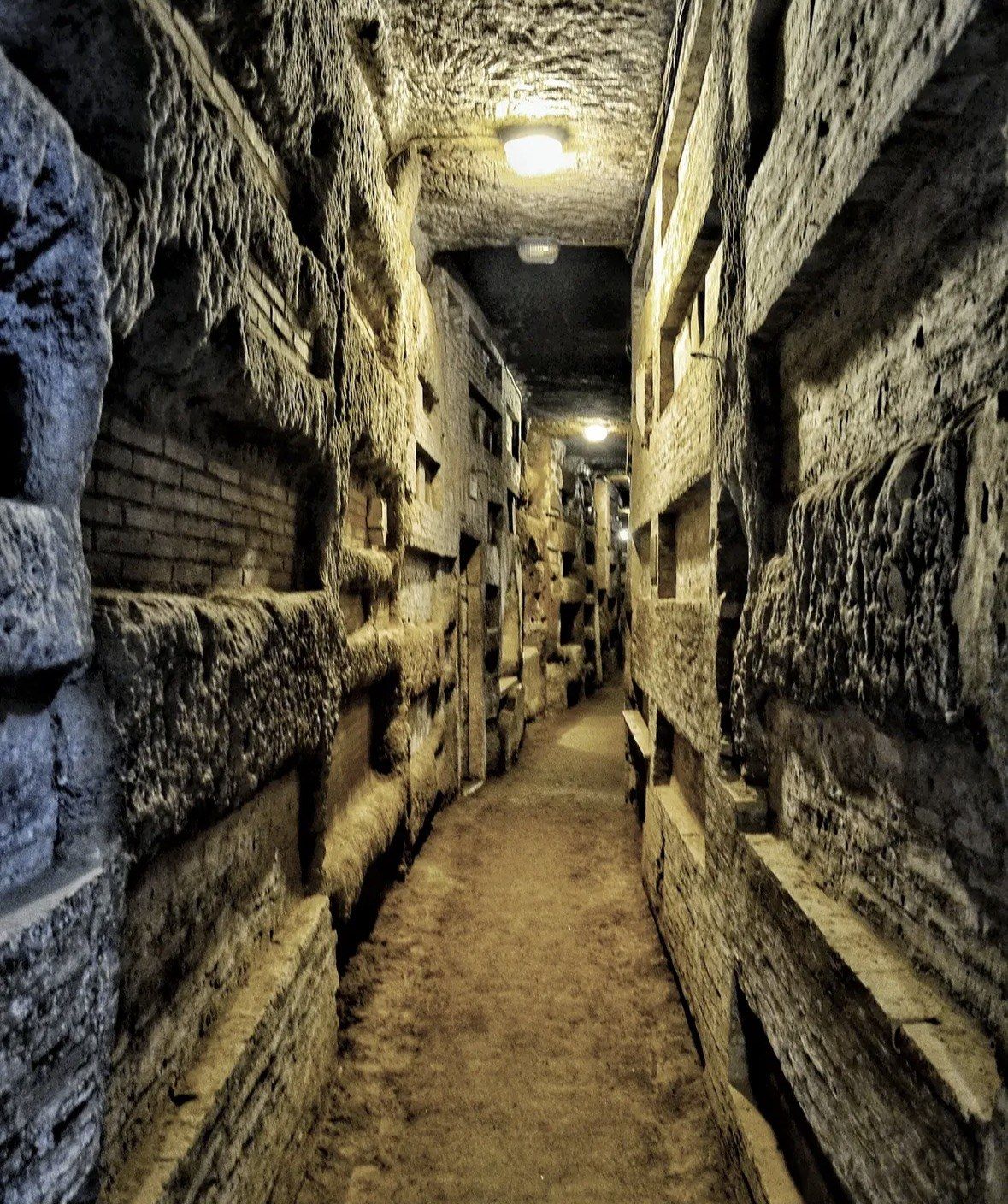
Almost everyone down there has no name you will hear on the visit. The standard grave along the corridors is the loculus, a slot cut lengthwise into the wall and closed with a marble slab or a line of bricks, stacked at every height for as far as the lighting reaches. Families with money paid for something better than a slot in the wall, and those are the tombs where the painting and the lettering have survived to be pointed out.
Two of the better tombs at Domitilla belong to people who were neither popes nor martyrs: the cubicle of Veneranda and the chamber of Diogenes, a gravedigger. The same route takes in the arcosolium of the Little Apostles and the Flavian Hypogeum. Ordinary trades and ordinary households are the social base of all of these cemeteries.
- Loculi: slots cut lengthwise into the gallery walls, sealed with marble slabs or bricks, the tomb type you see most of on any standard route
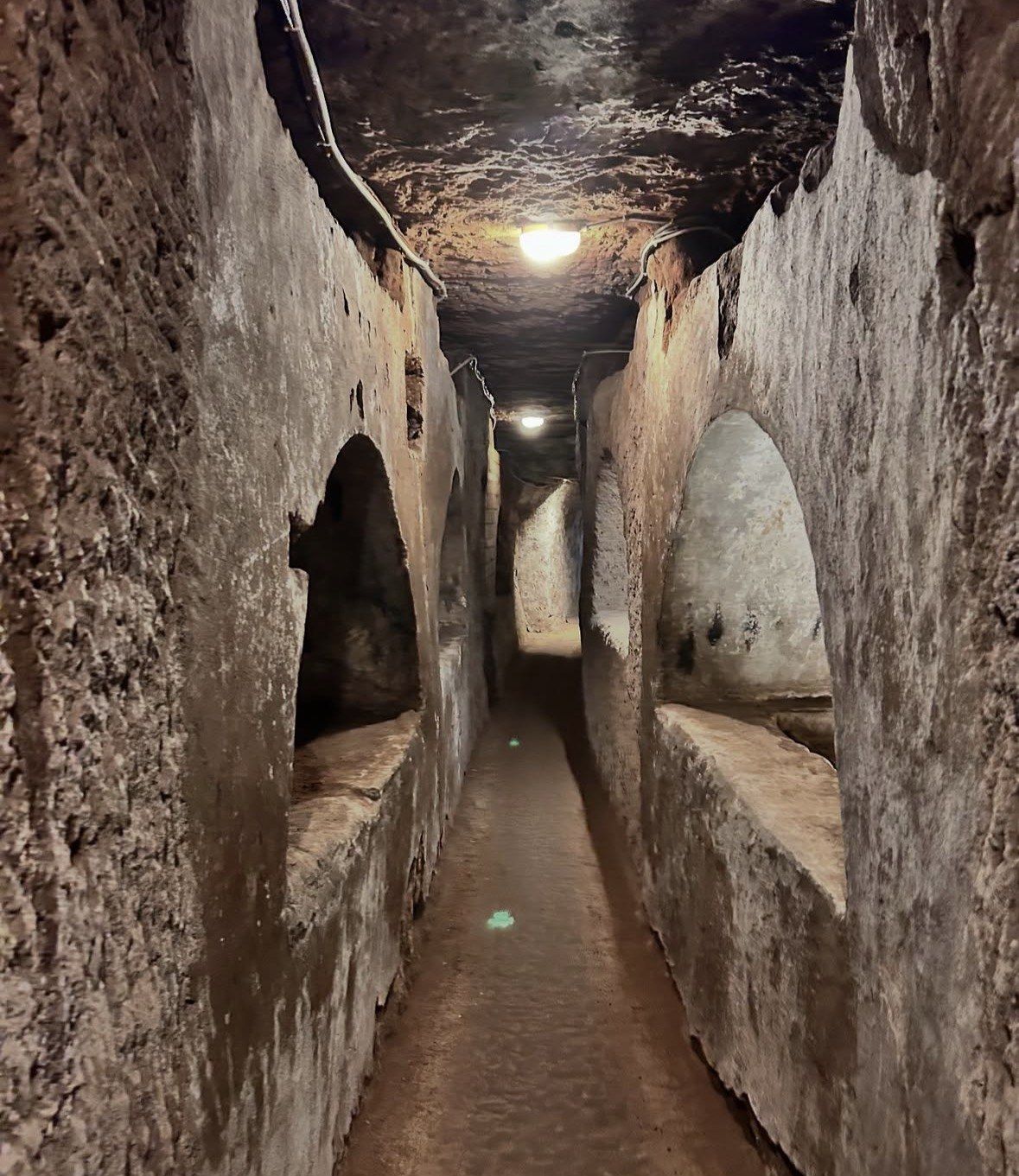
- Arcosolia: the second tomb type the Pontifical Commission lists, a step up in cost and in visibility
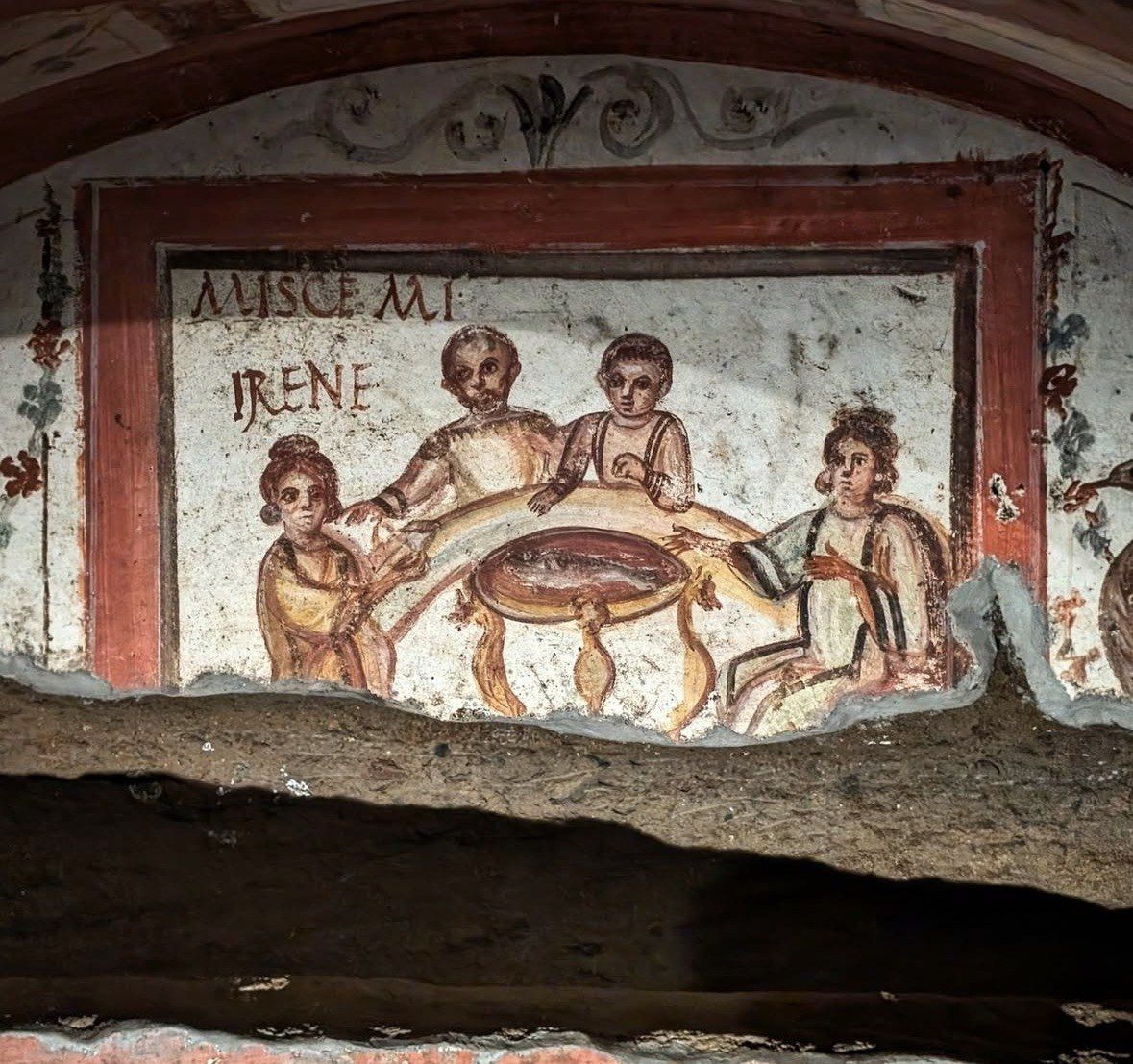
- Cubicula: chambers opening off the corridors, used by families, which is where the frescoes and the named inscriptions tend to be
- Not all Christian: the deepest part of San Sebastiano includes a second-century pagan necropolis with three mausoleums
- Jewish dead: the community buried at Vigna Randanini, Via Appia Antica 119, left about 700 metres of galleries on two levels used from the 2nd to the 4th centuries, with epitaphs in Greek and Latin and not one in Hebrew; reaching them is a matter of timing, since Roma Capitale lists that site as open only on special occasions and states that the Villa Torlonia hypogeum on Via Nomentana cannot be visited at all
Popes buried in the catacombs of Rome
Sixteen popes lie at San Callisto, and nine of them share a single room. That room is the Crypt of the Popes, the official burial place of nine pontiffs and probably eight dignitaries of the third-century Roman church, which is how it picked up the nickname of the little Vatican. The Greek inscriptions of Pontianus, Antherus, Fabian, Lucius and Eutychian are still readable on the walls, and Sixtus II, who died in Valerian's persecution, lies in the front wall.
Two more candidates turn up before you get that far. Near the entrance the route passes a pair of small three-apsed basilicas known as the Trichorae, where Pope Zephyrinus and the young martyr Tarcisius may have been buried.
Priscilla accounts for the other seven. The one the guide names is Sylvester, elected in 314, whose tomb lies beneath the excavated foundations of the basilica of San Silvestro raised over the cemetery. On either route, expect a lettered slab and a recess cut in the tufa.
San Sebastiano or Domitilla with the Appian Way
If the martyrs' side of the story is what you came for, this 3.5-hour outing from €55, rated 4.8 ★ (1691 reviews), goes into San Sebastiano or Domitilla depending on the day, in a group of 18 people or fewer, with the aqueducts and a walked stretch of the Appia around it.
★ 4.8/5 · 1,691 reviews
Martyrs' tombs and the pilgrim traffic they created
Pilgrims are documented most directly at San Sebastiano. The site preserves the triclia, a covered hall fitted with benches, and next to it the Memoria Apostolorum, where third-century visitors scratched invocations into the plaster, among them 'Paule et Petre petite pro Victore'. The two names on those walls may once have been the names of occupants: a long line of scholars holds that the remains of Peter and Paul rested on this spot for a period, which would explain the sheer quantity of writing left behind.
Sebastian himself is split between two levels. His relics are kept at the altar dedicated to him in the basilica above the catacomb, with the arrow of his martyrdom and part of the column of his martyrdom, while his crypt underground is seen only on the accompanied visit.
The rest of the martyr roll call is spread across the city. Nereus and Achilleus, the soldiers commemorated at Domitilla, were probably put to death in Diocletian's persecution of 304 AD. Marcellinus and Peter were beheaded in Rome about the same year, and a Roman woman called Lucilla moved their remains to the ad Duas Lauros site on the Via Casilina that now carries their names. Agnes died at about the age of twelve and was buried in a first-level gallery roughly six metres below the present road surface on Via Nomentana.
Saint Cecilia's crypt and the tombs that stand empty
The crypt of St Cecilia at San Callisto comes immediately after the popes, and her body is not in it. The occupant left in 821, the year her relics were carried up to the basilica of Santa Cecilia in Trastevere, and the figure now lying in the chamber is a copy of the statue Stefano Maderno carved in 1599. Anyone hunting for Saint Cecilia in the catacombs of Rome is standing in the room she was taken from.
That upward movement explains most of the empty space below. As a cult grew, the relics went into a church where crowds could reach them without a staircase, which is also why Sebastian's altar stands in the basilica above his own galleries. The cut stone, the inscriptions and the paintings stayed put.
Set your expectations before you go down. The official sites describe loculi, arcosolia and cubicula and make no claim about visible remains, so plan for cut tufa, lettering and fresco rather than anything on display. None of it goes home with you as a photograph: cameras and video are prohibited inside San Callisto and San Sebastiano, and the staff at San Callisto are entitled to remove anyone who ignores that.
Choosing the site by who lies in it
Decide on the names first, then book the accompanied visit, because nobody walks these galleries alone and each site shows a different cast. For popes and for Cecilia, go to San Callisto. For pilgrim devotion to Peter and Paul, San Sebastiano is the only address in Rome that shows it in writing on the wall. For soldier-martyrs and named ordinary burials, Domitilla. For a second set of popes and the painting dated about 230 to 240 called the oldest known image of the Virgin, Priscilla.
Check the closing day for the site you have chosen before you plan anything else: San Callisto shuts on Wednesdays, Domitilla on Tuesdays, San Sebastiano and Priscilla on Mondays. The burial galleries sit at around 16 °C with high humidity at San Callisto and about 13 °C at Priscilla in every month of the year, so carry something warm whenever you come.
| Catacomb | Who lies there | Names on the accompanied route |
|---|
| San Callisto, Via Appia Antica | About half a million Christian burials, dozens of martyrs, 16 popes | Crypt of the Popes with nine pontiffs; Pontianus, Antherus, Fabian, Lucius, Eutychian, Sixtus II; Crypt of St Cecilia; Zephyrinus and Tarcisius at the Trichorae |
|---|
| San Sebastiano, Via Appia Antica | Christian burials on three levels, plus a second-century pagan necropolis with three mausoleums at the deepest point | Memoria Apostolorum and triclia with the Peter and Paul graffiti; St Sebastian's crypt, his relics at the altar in the basilica above |
|---|
| Domitilla, Via Ardeatina | Burials from 120 AD on four levels | Basilica of Nereus and Achilleus, dedicated also to St Petronilla; cubicle of Veneranda; arcosolium of the Little Apostles; the gravedigger Diogenes; Flavian Hypogeum |
|---|
| Priscilla, Via Salaria | Thousands of burials including seven popes | Pope Sylvester, elected 314, under the San Silvestro foundations; Cubicolo della Velata; Greek Chapel |
|---|
| Sant'Agnese, Via Nomentana | A Christian cemetery with the martyr's gallery about six metres below the road | St Agnes, who died at about twelve |
|---|
| Santi Marcellino e Pietro, Via Casilina | About 18,000 m² with an estimated 15,000 third-century burials | Marcellinus and Peter, whose remains Lucilla brought to the ad Duas Lauros site; the adjacent Mausoleum of Sant'Elena |
|---|
Questions people ask
Are bones and skulls on show in the catacombs?
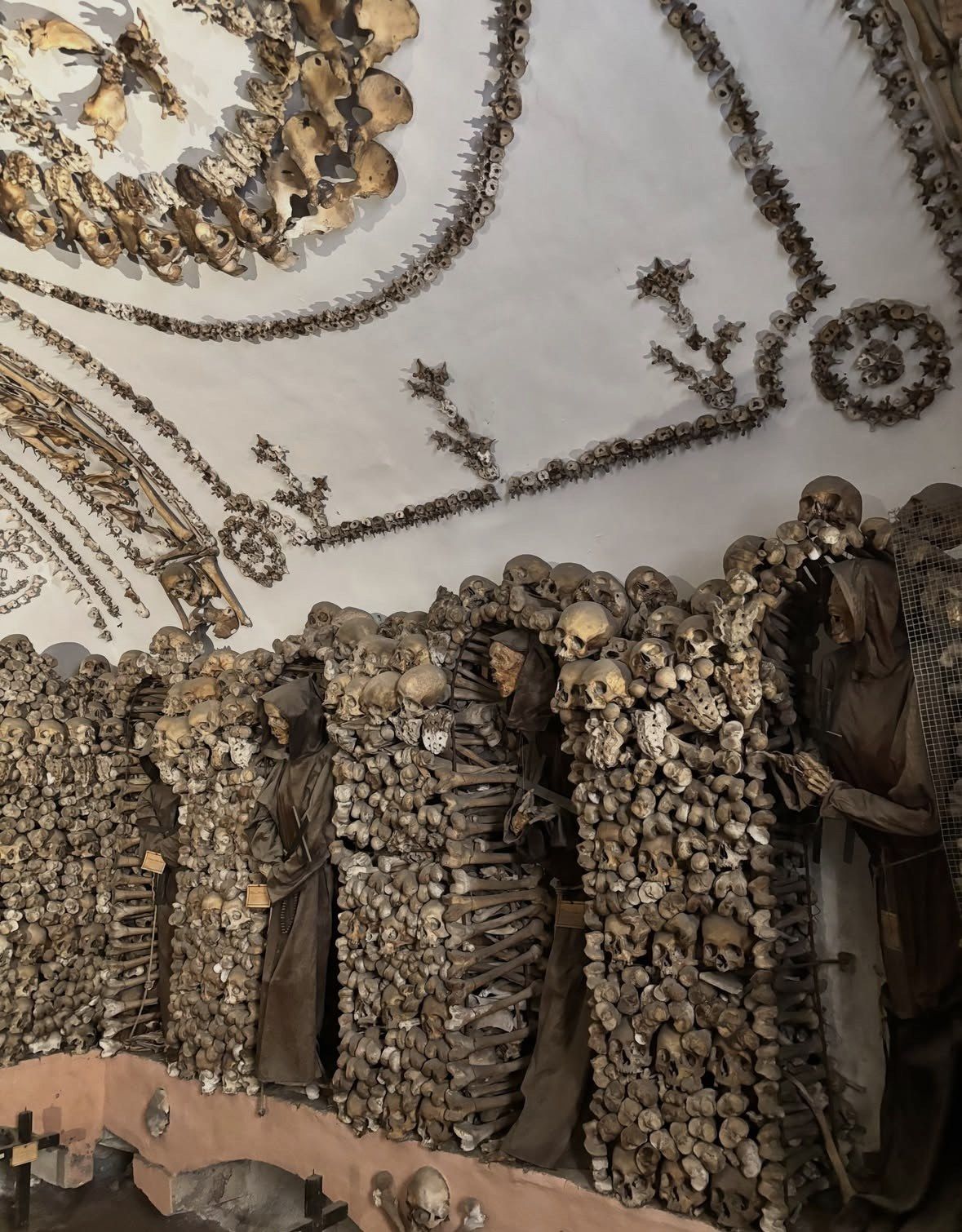
The official sites of San Callisto, San Sebastiano, Domitilla and Priscilla describe their tombs as loculi, arcosolia and cubicula and say nothing about visible remains, so do not plan a visit around seeing any. The place in Rome where human remains are openly arranged is the Capuchin Crypt under Santa Maria della Concezione at Via Vittorio Veneto 27, which is not a catacomb.
Are Peter and Paul buried in the catacombs of Rome?
San Sebastiano preserves the mid-third-century Memoria Apostolorum, covered in pilgrim graffiti invoking both apostles, including 'Paule et Petre petite pro Victore'. Many scholars think their remains were kept there temporarily. The accompanied visit shows you the hall, the benches of the triclia and the writing scratched by the people who came to pray on the spot.
How many people are buried in the Capuchin Crypt?
The crypt holds the remains of almost 4,000 Capuchin friars who lived between 1500 and 1800, about 3,700 people in total. The chapel used for Mass also contains the heart of Maria Felice Peretti, who died in 1656, and Giuseppe Matteo Orsini, who died in 1660, is buried on the right wall.
Can I walk to one particular pope's tomb on my own?
No. Entry to every open catacomb is on an accompanied visit with the site's own staff, and you stay with your group for the whole route, which at San Callisto means the Crypt of the Popes and the crypt of St Cecilia in a fixed order. If a specific name matters to you, say so to the guide at the start.
Who managed these burial grounds, and who looks after them now?
The third-century Church of Rome used San Callisto as its official cemetery; the property now sits with the Administration of the Patrimony of the Apostolic See, conservation is the job of the Pontifical Commission for Sacred Archaeology, and the Salesians of Don Bosco have handled reception and the guided visits there since 1930. The other cemeteries each have their own community: the Missionaries of the Society of the Divine Word at Domitilla, the Associazione Pro Deo et Fratribus – Famiglia di Maria at Priscilla, and at San Sebastiano a Franciscan presence that has now reached 200 years.
Read also