In shortThe Roman catacombs are not a bone display. The accompanied routes at San Callisto, San Sebastiano, Domitilla and Priscilla take you past loculi cut into the walls, closing slabs, inscriptions and painted chambers, with the martyr tombs sealed and the relics moved into churches long ago. For arranged bones, go to the Capuchin crypt on Via Vittorio Veneto, open daily 09:30-13:30 and 14:30-18:30.
about 40 minutesSan Callisto guided visit
about 60 minutesCapuchin museum and crypt
09:30-13:30, 14:30-18:30Capuchin crypt hours
No photosinside the catacombs
Rome catacombs skulls: what the galleries actually show
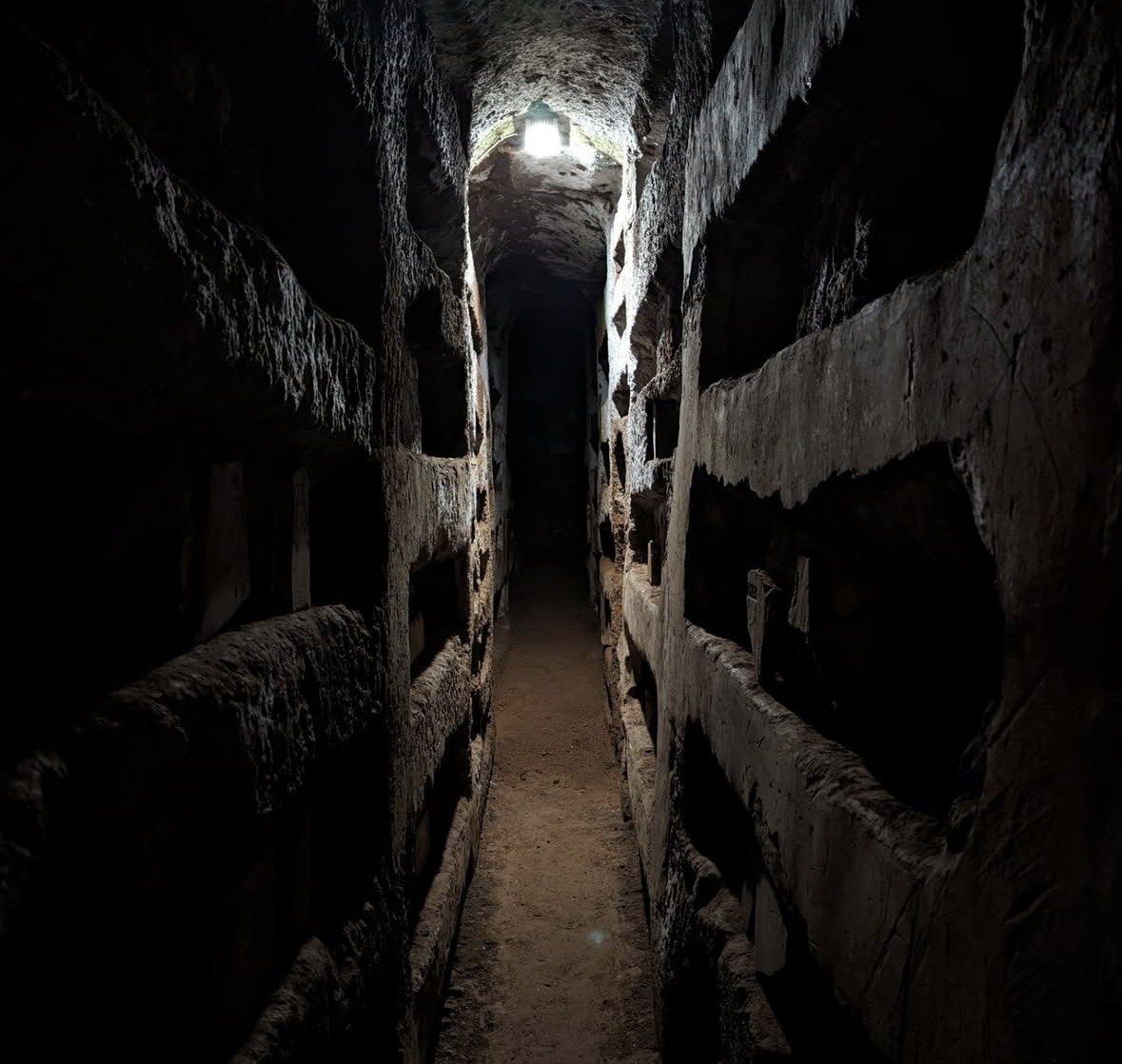
Get the expectation right before you book anything. The Pontifical Commission for Sacred Archaeology describes the burials along the galleries as loculi, rectangular graves cut lengthwise into the tufa and closed with marble slabs or bricks, with arcosolia and cubicula as the other tomb types, and says this is what visitors see on the standard routes. Walk San Callisto, San Sebastiano, Domitilla or Priscilla and you are mostly looking at rows of those cut graves, open and emptied, their closing slabs gone or reused.
What fills the forty minutes underground is on the walls rather than in the niches. Greek inscriptions of the popes Pontianus, Antherus, Fabian, Lucius and Eutychian survive in the Crypt of the Popes at San Callisto, and the Crypt of St Cecilia comes next, with a copy of Maderno's statue of 1599. At Priscilla the circuit stops in the Greek Chapel for the Susanna, the Adoration of the Magi and the Fractio panis, then at the image dated about 230 to 240 that the site calls the earliest known depiction of the Virgin. Domitilla takes in the Flavian Hypogeum, the cubicle of Veneranda and the cubicle of the gravedigger Diogenes, while San Sebastiano keeps the triclia and the graffiti of the Memoria Apostolorum, among them 'Paule et Petre petite pro Victore'.
Two practical things follow from that. None of the four official sites publishes any statement about human remains being visible along its route, so do not plan the day around seeing bones. Photography and video are banned inside San Callisto and San Sebastiano, so nothing you see underground goes home on your phone.
- Loculi cut into the gallery walls, the great majority open and empty
- Closing slabs in marble and brick, some of them still carrying their inscriptions
- Arcosolia, arched graves set under a curved recess
- Cubicula, small chambers with painted ceilings and walls
- Sealed martyr tombs, and crypts whose occupant left long ago, such as St Cecilia's
Where the remains went and what stays sealed
Bones are down there in quantities that are hard to picture. Put numbers on San Callisto: an estimated half a million people were buried in it, dozens of martyrs and 16 popes among them, filling about 19 km of galleries on four levels that reach more than 20 metres down under roughly 90 acres, with the digging starting in the middle of the second century and the complex serving as the official cemetery of the Church of Rome in the third. Priscilla adds thousands of burials and seven popes over 13 km on two levels. Off the Appia, the cemetery of Santi Marcellino e Pietro on Via Casilina spreads over about 18,000 m², with an estimated 15,000 graves of the third century inside it.
Human remains in the Rome catacombs mostly sit exactly where they were put, behind brick and marble, in galleries the accompanied route never opens. The famous relics left centuries ago: St Cecilia's were transferred to her basilica in Trastevere in 821, which is why her crypt now holds only a copy of the Maderno statue. One occupant you stand in front of without seeing anything of him is Pope Sixtus II, a victim of Valerian's persecution, whose grave is set into the front wall of the Crypt of the Popes. At San Sebastiano the martyr's own relics are kept at his altar in the basilica above the catacomb, together with the arrow of his martyrdom and part of the column, and his crypt below is seen only on the guided visit. The Memoria Apostolorum carries the pilgrim graffiti that led many scholars to think the remains of Peter and Paul were held there for a time.
Stay with your group and you see the tombs as the religious communities that look after them present them: closed, labelled, treated as graves. The Pontifical Commission for Sacred Archaeology governs and conserves San Callisto, with the Salesians of Don Bosco running reception and visits since 1930. At Domitilla the Missionaries of the Society of the Divine Word accompany visitors, at Priscilla the Associazione Pro Deo et Fratribus, and at San Sebastiano the Franciscans have now been on site for 200 years.
Catacomb and bone crypt in one half-day
This 3.5-hour trip from €49, rated 4.6 ★ (5439 reviews), puts a Rome catacomb and the Capuchin Crypt and Museum into one outing, with coach transfers from Piazza Barberini. That is the practical way to see cut graves and arranged bones on the same day.
★ 4.6/5 · 5,439 reviews
Rome bone church skulls: the Capuchin crypt on Via Veneto
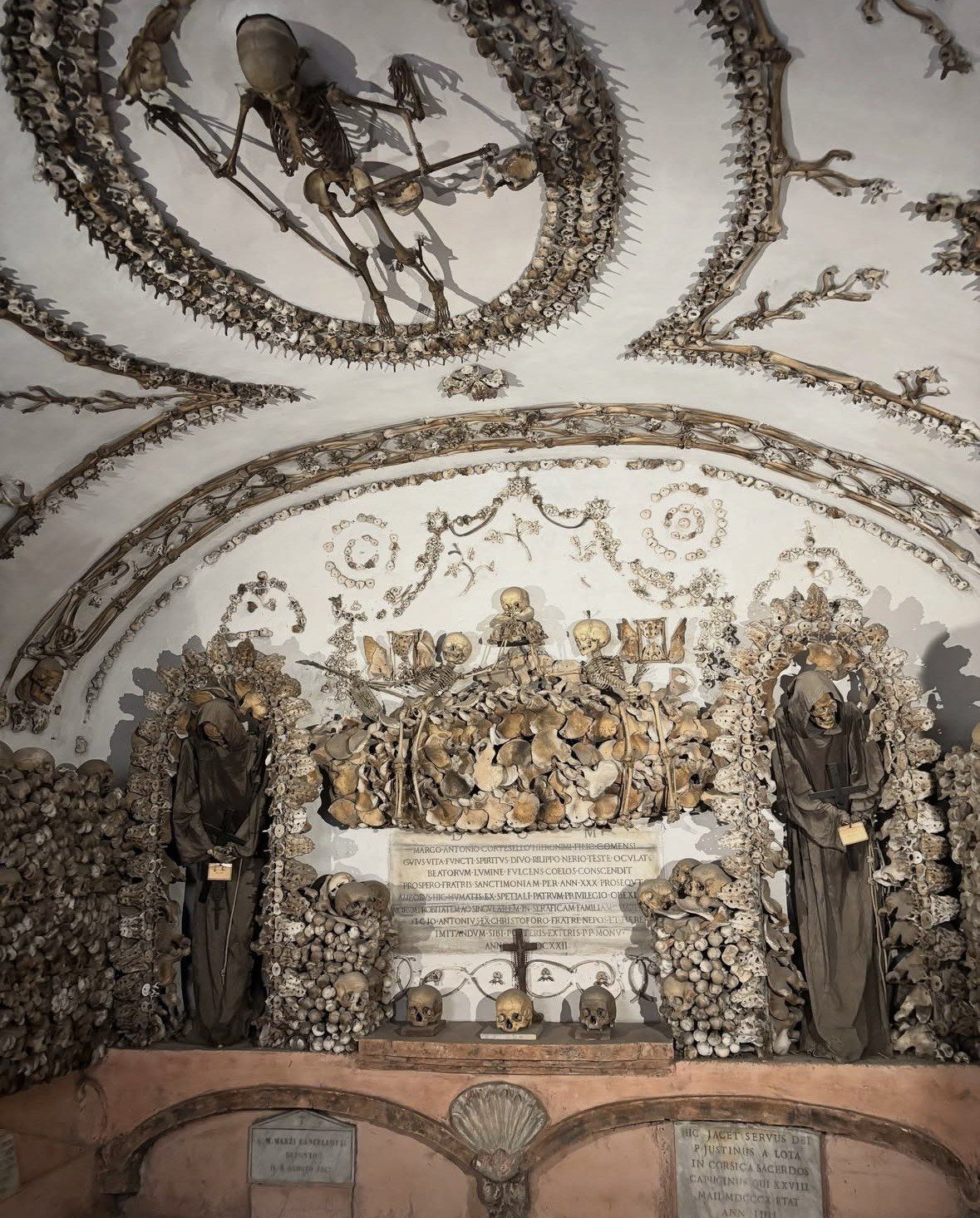
Arranged bones do exist in Rome, in the centre rather than out on a consular road. The crypt of the Capuchin friars runs under the church of Santa Maria della Concezione at Via Vittorio Veneto 27, and the remains were brought there from the burial ground of the earlier convent of San Bonaventura. About 3,700 people are buried in it in total, most of them Capuchins who lived between 1500 and 1800. Cardinal Antonio Barberini, brother of Urban VIII, founded the church and convent; Urban VIII said the first Mass on 8 September 1630 and the friars moved in on 16 April 1631.
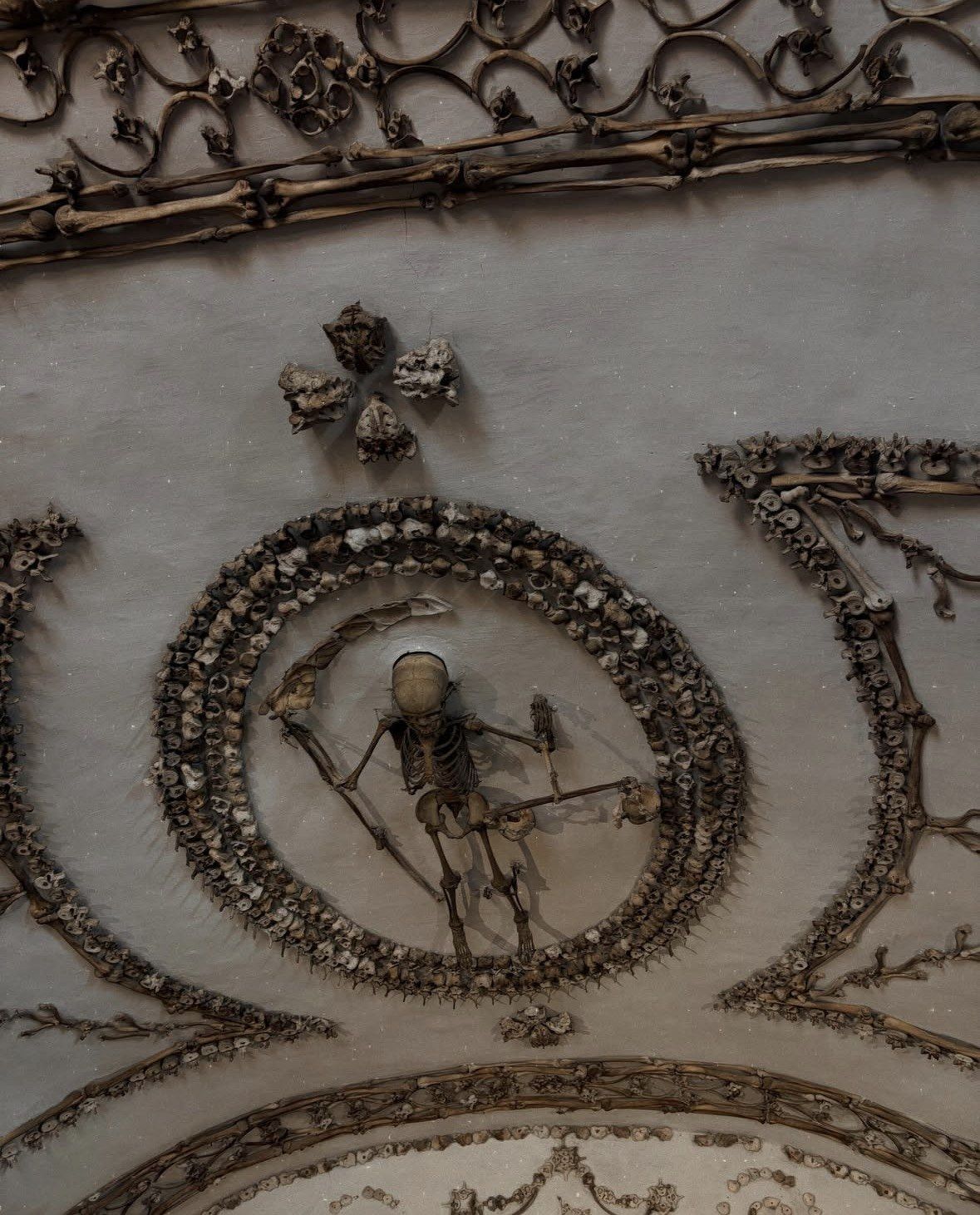
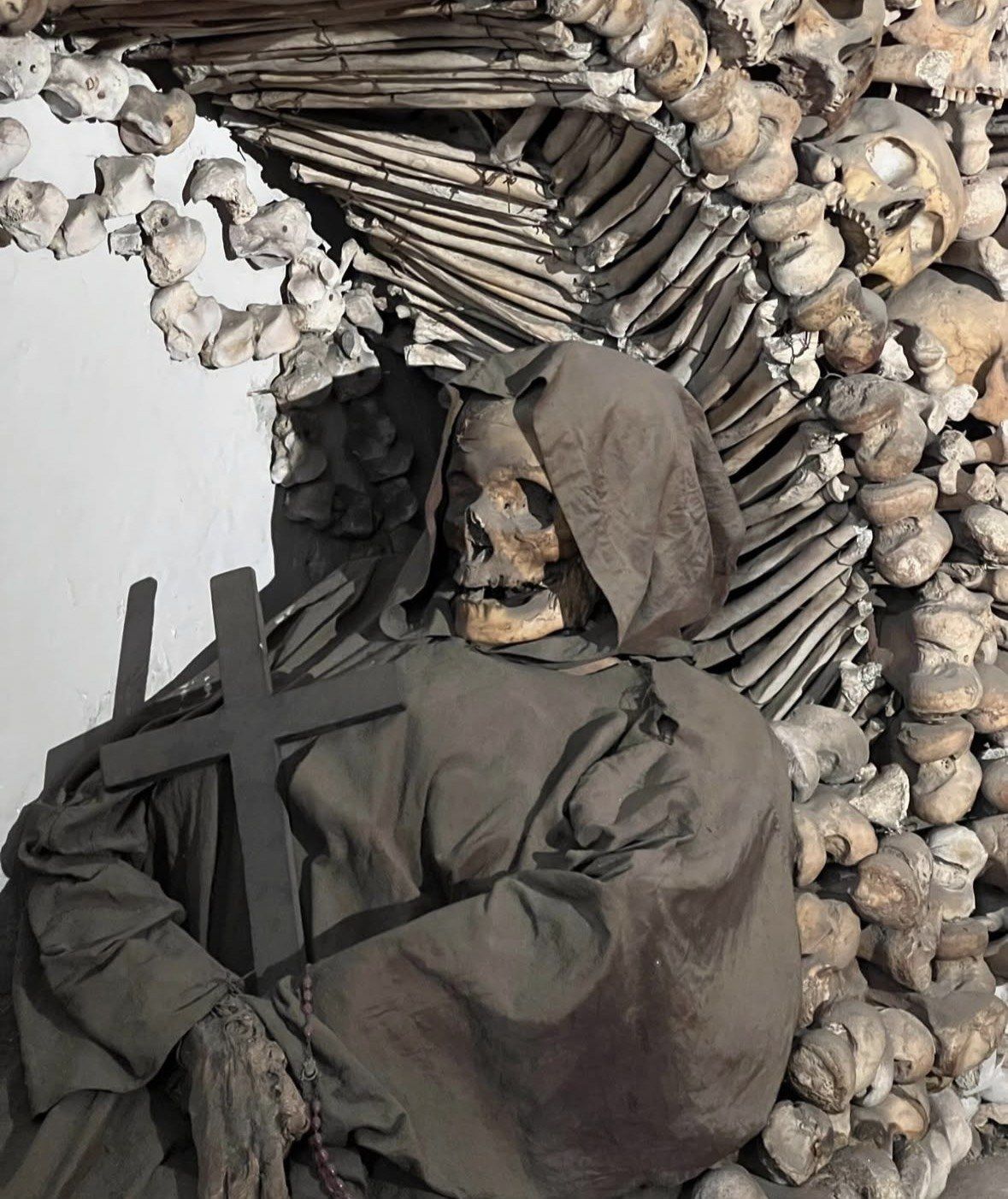
The decoration is made from the bones themselves, worked into rosettes, pilasters, stars, hourglasses, clocks, butterflies, chandeliers and crosses. A winged hourglass fills the back wall of the Crypt of the Skulls, and the vault bands are built from fibulae and humeri. In the Crypt of the Pelvises bands of pelvises and vertebrae cross the vault and finish in eight-pointed stars, around a central rosette of scapulae and vertebrae, with whole skeletons in Capuchin habits standing in the niches. The chapel for Mass holds an altarpiece by Jan François Courtois and the heart of Maria Felice Peretti, who died in 1656, with Giuseppe Matteo Orsini, died 1660, buried on the right wall.
Allow about 60 minutes for the whole thing, because the museum comes first: eight rooms on the Capuchin order from the sixteenth century onwards, with 'San Francesco in meditazione', attributed to Caravaggio and painted for the convent, in room five alongside works by the Capuchin painter Fra Luigi da Crema. There is no weekly closing day to work around here: the two daily sessions run 09:30 to 13:30 and 14:30 to 18:30, admission stops at 12:30 and 17:30, and only Easter Sunday, 25 December and 1 January take the crypt off the calendar. Access is the easiest of any bone site in the city: three low steps and no ramps into the crypt, and a lift up to the museum, where the rooms are step-free.
- Crypt of the Three Skeletons
- Crypt of the Tibias and Femurs
- Crypt of the Pelvises
- Crypt of the Skulls
- The chapel for Mass
- Crypt of the Resurrection
What the rules allow at each place
Photography and video are prohibited inside San Callisto, and the regulations state that staff may remove anyone who ignores that. San Sebastiano also forbids photos and video underground, and asks for clothing appropriate to the place. Neither site lets you wander on your own: the visit runs with the site's own staff, San Callisto needs a minimum of two people in the group, and you stay with that group from the stairs down to the stairs back up.
Bulky items are refused at the gate, luggage, strollers, musical instruments and banners included, and neither entrance has a cloakroom. San Callisto asks for clothing suited to a cold, damp place: it holds at around 16 °C with high humidity whatever the month, and Priscilla runs a few degrees lower, at about 13 °C.
The crypt on Via Veneto is treated as a sacred place and shoulders and knees must be covered. Photos and video are allowed there for private, non-commercial use, while commercial use needs authorisation from the Fondo Edifici di Culto. Large bags go into free lockers, food is not allowed in the exhibition rooms apart from one bottle of water, and guided groups are capped at ten people with radio earpieces compulsory.
Pairing a catacomb with the bone chapels
Decide on what you actually want to look at. If the arranged bones are the reason for the trip, build the day around the Capuchin crypt and add one Appia catacomb for the archaeology; the half-day tours on this site do both, with transfers from Piazza Barberini, so you are not crossing Rome twice on buses. If inscriptions, frescoes and the scale of the galleries are the draw, keep to the catacomb alone and give the rest of the day to the Appia Antica above ground.
One booking covers the pairing: The Original Roman Crypts and Catacombs Tour with Transfers, 3.5 hours, from €49, rated 4.6 ★ (5439 reviews). It runs with a private air-conditioned coach, a Rome catacombs entrance ticket, entry to the Capuchin Crypt and Museum and the Basilica of San Martino ai Monti on every option except the after-hours one, and it leaves from the Tritone fountain in the middle of Piazza Barberini, a short walk from the crypt itself.
Rome Catacombs & Capuchin Crypts Group Tour with Transfers reaches the same combination another way: 3.5 hours from €57, rated 4.6 ★ (991 reviews), with private round-trip transport from central Rome, a guided tour of St Callixtus, St Sebastian or Domitilla, timed entry and an audio-guide visit of the Capuchin Crypts, a drive past the Appian Way and views of the Aurelian Walls. Arrive ten minutes early in front of the Fontana del Tritone.
Pick the weekday before anything else. The crypt opens every day bar Easter Sunday, 25 December and 1 January, while the catacombs stagger their closures: San Callisto shuts on Wednesdays, San Sebastiano on Mondays, Domitilla on Tuesdays, so Thursday to Saturday clears all three. San Callisto and Domitilla also close between 12:00 and 14:00, which leaves San Sebastiano as the only workable midday start on the Appia strip, with continuous hours from 09:15 to 17:15 and last admission at 16:45. Check the operator's calendar on the day, since the sites publish their own notices.
- Take the pairing if the bone decoration is what you came to Rome to see, or if someone in the party cannot manage about 50 to 70 irregular steps underground
- Keep to the catacomb alone if frescoes, Greek inscriptions and the Crypt of the Popes matter more, and give the afternoon to the Appia Antica monuments
- Either way, expect a cool, damp 16 °C below ground and bring a layer, August included
Questions people ask
Do the Capuchin bone crypts count as Rome catacombs?
No. Seven sites appear on the Pontifical Commission for Sacred Archaeology's public list, and the bone crypt is absent from it: San Pancrazio, Priscilla, San Sebastiano, Domitilla, Sant'Agnese, San Callisto and Santi Marcellino e Pietro. The Capuchin crypt is a seventeenth-century burial place under a church at Via Vittorio Veneto 27, in the middle of the modern city. Several of the tours on this site include it, though it is not a catacomb in its own right.
Can wheelchair users or people with bad knees see any of this?
The crypt on Via Veneto, yes: three low steps, no ramps, and a lift up to the museum, where the rooms are step-free. The catacombs, no. The architectural barriers of the monument mean wheelchairs are not admitted at San Callisto, by its own regulations; the descent is about 50 uneven steps with the same number to climb back, there is no lift and no bench on the way, and the site says plainly that people with serious mobility problems or claustrophobia should not go down. San Sebastiano puts its own step count at about 70.
Which catacomb has the most to look at if the bones are not the point?
San Callisto for scale, and for the Crypt of the Popes with its Greek inscriptions, followed by the Crypt of St Cecilia. Priscilla for painting: the Greek Chapel panels and the image of about 230 to 240 described as the oldest known depiction of the Virgin. San Sebastiano for the pilgrim devotion scratched into the plaster of the Memoria Apostolorum, and Domitilla for Rome's only semi-underground basilica, dedicated to Nereus, Achilleus and St Petronilla.
Are the Jewish catacombs an alternative for seeing ancient burials?
Not on a normal trip. Vigna Randanini, at Via Appia Antica 119, is described on Roma Capitale's tourism pages as opening only for special occasions, and the same source says the Jewish catacombs in the Villa Torlonia grounds at Via Nomentana 70 are closed to visitors outright. Vigna Randanini runs to roughly 700 metres of galleries on two levels and dates from the second to the fourth centuries, with inscriptions in Greek and Latin.
How long should I allow for the two stops together?
Count about 40 minutes underground at San Callisto, or 40 to 45 at San Sebastiano and Domitilla, plus the travel out to the Appia and back. A full visit to the Capuchin museum and crypt takes about 60 minutes, with last entries at 12:30 and 17:30. The half-day tours that combine the two are timed at 3.5 hours door to door from Piazza Barberini.
Read also