In shortParco degli Acquedotti is open parkland behind the Appian Way, roughly 240 hectares of unpaved, traffic-free ground crossed by six of Rome's eleven aqueducts, among them the Aqua Claudia with tufa arches standing up to 28 metres. There is no ticketed monument here. Metro A at Giulio Agricola, Subaugusta or Lucio Sestio reaches the entrances, and a bike is the practical way to join it to the catacomb road.
about 240 hectaresunpaved, traffic-free ground
6 of 11Rome aqueducts crossing it
28 metrestallest Aqua Claudia arches
more than 16 kmpark walking and cycling routes
Parco degli Acquedotti, Rome's aqueduct park in one look
The ground is about 240 hectares of unpaved, traffic-free park, and six of Rome's eleven aqueducts run across it. What you get is grass, dirt tracks, umbrella pines and two separate lines of ancient arcade heading off towards the hills, with the apartment blocks of the modern suburb standing just behind the trees on three sides.
Nothing here works like the ticketed sites on the Appia. You walk in from the street and out wherever you like, and there is no turnstile, no closing time on a board and no guided slot to join. Settle your route before you arrive, because nobody on site will hand you one.
Remember that the two arch lines are not side by side. You cross open field between them, and that walk is the part most people underestimate, especially in July, when the tracks give you no shade at all and the nearest bar is back out on the street.
Which aqueducts cross the fields
The two you actually look at are the Aqua Marcia and the Aqua Claudia. The Marcia was built between 144 and 140 BC by the praetor Quintus Marcius Rex and ran 91 km, the longest of the city's aqueducts, though what survives in the park is the lower line of masonry rather than a tall arcade. The Aqua Tepula and the Aqua Iulia were later carried on top of its channels instead of on arcades of their own.
The Aqua Claudia is the one in every photograph. Caligula began it in 38 AD, Claudius finished it in 52 AD, it ran about 68 km, and the tufa arches reach 28 metres where the ground falls away. Walk under them and the scale registers as it never does from a car window.
| Aqueduct | Built | Length | In the park |
|---|
| Aqua Marcia | 144 to 140 BC, by the praetor Quintus Marcius Rex | 91 km, the longest of Rome's aqueducts | The lower line of masonry crossing the fields |
|---|
| Aqua Tepula and Aqua Iulia | Later than the Marcia | Not published | Carried on top of the Marcia's channels |
|---|
| Aqua Claudia | Begun by Caligula in 38 AD, finished by Claudius in 52 AD | About 68 km | The tall tufa arcade, up to 28 metres |
|---|
The aqueducts and the Appia on one ride
The longest active option on this site, 4–6 hours from €59 on a guided bike or e-bike, with the San Callisto or San Sebastiano visit in the 6-hour version.
★ 4.9/5 · 1,966 reviews
Parco degli Acquedotti: how to get there
Metro A does the work. Pick your gate by station: Giulio Agricola and Subaugusta both leave a short walk to the Piazza Aruleno Celio Sabino and Via Lemonia entrances, while Lucio Sestio drops you nearest the Via Viviani gate. All three are street-side ways into open parkland, so use whichever station suits your position on the line.
The awkward part comes afterwards. The catacomb strip sits on the other side of the Caffarella valley, and the Appia access points are reached from a different direction: Porta San Sebastiano on buses 118 and 218 or Metro C at Porta Metronia, Via Appia Antica at Cecilia Metella on bus 660, Porta Capena from Metro B at Circo Massimo. Joining the aqueducts to the catacomb gates on city transport means a metro, a bus, a long wait and a second bus, and that is before you have walked anything at either end.
Most visitors therefore see the aqueduct park on wheels, as one leg of a longer route. A bike, an e-bike or a minibus itinerary turns a two-transfer afternoon into a single continuous ride.
Linking the arches to the catacomb road
The Regional Park of the Appia Antica covers about 4,580 hectares and holds the three pieces together: over 16 km of the Via Appia Antica, the Caffarella valley in the middle and the Acquedotti archaeological area at the far end. Its walking and cycling itineraries run to more than 16 km and are described as passable at any time of year, which is what makes an aqueducts-and-catacombs day realistic on two wheels rather than a stitched-together bus plan.
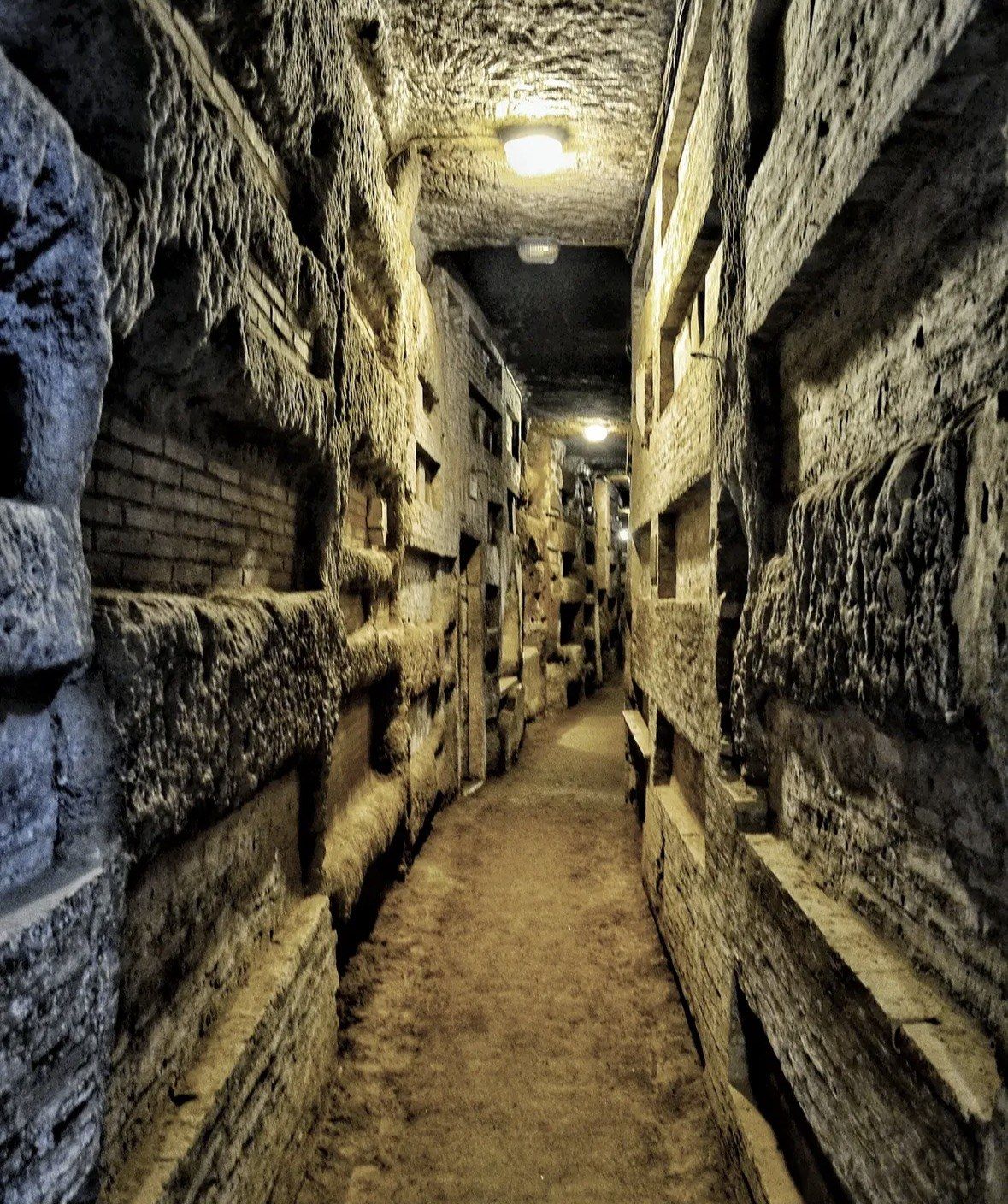
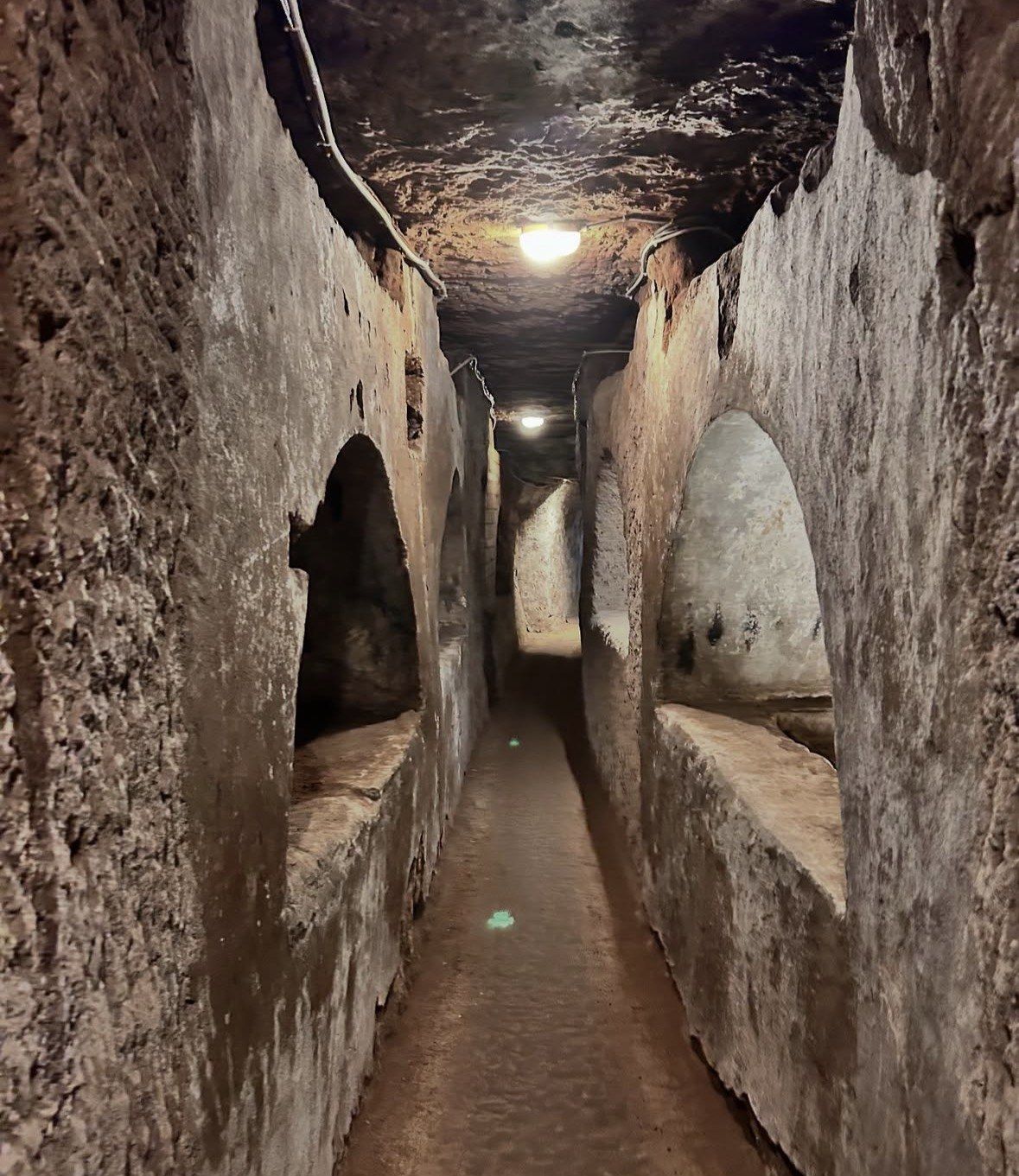
Riders crossing from the arches to the catacomb gates have three ways through. The private road of the San Callisto catacombs opens daily from 9:00 to 18:00, closed on Wednesdays and all through February. Without it you ride about 1.5 km of the Appia in traffic or swing north through the Caffarella valley.
On the surviving Roman basolato you get off and push, or use the dirt paths running alongside. The stones are rutted by cart wheels and cannot be ridden, so add walking time for that stretch instead of planning a smooth roll past the tombs.
Driving, Sundays and public holidays
Driving out of the aqueduct park and down onto the Via Appia Antica stops working on public holidays, when private vehicles are kept off that road altogether. The first stretch past the Maxentius complex is also cleared of ordinary traffic every Sunday and public holiday, which is why Sunday is the day Romans are out there on foot and on bikes, and why the road feels like parkland for a few hours.
Inside the aqueduct park none of this applies, since the ground is unpaved and traffic-free throughout. The link between the two areas is where a car becomes a liability, and a public holiday is the worst day to try it.
If your only free day falls on a holiday, make the bike or the organised itinerary the default and leave the car where it is.
Which itinerary to book for the aqueducts
Three tours on this site cover the aqueducts and the Appia in one route. What separates them is how you travel and whether you go underground at all.
Check which version you are booking before you pay. On both bike itineraries the catacomb visit belongs to the longer option, and the catacombs keep their own closing days on top of that, so a Monday or a Wednesday changes which complex the group is taken into.
- Rome Bike / EBike Tour: Appian Way, Catacombs & Roman Aqueducts keeps the aqueducts in the route as well as the title, over 4–6 hours, from €59, rated 4.9 ★ (1966 reviews). Premium bike or e-bike with anti-puncture tyres, mandatory helmet, handlebar bag, water in a biodegradable bottle and a professional guide; the guided visit of San Callisto or San Sebastiano is in the 6-hour tour only. You start from town rather than at a park gate, reaching the shop on foot in 10 minutes from Metro A Manzoni or in 10 to 15 minutes from Metro B Colosseo.
- Appian Way Aqueducts Bike Tour (Catacombs & Lunch Option) covers the same fields at a family pace, 4–5 hours, from €69, rated 4.8 ★ (1176 reviews). Kit runs to a high-quality e-bike, helmet, phone and handlebar holders and a child seat rated to 25 kg, with children aged 6 to 10 taken only if they are under 4'5'', while the guided catacombs visit and the lunch or afternoon aperitif are attached to the 5-hour version. Meets at Roma STARBIKE, next to the Carrefour supermarket by Colosseo metro on line B.
- Rome Underground: Catacombs Tour, Aqueducts and Appian Way reaches the same landscape without pedalling, 3.5 hours, from €55, rated 4.8 ★ (1691 reviews). You ride in private air-conditioned transport in a group of 18 people or fewer, see the Roman aqueducts, walk a stretch of the Appia, look at the Mausoleum of Cecilia Metella from outside and go into San Sebastiano or Domitilla depending on the day. The group forms outside Piramide metro station, across from Piazzale Ostiense.
Questions people ask
Is there anywhere to get information inside the aqueduct park?
The Punto Info Acquedotti opens on Sundays only and closes for January, February, July and August. The parkland around it is open ground with no gate, so for most of the year there is nobody on site to ask. Work out your route before you arrive.
Do the bike tours include the catacombs as well as the aqueducts?
Only in the longer version of each. The Rome Bike / EBike Tour includes the guided visit of San Callisto or San Sebastiano in the 6-hour tour, and the Appian Way Aqueducts Bike Tour includes the guided catacombs visit in the 5-hour version, along with the lunch or aperitif. The shorter versions stay above ground.
Can a Wednesday trip still take in San Callisto on the way?
No. San Callisto is closed every Wednesday, and its private road, the shortcut cyclists use between the aqueducts and the Appia gates, is shut on Wednesdays and all through February as well. Pair the aqueducts with San Sebastiano instead, or move the day to Thursday, Friday or Saturday.
Does the aqueduct park suit children on a cycling day?
The ground helps: unpaved, flat and traffic-free, which is easier going than the Roman paving on the Appia, where everyone has to dismount. The e-bike itinerary on this site carries a child seat rated to 25 kg, and a child aged 6 to 10 is accepted only if under 4'5''. Check the height limit before you book.
How does the aqueduct park compare with the Appia Antica monuments?
They work differently. The Appia has ticketed sites running on a Tuesday to Sunday clock, while the aqueducts are open parkland where the arches are the thing you came for. On one route the aqueducts give you the landscape and the Appia gives you the monuments and the catacomb entrances.
Read also