In shortThe Capuchin Crypt is the bone church beneath Santa Maria della Concezione at Via Vittorio Veneto 27, where the remains of almost 4,000 friars who lived between 1500 and 1800 are arranged into six chapels. The Museum and Crypt of the Capuchin Friars opens every day 09:30–13:30 and 14:30–18:30, last entries 12:30 and 17:30, and a full visit takes about 60 minutes.
09:30–18:30Open daily, two sessions
almost 4,000Friars in the crypt
about 60 minutesMuseum and crypt visit
3 low stepsDown into the crypt
Where the crypt is and what the visit covers
Walk up Via Vittorio Veneto from Piazza Barberini and the door you want is number 27, below the church of Santa Maria della Concezione. You enter through the museum rather than straight into the bones: eight rooms on the Capuchin order from the 16th century onwards come first, and the crypt is the final stop. The official site puts a complete visit at about 60 minutes.
Room five holds 'San Francesco in meditazione', a St Francis with a skull attributed to Caravaggio and made for this convent, shown alongside work by the Capuchin painter Fra Luigi da Crema. Tickets include an audio guide.
Access is the easiest of Rome's bone-display sites. The museum is reached by lift and its rooms are step-free and wide, and the crypt itself is entered down three low steps, with no ramps.
What you see in the Capuchin Crypt, Rome's bone church
The crypt runs as a sequence of small chapels along one corridor, each named after the bones used in it. The official order is:
- Crypt of the Three Skeletons
- Crypt of the Tibias and Femurs
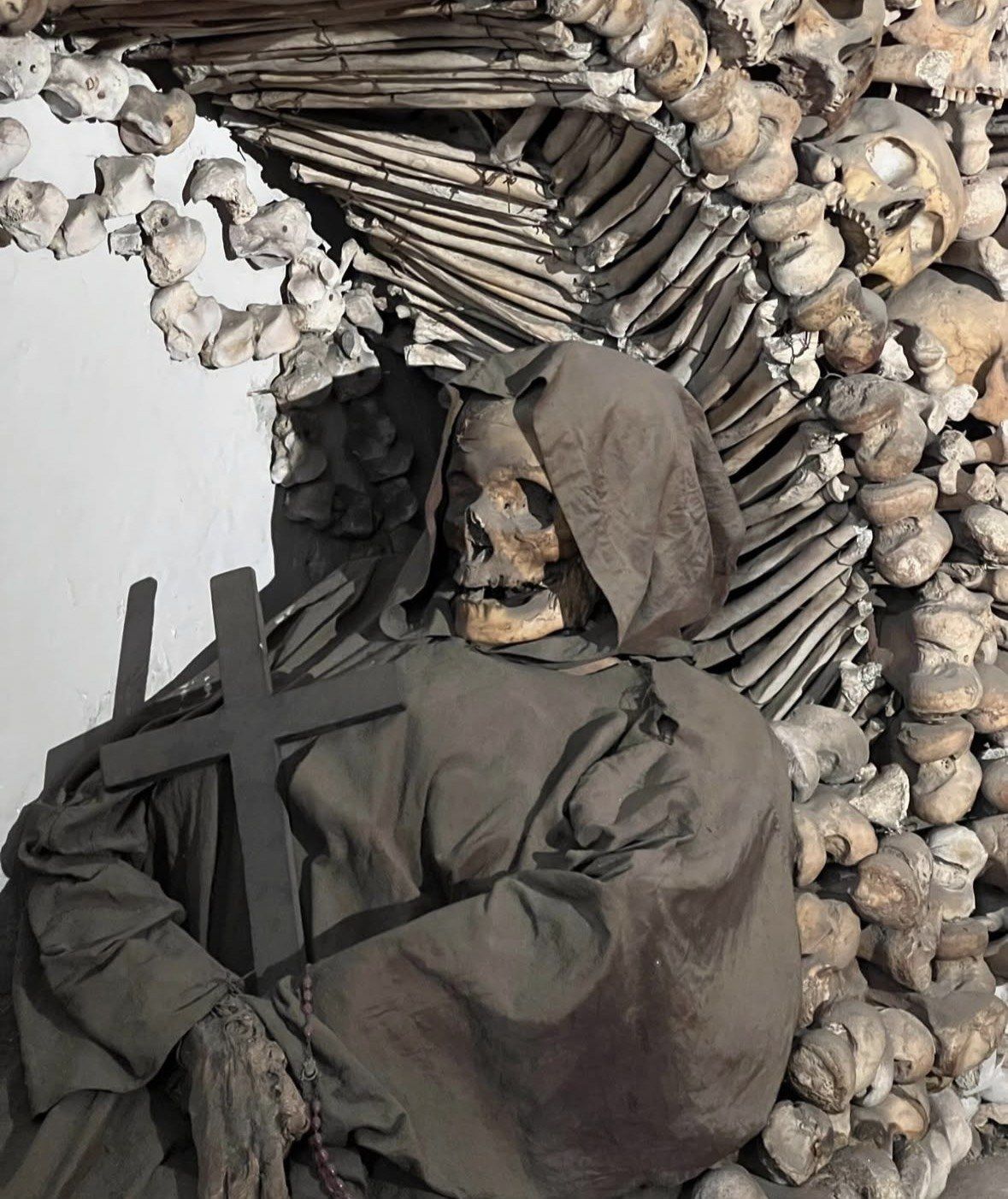
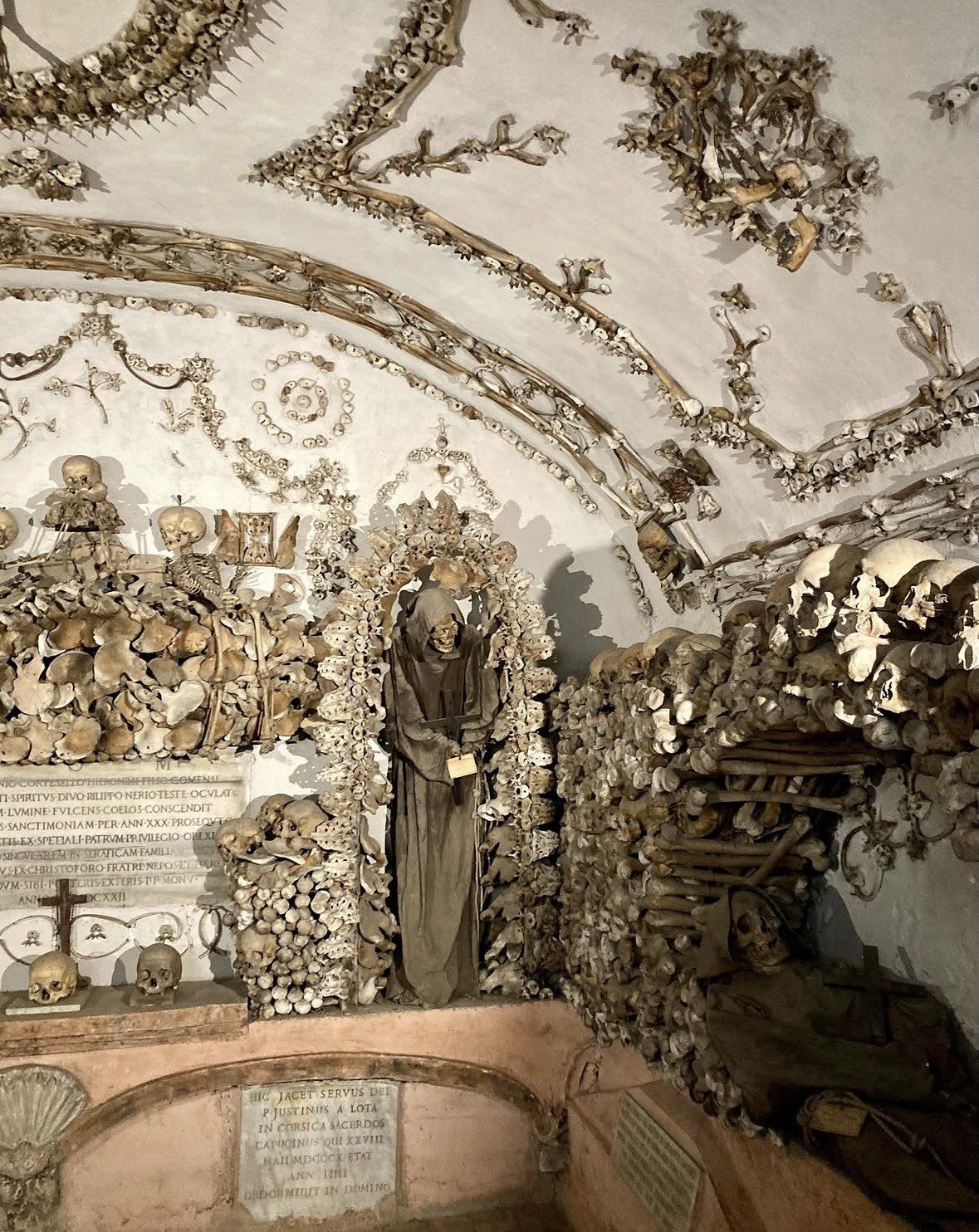
- Crypt of the Pelvises, where the vault carries bands of pelvises and vertebrae ending in eight-pointed stars, a central rosette of scapulae and vertebrae, and whole skeletons in Capuchin habits standing in the niches
- Crypt of the Skulls, with a winged hourglass on the back wall and vault bands of fibulae and humeri
- The chapel used for Mass, with an altarpiece by Jan François Courtois, the heart of Maria Felice Peretti, who died in 1656, and Giuseppe Matteo Orsini, died 1660, buried in the right wall
- Crypt of the Resurrection
Who the friars were and how the bones were arranged
The convent and its church exist because Cardinal Antonio Barberini, whose brother was Urban VIII, paid for them. Urban VIII blessed the first stone on 4 October and said the first Mass on 8 September 1630, and the Capuchins moved in on 16 April 1631. The remains now in the crypt were carried here from the cemetery of the order's earlier convent of San Bonaventura.
Those remains belong to almost 4,000 friars who lived between 1500 and 1800, with about 3,700 people buried in the crypt in total, mostly Capuchins. Instead of being stacked in an ossuary, the bones were worked into decoration: rosettes, pilasters, stars, hourglasses, clocks, butterflies, chandeliers and crosses. The arrangement was designed to be looked at, and the material is the bones of the community that built it.
The line visitors tend to carry away is the one on the founder's own grave. Antonio Barberini lies in the church floor near the main altar under the inscription 'Hic iacet pulvis cinis et nihil', here lie dust, ashes and nothing. The better-known admonition about what you are now and what we once were is quoted everywhere, but it does not appear on the official crypt pages, so treat it as tradition rather than a published fact and read the Barberini slab instead.
Museum and Crypt of the Capuchin Friars: hours and rules
The official site gives opening every day, Monday to Sunday, in two sessions: 09:30 to 13:30 and 14:30 to 18:30. The two last-entry times are 12:30 and 17:30, so arriving at 13:00 or at 18:00 gets you nothing. The site closes all day on Easter Sunday, 25 December and 1 January. Dates aside, check the official page on the day of your visit, since a church building can close for liturgical reasons at short notice.
This is treated as a sacred place and the rules are enforced at the door. Shoulders and knees must be covered. Photos and videos are permitted for private, non-commercial use only, a real difference from the Appia catacombs, where cameras are banned outright; commercial use here needs authorisation from the Fondo Edifici di Culto.
Large bags and luggage go into free lockers before you start. Food is not allowed in the exhibition rooms, with one bottle of water the exception. Guided groups are capped at ten people and must use radio earpieces, which keeps the corridor quiet even when it is busy. Keep your voice down for the full length of the crypt.
How the crypt differs from the galleries on the Appian Way
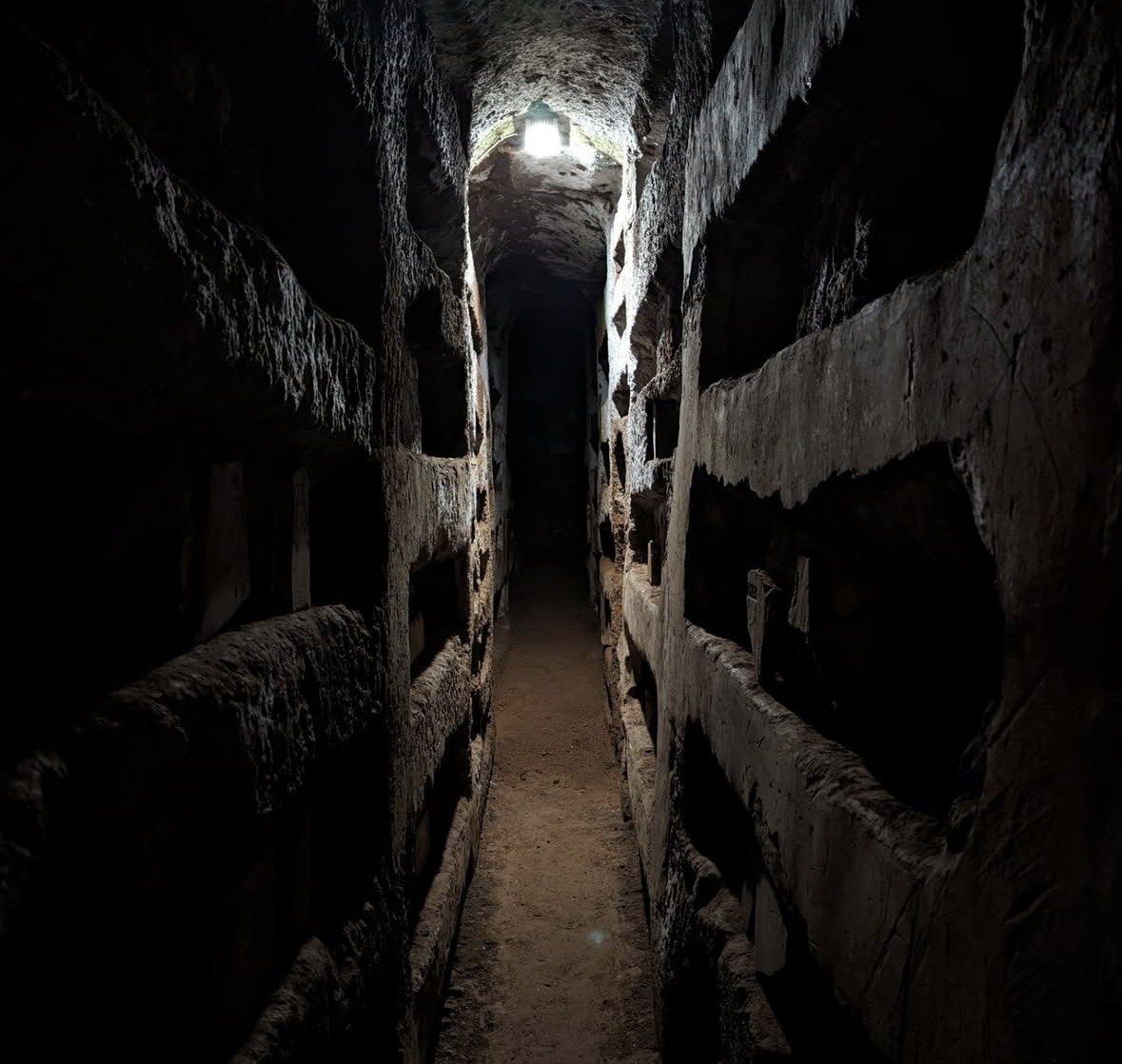
Out on the Appia you walk third-century Christian burial galleries cut into tufa: loculi sliced lengthwise into the walls and closed with marble slabs or bricks, arcosolia and cubicula, on an accompanied route of 40 to 45 minutes with the site's own staff. The official catacomb sites describe those tomb types and say nothing about visible human remains on the standard routes. The Capuchin Crypt is a 17th-century arrangement made to be looked at, indoors, in the centre, with the bones as the decoration.
The practical gap is just as wide. Getting round San Callisto costs you about 50 uneven steps down and 50 back up with no lift to help, San Sebastiano around 70, and wheelchairs are refused at both. The crypt is entered down three low steps. One takes a bus ride out past the Aurelian Walls, the other is ten minutes from Piazza Barberini.
| Capuchin Crypt, Via Veneto | San Callisto, Appia Antica | San Sebastiano, Appia Antica |
|---|
| Opening | Every day, 09:30–13:30 and 14:30–18:30 | 09:00–12:00 and 14:00–17:00, closed Wednesday | 09:15–17:15, closed Monday |
|---|
| Last entry | 12:30 and 17:30 | Last morning tour 12:00 | 16:45 |
|---|
| Length of visit | About 60 minutes, museum and crypt | About 40 minutes underground | About 40–45 minutes |
|---|
| Steps | Three low steps and no ramps | About 50 down and 50 up with no lift | About 70 down and up with no lift |
|---|
| How you go round | Audio guide; guided groups capped at ten with earpieces | Accompanied visit, departures every 30 minutes | Accompanied visit with the site's trained guide |
|---|
| Photography | Allowed, private non-commercial use only | Banned inside | Banned inside |
|---|
| Dress rule published | Shoulders and knees covered | A layer for cold, damp air, no formal rule | Clothing appropriate to the place |
|---|
Both entries and the transfer between them, in 3.5 hours
It solves the only hard part of pairing the two, the transfer back from the Appia in time for the crypt's last entry, and includes both entries from a meeting point at the Tritone fountain, from €49, rated 4.6 (5439 reviews).
★ 4.6/5 · 5,439 reviews
Putting the crypt and a catacomb into the same day
The crypt is a 60-minute stop, so it works as the second half of a catacomb morning or the first half of a catacomb afternoon. Doing it yourself means the Appia session at 09:00 or 14:00, the ride back into the centre, then the crypt before the 12:30 or 17:30 cut-off. That is tight either way, which is why most people take the combination as one outing.
The Original Roman Crypts and Catacombs Tour with Transfers covers both in 3.5 hours from €49, rated 4.6 (5439 reviews), meeting at the Tritone fountain in Piazza Barberini, with a private air-conditioned coach, the catacomb entrance ticket and entry to the Capuchin Crypt and Museum. The Basilica of San Martino ai Monti is on the itinerary except on the after-hours option, the late-start version of the same pairing: useful if your daytime is already spoken for, and the one way to see the crypt at the end of the day rather than the middle.
If you would rather do the crypt on a timed slot with an audio guide, the Rome Catacombs & Capuchin Crypts Group Tour with Transfers builds the pairing that way: a guided catacomb visit at St Callixtus, St Sebastian or Domitilla, timed entry with audio guide to the Capuchin Crypts, and the Appian Way and the Aurelian Walls seen from the vehicle. It also runs 3.5 hours, meets in front of the Fontana del Tritone, and goes from €57, rated 4.6 (991 reviews).
A true night outing is a different trip. The Rome Catacombs Night Tour with Santa Maria Maggiore After Hours runs 2 hours 45 minutes from €209, rated 4.9 (133 reviews), in a semi-private group of maximum 6 people guaranteed, and takes in the Catacombs of St Agnes, the Basilica of St Agnes, the Mausoleum of Costanza and Santa Maria Maggiore after closing. The Capuchin Crypt is not part of it, because the crypt stops admitting at 17:30.
Questions people ask
Is the Capuchin Crypt a catacomb?
No. The catacombs are ancient Christian cemeteries cut underground outside the city walls, and the Pontifical Commission for Sacred Archaeology lists seven of them open to the public. The Capuchin Crypt is a 17th-century burial place under a church in the modern centre, holding friars who lived between 1500 and 1800. It is bundled into several catacomb tours for practical reasons: it sits in the centre and the whole visit takes about 60 minutes.
Can I go straight to the crypt without the museum?
The route runs the other way round. The museum occupies eight rooms on the history of the Capuchin order and the crypt is the final stop, which is why the official site quotes about 60 minutes for the whole thing. Allow that hour rather than planning on fifteen minutes with the bones.
Is it open on public holidays?
It opens Monday to Sunday with no weekly closing day, which already puts it ahead of every catacomb on the planning calendar. The exceptions are Easter Sunday, 25 December and 1 January, when it shuts all day. San Callisto closes on those dates too, so those are days to drop the underground plan entirely.
What do I do with a backpack, and can I bring water?
Large bags and luggage have to go into the free lockers before you go in. Food is not allowed in the exhibition rooms, with a single bottle of water the one permitted exception. If you are with a guided group you will be given a radio earpiece, which is compulsory, and those groups are capped at ten people.
Can someone with limited mobility visit the crypt?
In most cases yes. The museum is reached by lift and its exhibition rooms are step-free and wide, and the crypt is entered down three low steps, with no ramps. That is a different proposition from San Callisto, where the official regulations state that wheelchairs cannot enter and the route involves about 50 irregular steps down and the same number back up with no lift.
Read also