In shortYes for most first-time visitors, as long as you plan a half day rather than a detour between other sights. What the trip out of the centre buys you at San Callisto is four stacked levels of galleries, about 19 km of them, reaching more than 20 metres down, where an estimated half a million Christians were buried along with dozens of martyrs and 16 popes. The visit lasts 40 to 45 minutes, always with a guide, and no photography is allowed.
19 kmgalleries at San Callisto
4 levelsmore than 20 m deep
16 popesburied at San Callisto
40–45 mintime underground
Why the catacombs are worth half a day on a short trip
The answer is yes if you give it half a day and take in the road above ground while you are out there. The complexes sit beyond the Aurelian Walls, entry is only on an accompanied visit of 40 to 45 minutes, and the trip out and back accounts for most of the time you spend on it.
San Callisto is why the answer is yes for most people. The complex covers roughly 90 acres, with about 19 km of galleries stacked on four levels and reaching more than 20 metres below the fields. The first galleries were cut in the middle of the second century, and by the third the complex served as the official cemetery of the Church of Rome. An estimated half a million Christians were buried there, dozens of martyrs among them, along with 16 popes. The room that on its own justifies the trip is the Crypt of the Popes, the little Vatican, burial place of nine of them, with the Greek inscriptions of Pontianus, Antherus, Fabian, Lucius and Eutychian still readable on the wall slabs.
Two objects carry as much weight as the figures. Priscilla, on Via Salaria, keeps the wall painting dated about 230 to 240 that is described as the oldest known image of the Virgin, inside a complex of over 13 km of galleries on two levels holding seven popes. If what you want is something nowhere else in Rome can show you, it is San Sebastiano's triclia and Memoria Apostolorum, their plaster covered in appeals scratched by pilgrims such as 'Paule et Petre petite pro Victore'; many scholars hold that the remains of Peter and Paul were kept there for a period.
The half day this page recommends
This 3.5-hour outing puts San Sebastiano or Domitilla together with the aqueducts, a walked stretch of the Appia and the exterior of Cecilia Metella, in a group of 18 or fewer, so the trip out of the centre buys more than 40 minutes below ground.
★ 4.8/5 · 1,691 reviews
What the accompanied route actually shows you
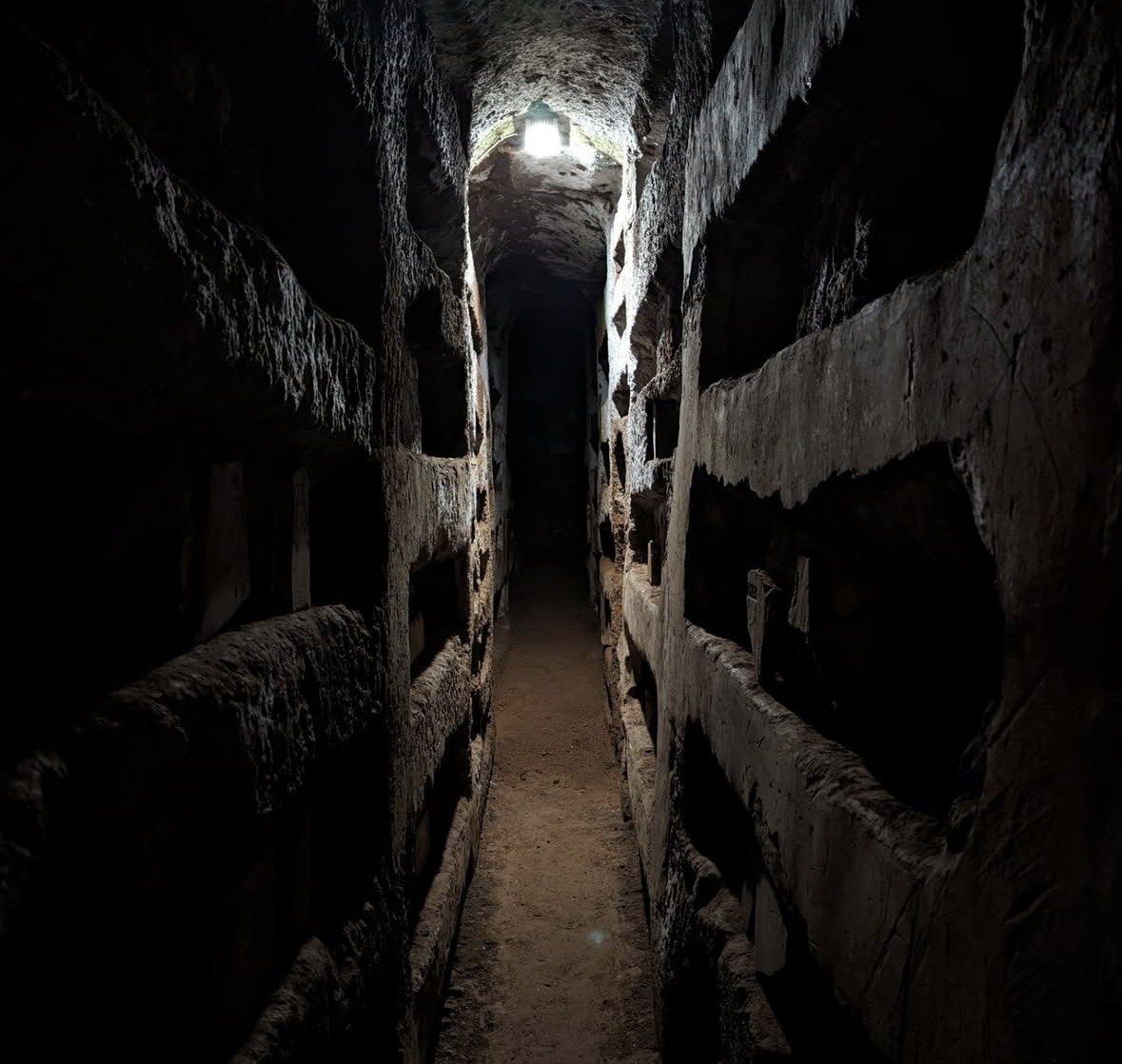
Most of what passes your shoulder is burial architecture. The galleries are lined with loculi, the rectangular niches cut lengthwise into the tufa and once closed with marble slabs or bricks. Arcosolia, the arched recesses, and cubicula, the small chambers, are the other two tomb types on the standard routes. Nothing stands in display cases, and the painted and inscribed rooms are a handful of stops along the walk.
Those stops are what the guides build the visit around. At San Callisto the route passes the two three-apsed Trichorae near the entrance, then the Crypt of the Popes and the Crypt of St Cecilia, whose relics went to the basilica in Trastevere in 821 and whose chamber now holds a copy of Maderno's statue of 1599. Domitilla gives you more room to stand: its circuit turns on the semi-underground three-nave basilica of Nereus and Achilleus and takes in the Flavian Hypogeum, the cubicle of Veneranda, the arcosolium of the Little Apostles and the cubicle of the gravedigger Diogenes.
Expect low light, cool damp air, brick and tufa, and a guide's voice, for about 40 to 45 minutes. Nothing is laid out in cases and there is no treasure to photograph. What you walk through is the earliest Christian cemetery of the city, cut as it stands.
| Site | Extent | The stop people remember |
|---|
| San Callisto, Via Appia Antica | About 19 km on four levels, more than 20 m deep, roughly 90 acres | Crypt of the Popes, the little Vatican, and the Crypt of St Cecilia |
|---|
| San Sebastiano, Via Appia Antica | About 12 km on three levels, down to 18 m | The triclia and the Memoria Apostolorum with pilgrim graffiti to Peter and Paul |
|---|
| Domitilla, Via Ardeatina | 17 km on four levels, origins in 120 AD | The semi-underground basilica of Nereus and Achilleus, the only one in Rome |
|---|
| Priscilla, Via Salaria | Over 13 km on two levels, seven popes | The image of about 230 to 240 called the oldest known depiction of the Virgin |
|---|
The trade-offs worth knowing
The case against starts with distance. Everything is outside the centre: from Colosseo or Circo Massimo on Metro B, bus 118 towards Appia and Villa dei Quintili sets you down at a stop called Catacombe di San Callisto, while Priscilla lies on the other side of the city, reached by bus 310, 92 or 63, or by Metro B1 to Sant'Agnese/Annibaliano and a quarter of an hour on foot along Via Lago di Lesina. Private vehicles are banned from the Via Appia Antica on public holidays, which rules out driving on exactly the dates most visitors are free.
Midday is dead time on the Appia strip. Turn up at San Callisto or Domitilla at one o'clock and you will find the gate shut: both work 09:00 to 12:00, then 14:00 to 17:00, with the last morning group at San Callisto setting off at 12:00. San Sebastiano is the one site that rescues a midday arrival, open without a break from 09:15 to 17:15, Tuesday to Sunday, and still admitting visitors at 16:45. Check the site's own calendar close to your date, because maintenance and feast-day closures move.
- No photographs and no video underground at San Callisto or San Sebastiano, and San Callisto warns that staff can put you out of the visit for trying
- You cannot walk the galleries alone: the route is fixed, you stay with the group, and there is no early exit
- Roughly 50 uneven steps down and the same number back up at San Callisto, about 70 either way at San Sebastiano, with no lift and no bench on the route
- Architectural barriers keep wheelchairs out, and both operators say the visit does not suit anyone who struggles in confined spaces
- Anything bulky stays outside: strollers, suitcases, musical instruments, banners
- The thermometer does not follow the seasons, sitting around 16 °C and damp at San Callisto and nearer 13 °C at Priscilla, so August visitors need a layer as much as March visitors do
Pair the descent with the road above
A bare descent is where people feel short-changed. Add the surface and the same trip changes character. The road is roughly 2,300 years old; it set off from Porta Capena and carried on to Capua and then Brindisi, and the long surviving run of basolato, cart ruts and all, starts where Via Ardeatina branches off beside Domine Quo Vadis, the church at Via Appia Antica 51 some 800 metres beyond Porta San Sebastiano. Keep going and you reach the Villa and Circus of Maxentius, the one Roman circus that survives with all its architectural components, central spina included, then the Mausoleum of Cecilia Metella, built between 30 and 10 BC at the third mile, carrying its ox-skull frieze and the Castrum Caetani the family raised on top of it in the 14th century.
The aqueducts are the other half of the landscape. Parco degli Acquedotti is about 240 hectares of unpaved ground with no traffic on it, crossed by six of the city's eleven aqueducts, among them the Aqua Marcia of 144 to 140 BC, at 91 km the longest, and the Aqua Claudia, started by Caligula in 38 AD and finished by Claudius in 52 AD, whose tufa arches stand up to 28 metres. More than 16 km of walking and cycling itineraries are listed by the regional park as passable at any time of year, and ordinary traffic is kept off the first stretch beyond the Maxentius complex on Sundays and public holidays.
Two practical notes on the surface sites, which belong to a separate state park with its own tickets. Their clock changes three times a year, Tuesday to Sunday throughout: 9:00 to 19:15 between 1 April and 30 September, 9:00 to 18:30 in March and in October, 9:00 to 16:30 from 1 November until the end of February, with last entry 30 minutes before closing and 75 minutes at Villa dei Quintili. Restoration has kept the Tombe della Via Latina and the Capo di Bove complex shut since 22 June 2026, which trims two stops off the day that older write-ups describe.
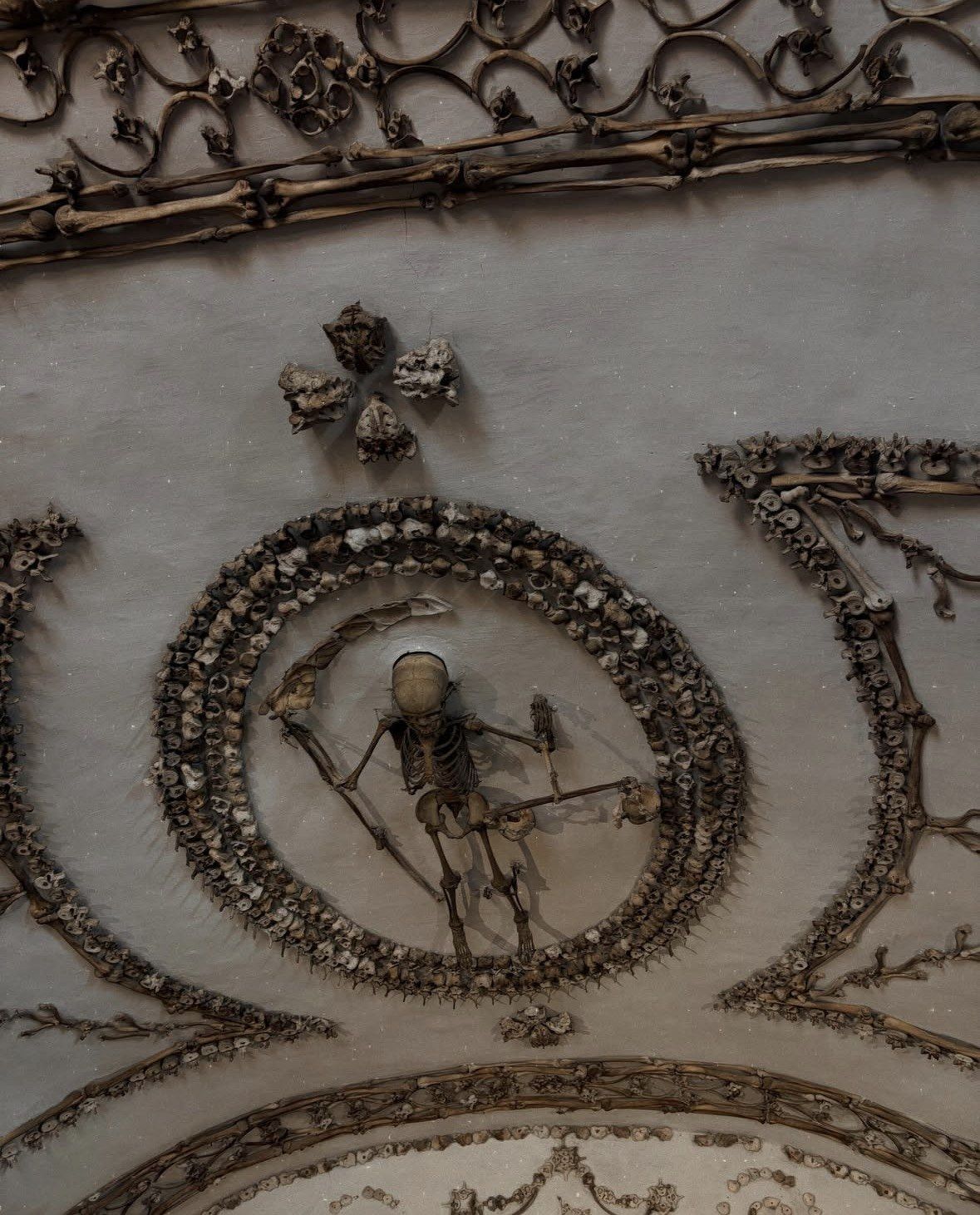
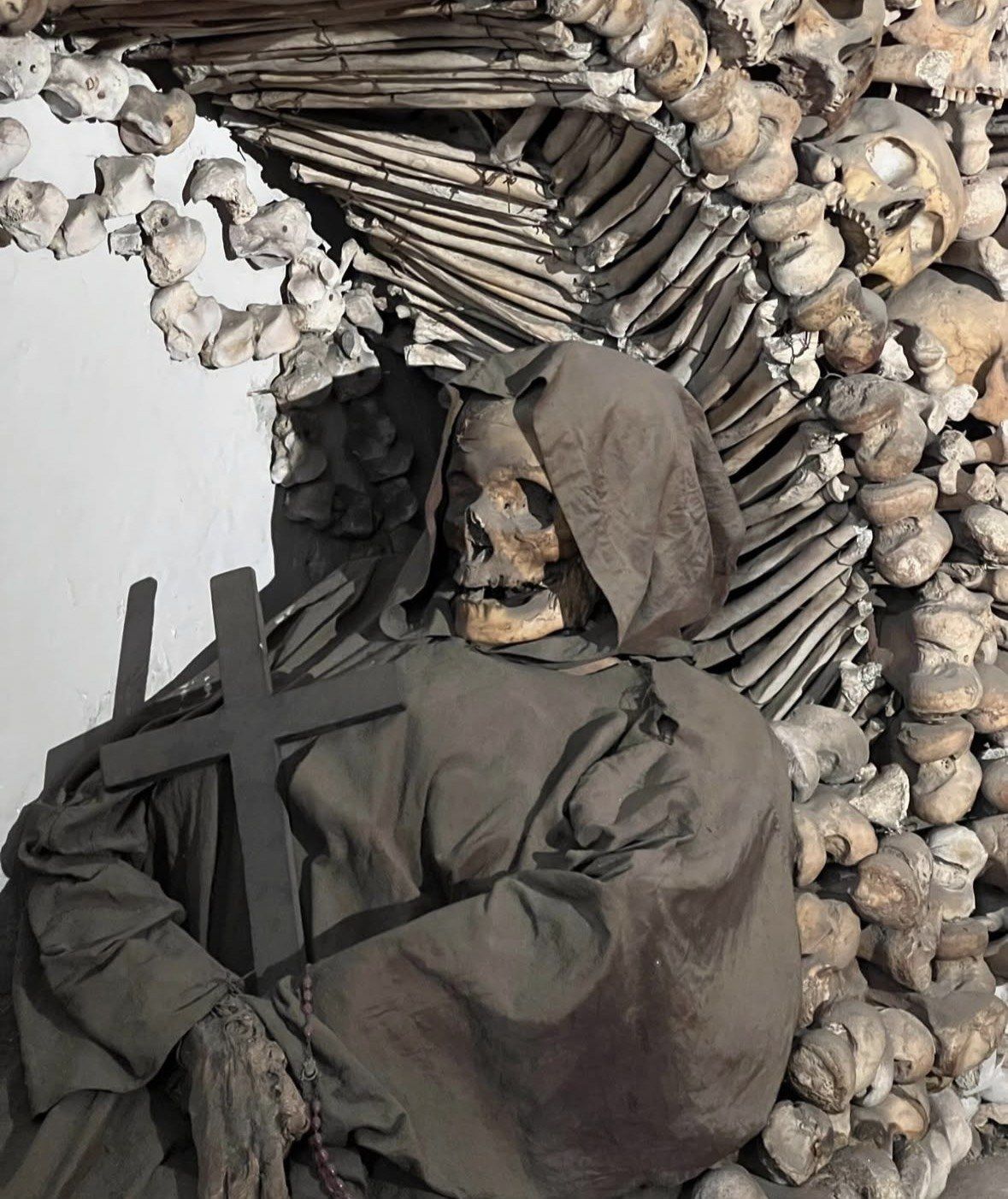
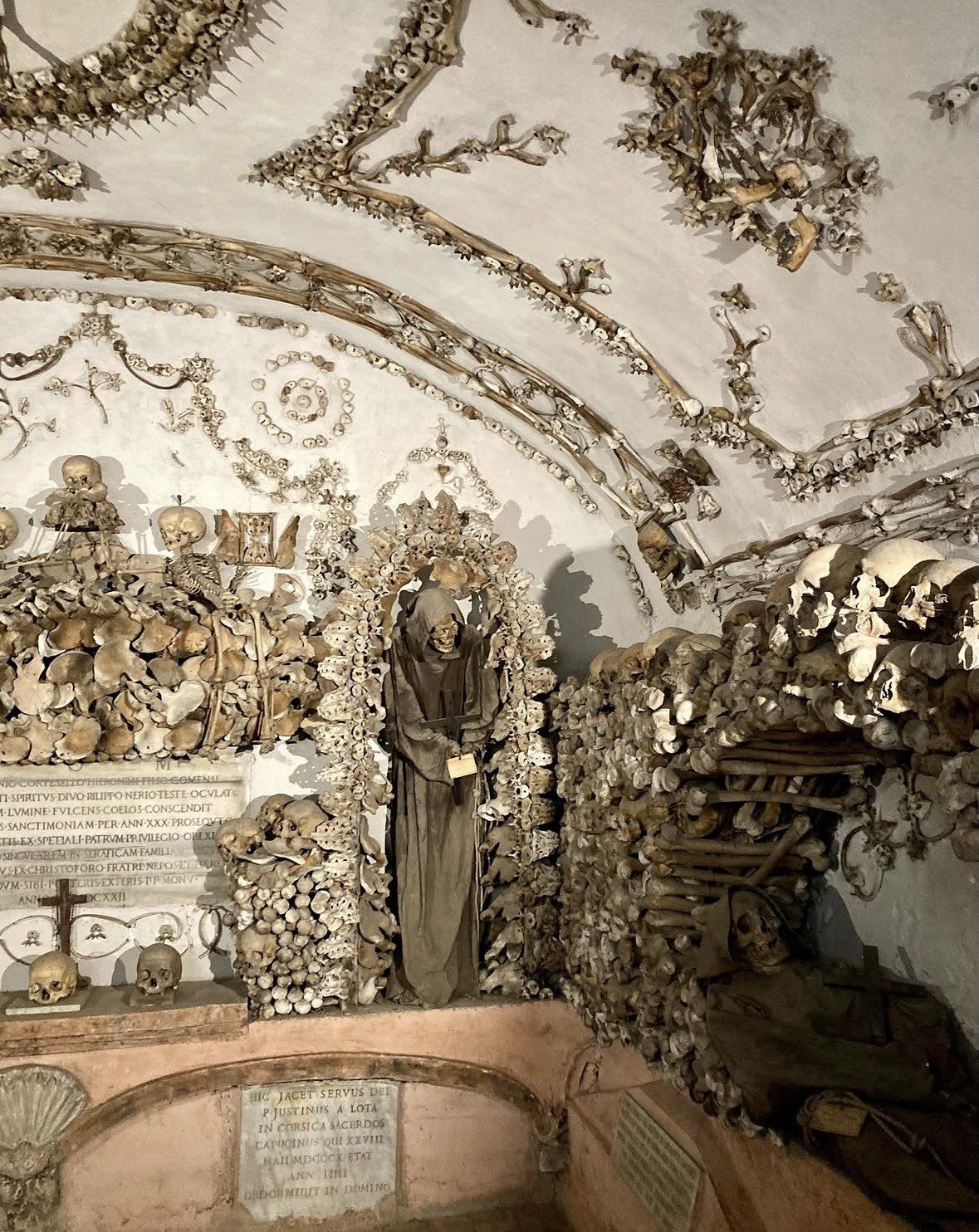
The alternative second stop is indoors and central. Calling the Capuchin Crypt a catacomb is wrong, though it does the job of a second stop: it lies beneath Santa Maria della Concezione at Via Vittorio Veneto 27, and the remains of almost 4,000 friars who lived between 1500 and 1800 have been worked into rosettes, stars, hourglasses and chandeliers through the Crypt of the Three Skeletons, of the Tibias and Femurs, of the Pelvises, of the Skulls, the Mass chapel and the Crypt of the Resurrection. A full visit with the museum takes about 60 minutes, shoulders and knees must be covered, and there are only three low steps.
The half day worth booking, and which of the three to pick
Commit to a combined accompanied day instead of squeezing in a bare descent. Once you are paying for the hour of travel each way, the step up from 40 minutes underground to a half day that also covers the Roman paving, the aqueduct arches or a second underground site costs very little.
Three of the tours on this site are built that way, and they split by how you want to move:
- Rome Underground: Catacombs Tour, Aqueducts and Appian Way, 3.5 hours, from €55, rated 4.8 (1691 reviews): the half day for visitors who want the landscape, with San Sebastiano or Domitilla according to the day, the Roman aqueducts, a section of the Appia covered on foot and Cecilia Metella seen from outside, capped at 18 people, starting at Piramide metro station
- Appian Way Aqueducts Bike Tour (Catacombs & Lunch Option), 4–5 hours, from €69, rated 4.8 (1176 reviews): the one to pick if the family is riding, with e-bikes, helmets, handlebar holders and a child seat up to 25 kg, starting near Colosseo on Metro B; the guided catacomb visit and the lunch or aperitif come with the 5-hour version only
- Rome Catacombs & Capuchin Crypts Group Tour with Transfers, 3.5 hours, from €57, rated 4.6 (991 reviews): St Callixtus, St Sebastian or Domitilla with private round-trip transport from central Rome, a drive past the Appian Way, views of the Aurelian Walls and a timed entry with audio guide at the Capuchin Crypts, meeting in front of the Fontana del Tritone in Piazza Barberini
Questions people ask
Which day of the week is best for the catacombs?
Pick the day before you pick the catacomb, because the closing days do not line up. San Callisto closes every Wednesday, Domitilla every Tuesday, and San Sebastiano, Priscilla and the state park monuments on the Appia all close on Monday. Thursday to Saturday, every one of them is open.
Is it still worth it in January or February?
Mid-January to early February is the one window to avoid: San Callisto is shut from 13 January to 10 February 2027 and Priscilla from 11 January to 1 February 2027, so the two largest options close almost together. San Sebastiano's own annual closure runs 7 to 27 December 2026, which takes out most of the pre-Christmas period. Priscilla also closes 16 to 23 August 2027.
Can I photograph the galleries?
No. Photography and video are banned inside San Callisto, and the site states that staff may remove anyone who ignores the rule; San Sebastiano's regulations forbid them as well. The ban holds for the whole 40 to 45 minutes underground, so put the phone away before the stairs down and keep it away.
Is it worth going if stairs or tight spaces are a problem?
Skip the descent in that case. The numbers published by San Callisto settle it: around 50 uneven steps going down, as many coming back up, no lift and nowhere to sit, while San Sebastiano asks about 70 each way; wheelchairs are not admitted at either, and both tell visitors prone to claustrophobia to stay above ground. The Capuchin Crypt on Via Vittorio Veneto has three low steps and the museum above is reached by lift, which makes it the sensible substitute while the rest of the party goes out to the Appia.
Should I fit in two catacombs?
One is enough. Every accompanied visit runs 40 to 45 minutes through galleries of broadly similar type, so a second complex adds little, and crossing the city to reach it eats the only hours you have. Put the remaining time into the Appia's surface monuments or the aqueducts.
Read also