In shortThe Catacombs of San Sebastiano lie on the Via Appia Antica above an old pozzolana quarry known as ad catacumbas, the name that gave the word catacomb its meaning. About 12 km of galleries run on three levels, down to 18 metres. Visits are guided and last about 40 to 45 minutes, Tuesday to Sunday 09:15 to 17:15, last admission 16:45, closed Mondays.
12 kmgalleries underground
3 levelsdown to 18 metres
200 yearsFranciscan presence
09:15–17:15Tuesday to Sunday
The Catacombs of San Sebastiano and the quarry that named them
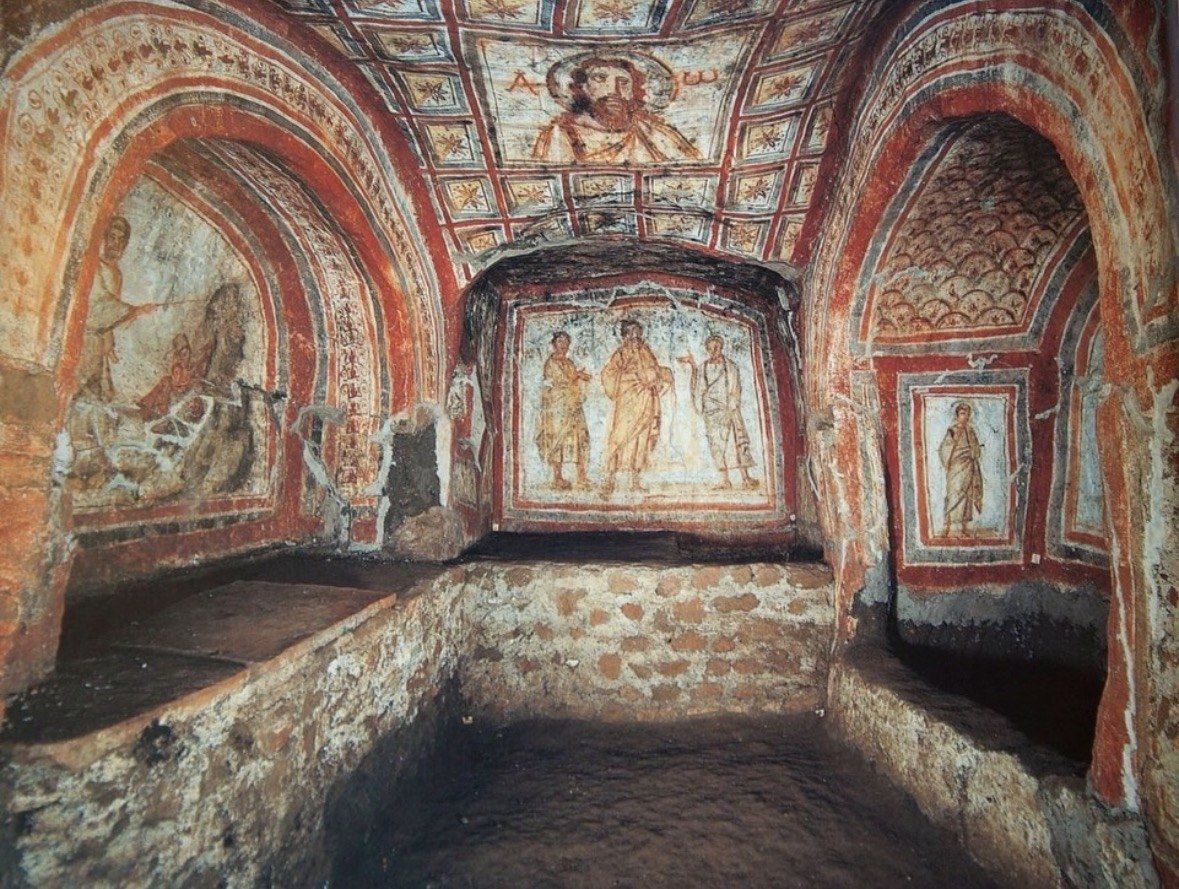
Pozzolana was dug out of the ground here long before anyone was buried in it, and the worked-out quarry was known as ad catacumbas. The Christian cemetery that spread into those voids inherited the name, and from this one patch of the Appian Way the word passed into every language that now uses it for an underground burial complex.
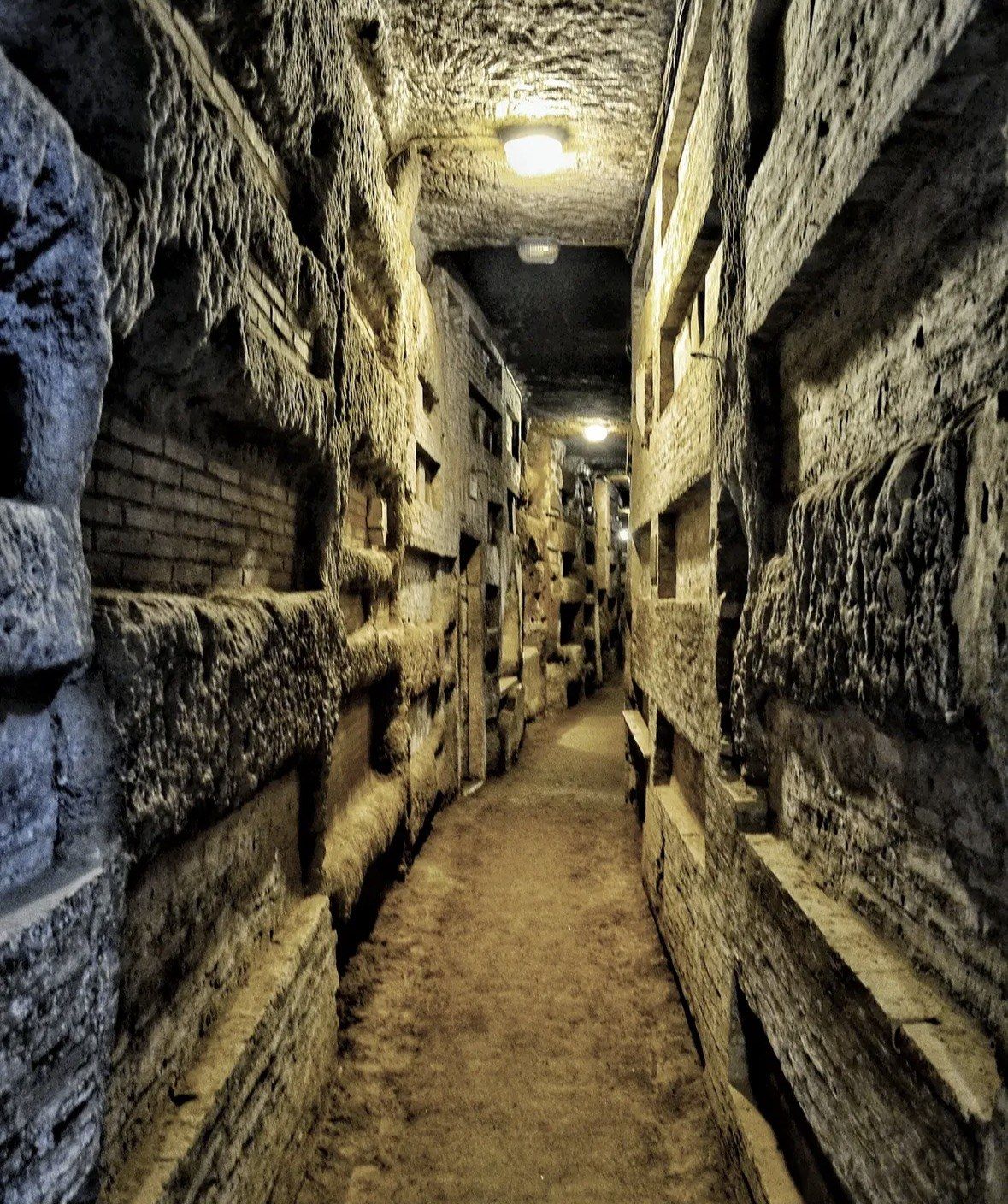
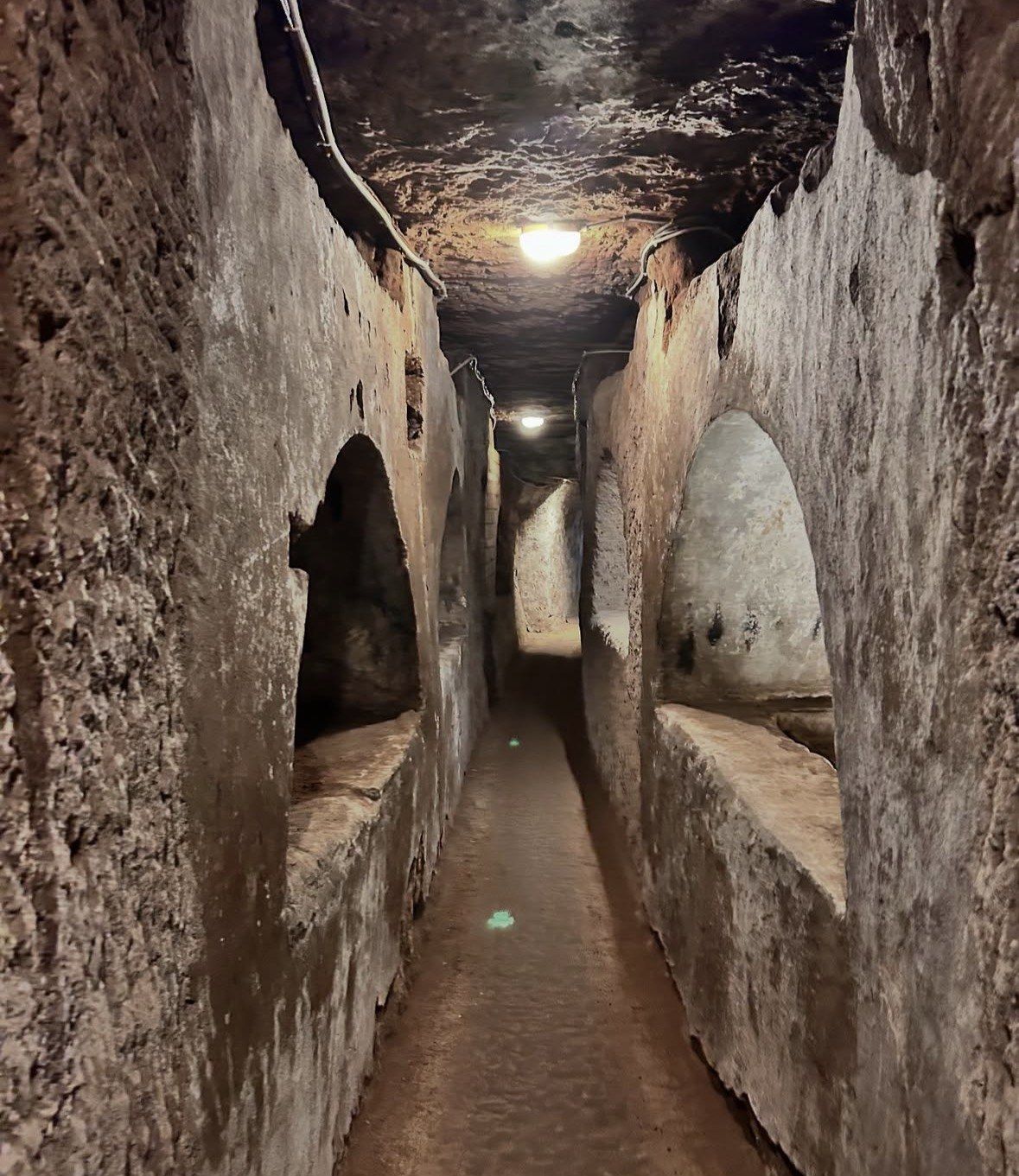
The figures are smaller than at the neighbouring complex and the shape is different: about 12 km of tunnels stacked on three levels, the deepest of them 18 metres under the road. The lower reaches include a pagan necropolis of the second century with three mausoleums, which explains the layout as you walk it, since the Christian galleries were cut around tombs that were already there.
The triclia and the Memoria Apostolorum graffiti
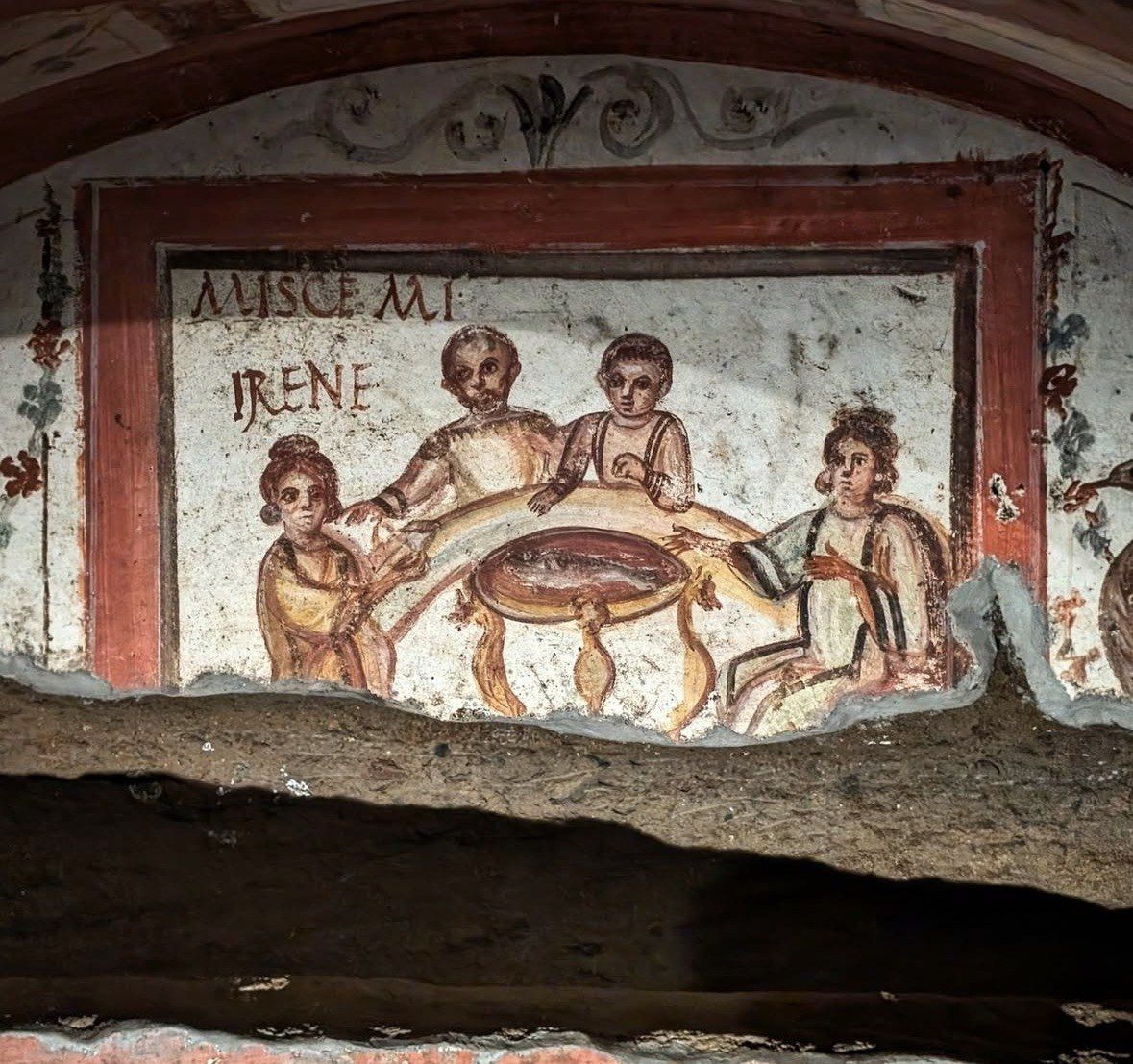
Two spaces make this site unlike anything else open in Rome. The first is the triclia, a covered hall with benches built along its walls, where pilgrims sat and ate in honour of the apostles. It survives, benches included, which is rare: most of what visitors see in a Roman catacomb is a burial corridor, while this is a room designed for people who came to stay a while.
The second is the Memoria Apostolorum, dated to the middle of the third century, whose plaster is covered in names and short prayers scratched by the people who came. One of them reads 'Paule et Petre petite pro Victore', Paul and Peter, pray for Victor. Many scholars take the whole arrangement as evidence that the remains of Peter and Paul were kept here for a time before being moved, which is why the devotion concentrated on this spot rather than on a martyr's tomb.
Photography and video are not allowed inside, so the graffiti stay on the wall and nowhere else. Expect the guide to hold the group at the hall for several minutes; it is the part of the route people remember.
San Sebastiano with the aqueducts in one half-day
A 3.5-hour outing from €55, rated 4.8 ★ (1691 reviews), that puts this complex or Domitilla together with the aqueducts and a walked stretch of the Appian Way, in a group of 18 people or fewer.
★ 4.8/5 · 1,691 reviews
The basilica above the catacomb and the Franciscans
The church at ground level is the basilica of San Sebastiano fuori le Mura, and it is part of the reason to come. The relics of St Sebastian are kept at the altar dedicated to him, together with the arrow of his martyrdom and part of the column to which tradition says he was tied. His crypt below is not a separate stop you can wander into on your own: it is seen only on the accompanied catacomb visit.
The complex is governed by the Pontifical Commission for Sacred Archaeology, and the site marks 200 years of Franciscan presence. That continuity is worth keeping in mind underground, where the guides are the site's own staff and the place is still treated as a cemetery rather than a museum.
Opening days, hours and the closures to plan around
This is the one complex on the Appia strip that does not break for lunch, and that single fact decides a lot of itineraries. Arrive at 13:00 anywhere else on the road and you wait; here the doors stay open from 09:15 to 17:15, Tuesday to Sunday.
Monday is the weekly closing day. Then there is Advent: the gates here are shut from 7 to 27 December 2026, so if San Sebastiano is the complex you have come for, the visit has to happen before 7 December, and 25 December and 1 January are out as well. Dates are published by the official site; if your trip falls close to one of those edges, check again shortly before you travel.
| Practical point | What the official site publishes |
|---|
| Open days | Tuesday to Sunday |
|---|
| Hours | 09:15 to 17:15, continuous through the middle of the day |
|---|
| Weekly closing day | Monday |
|---|
| Last admission | 16:45 |
|---|
| Last guided tour in English | Starts at 16:45 |
|---|
| Length of the visit | About 40 to 45 minutes, with the site's own trained guide |
|---|
| Annual closure | 7 to 27 December 2026 |
|---|
| Feast days closed | 25 December and 1 January |
|---|
| Steps on the route | About 70 irregular steps down and about 70 back up, with no lift |
|---|
What the descent actually involves
Reckon on about 70 irregular steps down and 70 back up, with no lift and nowhere to sit along the way. That is the steepest of the Appian Way complexes, and the site's own regulations state that wheelchair users cannot enter because of the architectural barriers, and advise against the visit for anyone who feels uneasy in tight spaces.
There is no cloakroom, and bulky items such as luggage, musical instruments and banners are refused at the entrance, so travel light. The regulations ask for clothing appropriate to the place and ban photographs and video below ground. Air down there is cool and damp whatever the month, so bring a layer even in August; a visit of 40 to 45 minutes standing still feels colder than the same temperature outdoors.
Nobody walks the galleries alone. Entry is on the accompanied visit with the in-house staff, and the site warns that a party of fewer than two people may have its visit postponed, so solo travellers should expect to be joined to a group.
Choose this site for the apostolic and pilgrimage layer
Pick this complex if what interests you is devotion rather than scale: the triclia, the scratched prayers to Peter and Paul, St Sebastian's altar upstairs. For sheer size the neighbouring San Callisto wins, with about 19 km of galleries on four levels more than 20 metres deep over roughly 90 acres, an estimated half a million burials and 16 popes. Neither replaces the other, and the continuous timetable here is what makes a midday or late-afternoon slot possible at all.
Two of the tours on this site take in this complex or the one next door, and both add the surface landscape that most coach outings only drive past.
- Rome Underground: Catacombs Tour, Aqueducts and Appian Way is the half-day built around this complex, or Domitilla when the calendar sends the group there: 3.5 hours, from €55, 4.8 ★ (1691 reviews), with the Roman aqueducts, a stretch of the Appia walked rather than driven, the Mausoleum of Cecilia Metella seen from outside, private air-conditioned transport and a cap of 18 people or fewer. You join the guide outside Piramide metro station, on the Piazzale Ostiense side of the road.
- Appian Way Aqueducts Bike Tour (Catacombs & Lunch Option): 4–5 hours, from €69, 4.8 ★ (1176 reviews), on a high-quality e-bike with helmet and handlebar holders, child seat up to 25 kg. Going underground is tied to the longer version: only the 5-hour booking includes the guided catacombs visit, and the lunch or afternoon aperitif comes with that length too. Meets at Roma STARBIKE next to the Carrefour supermarket, a few steps from Colosseo metro on line B.
Questions people ask
Can I walk the galleries without a guide?
No. Entry is on an accompanied visit with the site's own trained staff, lasting about 40 to 45 minutes. The regulations also warn that a party of fewer than two people may have its visit postponed, so if you are travelling alone expect to be put with another group. The last tour in English begins at 16:45, which is also the last admission of the day.
What if Monday is my only free day in Rome?
Then this is not the complex for that day, because Monday is its weekly closing day, and Priscilla on Via Salaria plus the state-run Appia Antica park monuments are shut too. San Callisto closes on Wednesdays and Domitilla on Tuesdays, so both are options on a Monday. Keep this site for a Tuesday to Sunday slot, ideally one where you want to go underground around midday.
How does this complex compare with San Callisto in size?
San Sebastiano is the smaller site on every measure of extent, and comfortably so: its neighbour up the road covers roughly 90 acres, with about 19 km of galleries spread over four levels, the lowest more than 20 metres down, an estimated half a million burials and 16 popes. This site runs about 12 km on three levels to 18 metres. What it has instead is the triclia and the Memoria Apostolorum, which have no equivalent elsewhere in Rome.
How do I reach the Appian Way catacomb strip on public transport?
Bus 118 from Colosseo or Circo Massimo on Metro B runs out along the Appia towards Villa dei Quintili and serves the catacomb strip, including the stop named Catacombe di San Callisto. Bus 218 from San Giovanni on Metro A is the backup towards Ardeatina. The Porta San Sebastiano access point to the Appia park is served by both the 118 and the 218 and by Metro C at Porta Metronia, which is useful if you want to walk a stretch of road first.
Is the second-century pagan necropolis part of the standard route?
The pagan necropolis with its three mausoleums belongs to the deepest part of the complex and is one of the things that makes the layout here unusual, since the Christian galleries were cut around older tombs. What any given group sees is decided by the in-house guide on the day. Ask at the start if it matters to you, and plan for the full 40 to 45 minutes underground either way.
Read also