Rome Catacombs Map: Where the Entrances Are and What Lies Below
Three open catacomb entrances stand on two roads south of the walls, with a fourth north of the centre on Via Salaria. Below them the galleries stack up on levels that no street map can draw.
Updated 24 October 2026
In shortThe map works on two layers. On the surface, three open complexes sit on the Appia Antica and Ardeatina strip, Priscilla stands north of the centre on Via Salaria, and the park's walking and cycling itineraries cover more than 16 km. Underground, San Callisto alone runs about 19 km of galleries on four levels, more than 20 metres down, and the part you walk is the accompanied section.
19 kmgalleries at San Callisto
more than 20 mdeepest level, San Callisto
16+ kmpark walking and cycling routes
7catacombs open to the public
Main visitor pointOpen-air landmarkNearby catacomb or siteTour meeting point
The Appia Antica catacombs, the landmarks along the ancient road and the central meeting points used by the tours on this site.
What this map marks on the surface and below
Four pins carry most of the day. San Callisto sits in the fields between Via Appia Antica and Via Ardeatina, which is why its gate has an Appia number while the public parking in front of it is addressed on the Ardeatina side. San Sebastiano and Domitilla are on the same short strip, close enough to walk between. Priscilla is the outlier, north of the centre on Via Salaria, reached by a different bus on a separate trip.
The character of the map changes at the Via Ardeatina junction, by the church of Domine Quo Vadis. From there the preserved Roman basolato begins, still rutted by cart wheels, and the monuments come one after another: the Villa and Circus of Maxentius, then the Mausoleum of Cecilia Metella at the third mile with the Castrum Caetani raised over it in the early 14th century, then Casal Rotondo of the late 1st century BC. Vigna Randanini turns up at Via Appia Antica 119, although Roma Capitale's tourism listing says it opens only on special occasions.
The transport layer decides whether the day works. Three bus poles cover the strip, one park access point sits by the city gate and another further out at Cecilia Metella, and drivers leave the ring road at a single marked exit.
Catacomb entrances on the strip: San Callisto, San Sebastiano, Domitilla
North of the centre: Priscilla, on Via Salaria
Surface monuments in order: Domine Quo Vadis, the Maxentius complex, Cecilia Metella, Casal Rotondo
Bus poles: Catacombe di San Callisto on the 118, Fosse Ardeatine on the 218, Navigatori on the 714 with about 1 km on foot along Via delle Sette Chiese
Appia park access: Porta San Sebastiano, served by the 118 and 218 and by Metro C Porta Metronia, and Via Appia Antica at Via di Cecilia Metella on the 660
Parking: the public area in front of the San Callisto entrance, reached from GRA exit 24, signposted Roma centro and Fosse Ardeatine
Green overlay: the regional park, about 4,580 hectares, with over 16 km of walking and cycling itineraries described as always passable
From Porta San Sebastiano out to the third mile
Distances here are short and the order never changes. A copy of the first milestone of the Appian Way is set into the wall just outside Porta San Sebastiano, on the right, and a Roman mile measured about 1,480 metres from Porta Capena. The first four kilometres of road show no ancient surface at all. The long preserved stretch starts at the Ardeatina junction, roughly 800 metres beyond the gate, and the catacomb gates follow immediately after.
Every pin marked on this stretch above ground is ticketed by the state archaeological park, and the park's gates follow the season rather than the catacomb timetable: Tuesday to Sunday, 9:00 to 19:15 between 1 April and 30 September, 9:00 to 18:30 in March and October, then 9:00 to 16:30 from 1 November to the end of February. Last entry falls 30 minutes before closing, and 75 minutes before at Villa dei Quintili. Since 22 June 2026 the Tombe della Via Latina and the Capo di Bove complex have been closed for restoration, so an Appia day has fewer stops than older write-ups put on the map. Read the park's own notices on the day before you build an itinerary around either one.
The strip and one catacomb in a half-day
Rome Underground: Catacombs Tour, Aqueducts and Appian Way runs 3.5 hours in groups of 18 people or fewer, with entry to San Sebastiano or Domitilla depending on the day, the aqueducts, a walking stretch of the Appia and the exterior of Cecilia Metella. It starts from €55 and carries a rating of 4.8 (1691 reviews).
Catacombs of Rome levels and galleries, complex by complex
Nothing on the surface hints at the volume underneath. San Callisto covers roughly 90 acres with about 19 km (12 miles) of galleries stacked on four levels, the lowest more than 20 metres down, and it was in use from the middle of the second century. Domitilla, dated to 120 AD, reaches 17 km of tunnels on four levels and holds Rome's only semi-underground basilica. At San Sebastiano the count drops to three levels and about 12 km, with the lowest floor at roughly 18 metres, where the plan takes in a second-century pagan necropolis and its three mausoleums. Priscilla has two levels, the fewest of any open site, and still totals over 13 km.
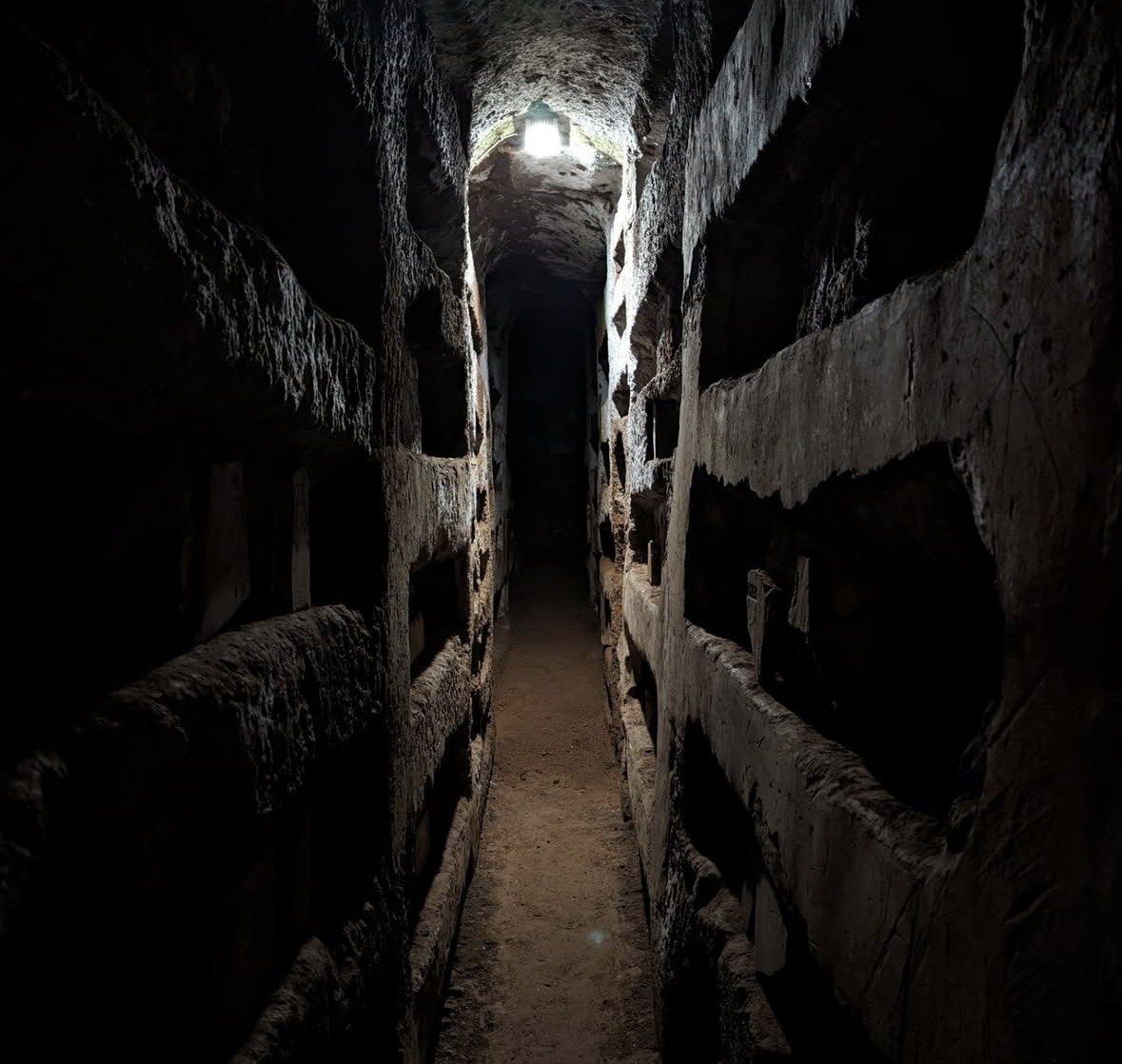
What you walk is a small fraction of that, signed and staffed from end to end. The official rules state that you stay with your group, and side corridors are off limits. At San Callisto a group leaves every half hour and is underground for about 40 minutes, the last morning departure at 12:00. Along the route you see loculi cut lengthwise into the tufa and closed with marble slabs or brick, with arcosolia and cubicula opening off the galleries.
Complex
Levels
Galleries
Depth reached
Accompanied visit
San Callisto, Via Appia Antica
4
about 19 km (12 miles)
more than 20 m
about 40 minutes, departures every 30 minutes
Domitilla, Via delle Sette Chiese
4
17 km
not published
Italian, English, German, Spanish, French; Polish and Portuguese by request
San Sebastiano, Via Appia Antica
3
about 12 km
up to 18 m
about 40 to 45 minutes, last English tour 16:45
Priscilla, Via Salaria
2
over 13 km
not published
about 45 minutes, groups capped at 25 people
Sant'Agnese, Via Nomentana
martyr's gallery on the first level
not published
about 6 m below the modern road
hourly departures 10:00 to 12:00 and 15:00 to 17:00, 30 minutes each
Vigna Randanini, Via Appia Antica 119
2
about 700 metres
not published
open only on special occasions
Judging what fits one day on foot, by bike or with transport
Walking is the honest way to join the dots, and the regional park describes its itineraries, more than 16 km of them, as passable all year. One catacomb plus the surface monuments fills a day without rushing. A second catacomb adds less than people expect: each visit is a guided walk of 40 to 45 minutes through galleries of broadly the same kind, and the two above-ground parks want separate tickets.
Bikes change the arithmetic and come with rules of their own. On the surviving basolato riders have to dismount and push, or use the dirt paths alongside, while the first section up to Cecilia Metella is mostly cobblestone and asphalt. Coming across from Parco degli Acquedotti, cyclists can cut through on the private road of the San Callisto catacombs, open daily 9:00 to 18:00 except Wednesdays and throughout February; when that road is shut the choice is about 1.5 km of the Appia in traffic or a longer detour through the Caffarella valley.
Sundays and public holidays rearrange everything with an engine. The first stretch past the Maxentius complex closes to ordinary traffic on those days, and private vehicles are barred from the Via Appia Antica on public holidays, so a car is the wrong tool on exactly those dates. Parco degli Acquedotti, about 240 hectares of unpaved traffic-free ground crossed by six of Rome's eleven aqueducts, is entered at Piazza Aruleno Celio Sabino or Via Lemonia near Metro A Giulio Agricola and Subaugusta, or at Via Viviani near Lucio Sestio.
Timing limits a day more than distance does. San Callisto and Domitilla both run two sessions, 09:00 to 12:00 and 14:00 to 17:00, so arriving at 12:30 means waiting until two. Only San Sebastiano stays open straight through, 09:15 to 17:15 from Tuesday to Sunday with the gate closing to new visitors at 16:45, so put that pin on the map for anything between noon and two.
Priscilla to the north, plus the points that are not catacomb stops
Priscilla takes a trip of its own, north of the centre on Via Salaria. Buses 310, 92 and 63 stop at a pole named Priscilla, and Metro B1 to S. Agnese and Annibaliano leaves about a quarter of an hour on foot along Via Lago di Lesina. Inside, the air sits at roughly 13°C, the coolest of the main open sites. Monday is closed and Sunday mornings start only at 11:30.
Three more of the seven open catacombs sit off both maps. Sant'Agnese on Via Nomentana admits visitors only on its 30-minute accompanied tours, hourly from 10:00 to 12:00 and 15:00 to 17:00, Monday to Saturday. San Pancrazio on the Janiculum opens Tuesday and Thursday 9:30 to 12:00, Wednesday 9:30 to 12:00 and 16:30 to 18:00, closes Friday to Monday and for the whole of August, and shows just one of its four original regions, under the central nave. Santi Marcellino e Pietro on Via Casilina covers about 18,000 m² with an estimated 15,000 third-century burials, closes on Thursdays and has to be booked in advance; the ticket also covers the adjacent Mausoleum of Sant'Elena.
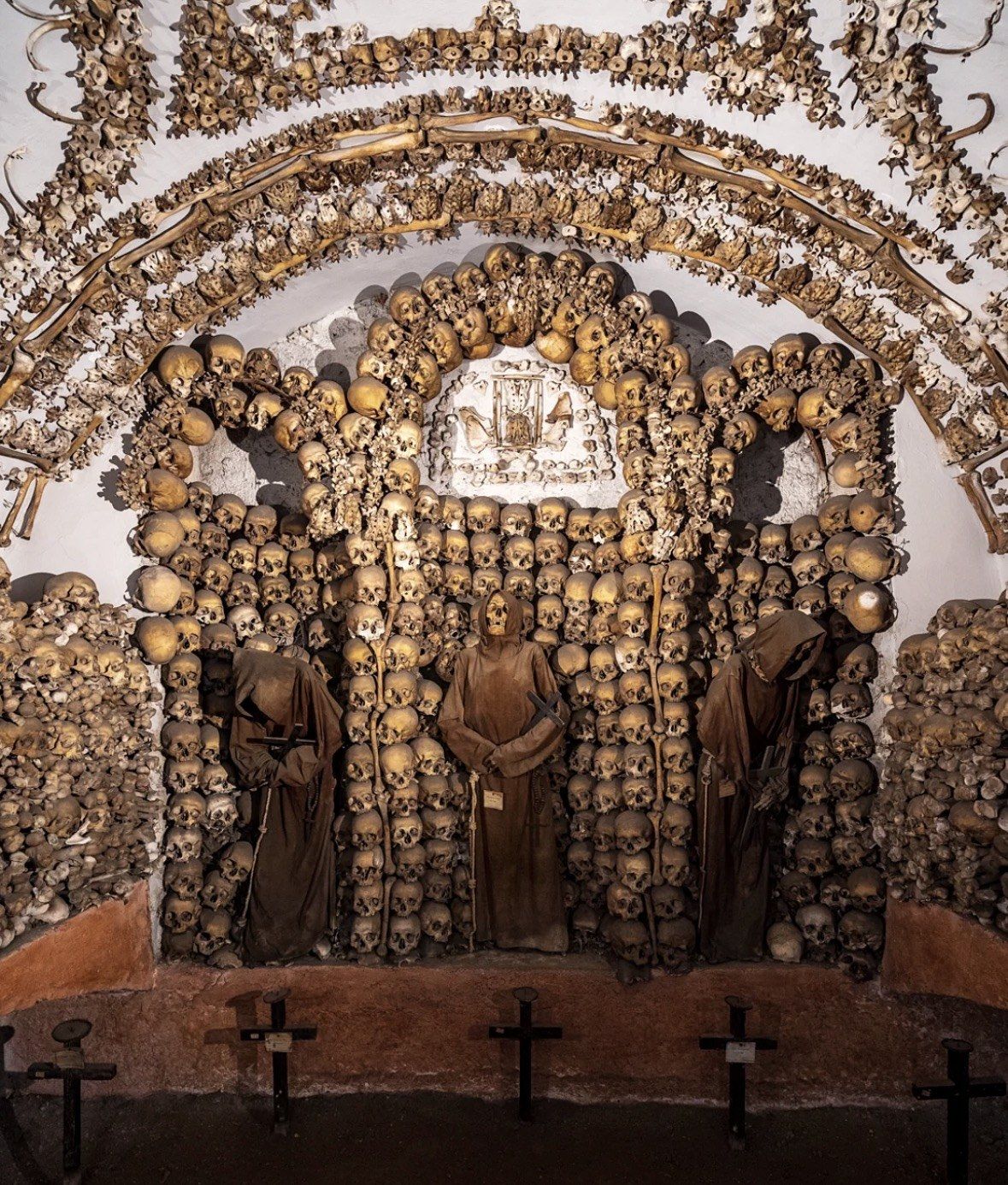
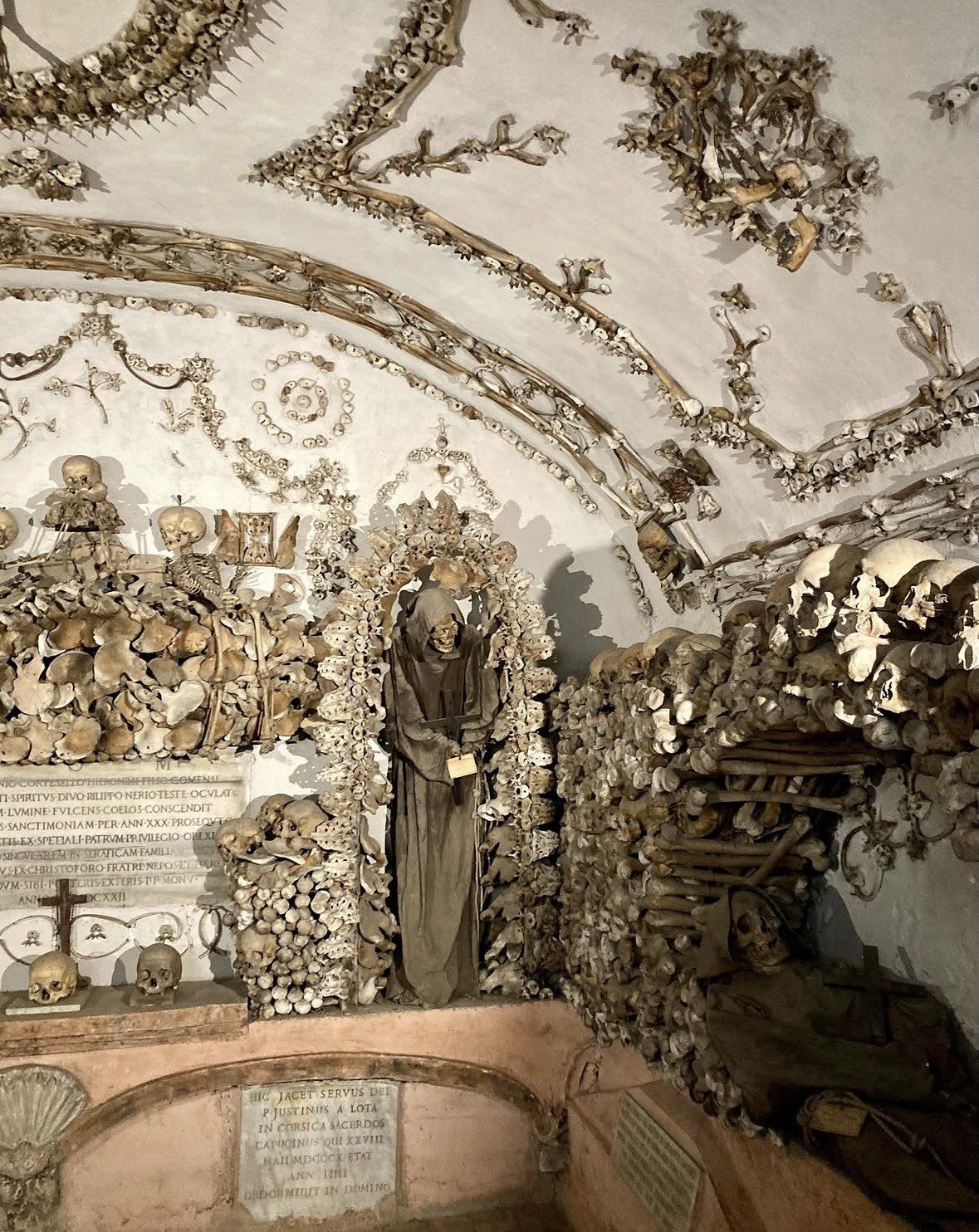
Two further markers get taken for catacomb stops. The Jewish hypogeum in the Villa Torlonia grounds on Via Nomentana, two originally separate catacombs later joined by tunnels across an area of roughly 110 by 120 metres, cannot be visited according to Roma Capitale's listing. The Capuchin Crypt under Santa Maria della Concezione at Via Vittorio Veneto 27 stands in the centre and is no catacomb: three low steps, no ramps, open every day 09:30 to 13:30 and 14:30 to 18:30 with last entries at 12:30 and 17:30, shoulders and knees covered.
Questions people ask
Can I follow the galleries on a map once I am underground?
No. Entry is on an accompanied route with the site's own staff, and the official rules require you to stay with your group rather than explore side corridors. Nor can you record what you pass: both San Callisto and San Sebastiano prohibit photographs and video underground, and at San Callisto the staff are entitled to send out anyone who keeps shooting. The signed section is a short part of networks that run for kilometres on several levels.
Why does San Callisto appear under two different street addresses?
The complex lies between two roads. The visitor entrance and ticket office carry a Via Appia Antica number, while the public parking directly in front of it is addressed on Via Ardeatina, reached from GRA exit 24 signposted Roma centro and Fosse Ardeatine. There is also an unattended private car park reached from the Appia Antica and Ardeatina junction by the Quo Vadis church.
How many catacombs in Rome are actually open to the public?
Seven, by the Pontifical Commission for Sacred Archaeology's own list, and the names worth pinning are San Pancrazio, Priscilla, San Sebastiano, Domitilla, Sant'Agnese, San Callisto and Santi Marcellino e Pietro. Three of them stand on the Appia Antica and Ardeatina strip: San Callisto, San Sebastiano and Domitilla. Catacombs normally closed can be opened on request for groups of no more than 15 people, arranged by email with the Commission.
How far along the road is the Mausoleum of Cecilia Metella from the catacomb gates?
They belong to the same short run of the Appia. The mausoleum was built between 30 and 10 BC at the third mile of the road, and a Roman mile measured about 1,480 metres from Porta Capena, so the walk south from the catacomb entrances stays on one continuous stretch of ancient paving and field walls. Bus 660 serves the access point at Via Appia Antica and Via di Cecilia Metella if you would rather not walk back.
Which underground site has the fewest steps?
Among the catacombs, Sant'Agnese is the shallowest: the martyr's gallery lies only about six metres below the modern road, though wheelchair users cannot enter. Count on about 50 uneven steps down at San Callisto and 50 again on the way out, with no lift and no bench anywhere on the route; San Sebastiano puts the figure nearer 70. Off the catacomb map altogether, the Capuchin Crypt at Via Vittorio Veneto 27 drops only three low steps, and a lift serves the museum rooms above it.
The Appian Way, catacombs and aqueducts bike and e-bike tour runs 4-6 hours, from €59, rated 4.9 (1966 reviews). The guided visit of San Callisto or San Sebastiano comes with the 6-hour tour only.