In shortA catacomb in Rome is an underground cemetery: galleries cut on several levels into soft volcanic rock outside the city walls, along the consular roads, with the dead sealed into niches in the gallery walls. Christian and Jewish communities began digging them in the second century, Domitilla from 120 AD. Seven are open to visitors, and every visit is accompanied.
7catacombs open to visitors
120 ADdate of Domitilla
about 19 kmgalleries under San Callisto
about 16 °Cair inside San Callisto
What are catacombs in Rome, and why they lie outside the walls
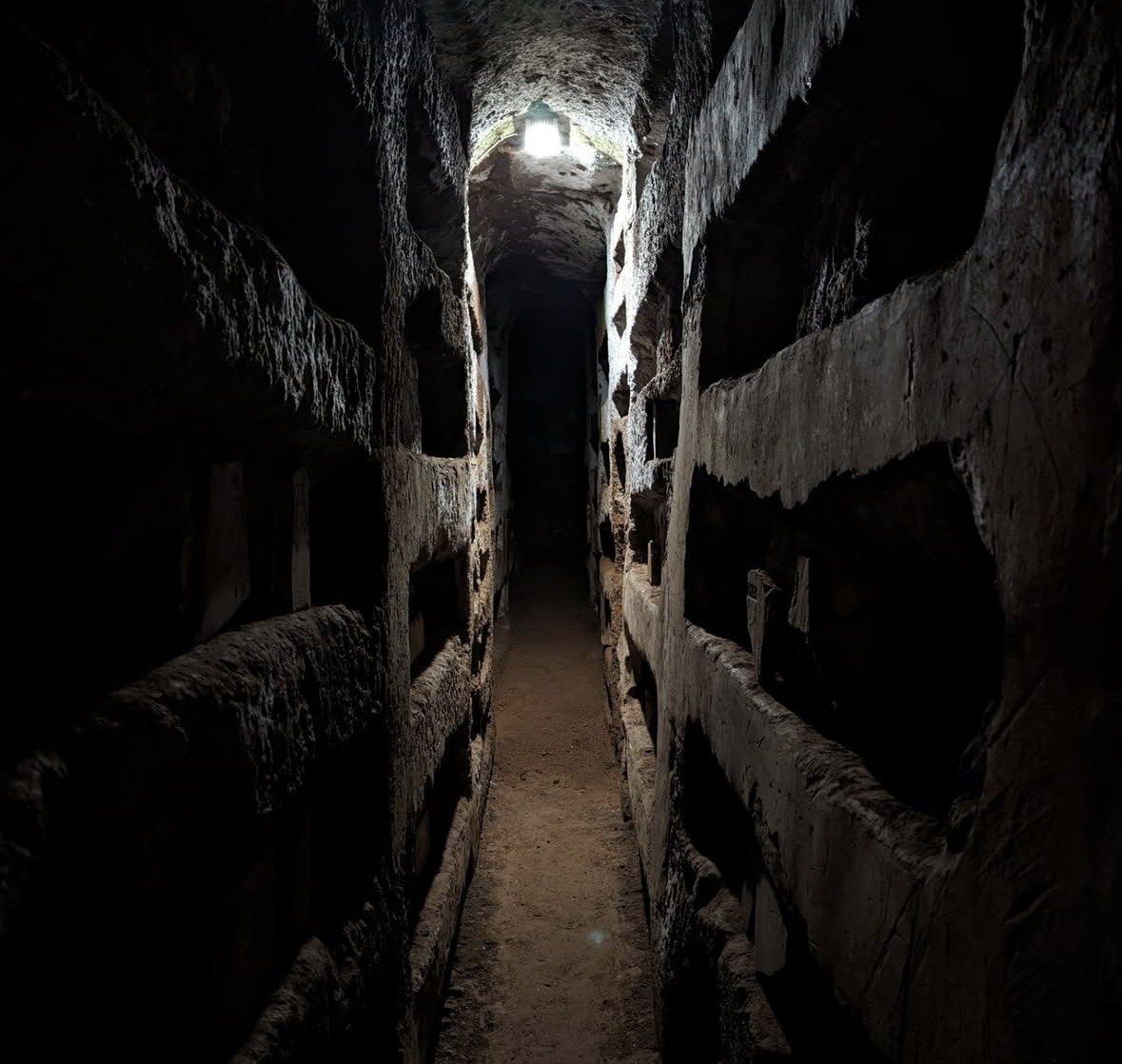
A catacomb is a cemetery dug downwards. Narrow corridors run through the soft volcanic rock outside Rome, and the dead were laid in niches cut lengthwise into the corridor walls. Burial inside the city was not allowed, so communities acquired land along the consular roads, the Appia, the Ardeatina, the Salaria, the Nomentana and the Casilina, and when one level of corridors filled up they cut a second below it, then a third.
Christians and Jews both worked this way, side by side on the same roads, since both wanted ground of their own and burial rather than cremation. Domitilla goes back to 120 AD, among the earliest Christian complexes in the city. San Callisto took shape from the middle of the second century, and a hundred years later the Church of Rome was using it as its official cemetery: roughly half a million burials, dozens of martyrs and 16 popes. On the Jewish side, Vigna Randanini at Via Appia Antica 119 dates from the 2nd to the 4th centuries AD, with about 700 metres of galleries on two levels and inscriptions in Greek and Latin, none in Hebrew. The Villa Torlonia hypogeum, excavated from 1918, is really two separate catacombs later joined by tunnels, over an area of roughly 110 by 120 metres.
How a catacomb is laid out underground
The structure is simple and repeats itself. Levels stack vertically, galleries run between them like streets, and the standard burial is the loculus, a slot cut into the wall and closed with a marble slab or with bricks. Richer families paid for an arcosolium, a tomb under a carved arch, or for a cubiculum, a small chamber off the corridor holding several tombs. Shafts called luminaria were driven up to the surface to bring in light and air and to lift out the spoil while the digging went on, and they are still the reason a few stretches feel unexpectedly bright.
Scale catches people out. San Callisto covers roughly 90 acres: four levels, some 19 km of galleries, the lowest more than 20 metres under the fields. Domitilla reaches 17 km of tunnels on four levels and keeps Rome's only semi-underground basilica, dedicated to Nereus, Achilleus and St Petronilla. San Sebastiano runs about 12 km on three levels, down to 18 metres, and its deepest part includes a second-century pagan necropolis with three mausoleums. Priscilla, on Via Salaria, has only two levels but still totals over 13 km, and the air in it sits at about 13°C.
The route you walk is a lit section of the complex, and the famous stops sit on it: the Crypt of the Popes at San Callisto, nicknamed the little Vatican, with Greek inscriptions of Pontianus, Antherus, Fabian, Lucius and Eutychian still on its walls; the Cubicolo della Velata and the Greek Chapel frescoes at Priscilla; the basilica, the Flavian Hypogeum and the cubicle of the gravedigger Diogenes at Domitilla.
Catacomb plus the Appian Way in one half-day
For the galleries and the landscape above them without working out the buses, this 3.5-hour outing takes groups of 18 people or fewer into San Sebastiano or Domitilla and adds the aqueducts, a walking stretch of the Appia and the exterior of Cecilia Metella, from €55, rated 4.8 (1691 reviews).
★ 4.8/5 · 1,691 reviews
How many catacombs are in Rome, and who looks after them
Seven Roman catacombs are currently open to the public, and the list comes from the Pontifical Commission for Sacred Archaeology, the Holy See body that governs and conserves them: San Pancrazio, Priscilla, San Sebastiano, Domitilla, Sant'Agnese, San Callisto and Santi Marcellino e Pietro. Only three of the seven sit on the Appia Antica strip, which is why people who say they are going to see the catacombs of Rome usually mean San Callisto, San Sebastiano or Domitilla.
Ownership, conservation and daily reception are three different things. San Callisto belongs to the Administration of the Patrimony of the Apostolic See, is conserved by the Commission, and has had the Salesians of Don Bosco running reception and the accompanied visits there since 1930. Domitilla is in the care of the Missionaries of the Society of the Divine Word on the Commission's behalf, Priscilla is run by the Associazione Pro Deo et Fratribus, Famiglia di Maria, and San Sebastiano marks 200 years of Franciscan presence. Catacombs that normally stay shut, Pretestato or Commodilla among them, can be opened for very small groups on request to the Commission.
Timetables are set site by site and the closing days deliberately do not line up. Check the current calendar for the site you have chosen before you fix the day.
| Catacomb | Road or area | Extent from the official sources | Weekly closing day |
|---|
| San Callisto | Via Appia Antica | 4 levels, about 19 km of galleries, over 20 metres deep, roughly 90 acres | Wednesday |
|---|
| San Sebastiano | Via Appia Antica | 3 levels, about 12 km, down to 18 metres | Monday |
|---|
| Domitilla | Appia Antica strip | 4 levels, 17 km of tunnels, origins in 120 AD | Tuesday |
|---|
| Priscilla | Via Salaria, north of the centre | 2 levels, over 13 km, interior about 13°C | Monday |
|---|
| Sant'Agnese | Via Nomentana | martyr's gallery about 6 metres below the modern road | no tours on Sunday |
|---|
| San Pancrazio | Janiculum | one of the four original regions open, beneath the central nave | Friday to Monday |
|---|
| Santi Marcellino e Pietro | Via Casilina | about 18,000 m², an estimated 15,000 third-century burials | Thursday |
|---|
The quarry on the Appian Way that gave the word to every language
The word comes from one place on the Appia. San Sebastiano grew in and around a worked-out pozzolana quarry that Romans knew as ad catacumbas, and the cemetery took the quarry's name; from there it passed to the basilica above, then to every other underground Christian burial place in Europe. The site also preserves the triclia, a covered hall with benches, and the Memoria Apostolorum, whose plaster is scratched with pilgrim invocations, among them Paule et Petre petite pro Victore. Many scholars think the remains of Peter and Paul were held there for a time.
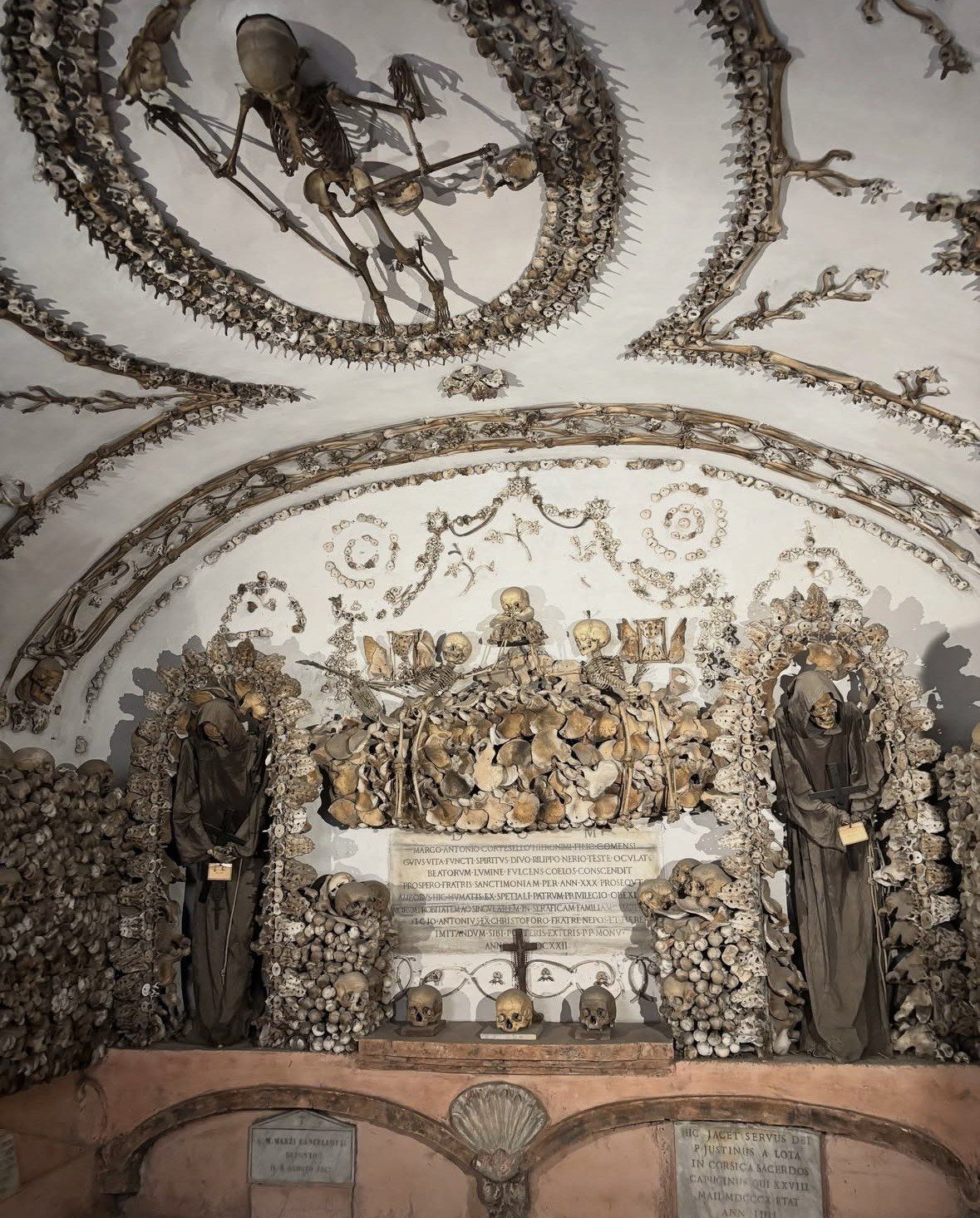
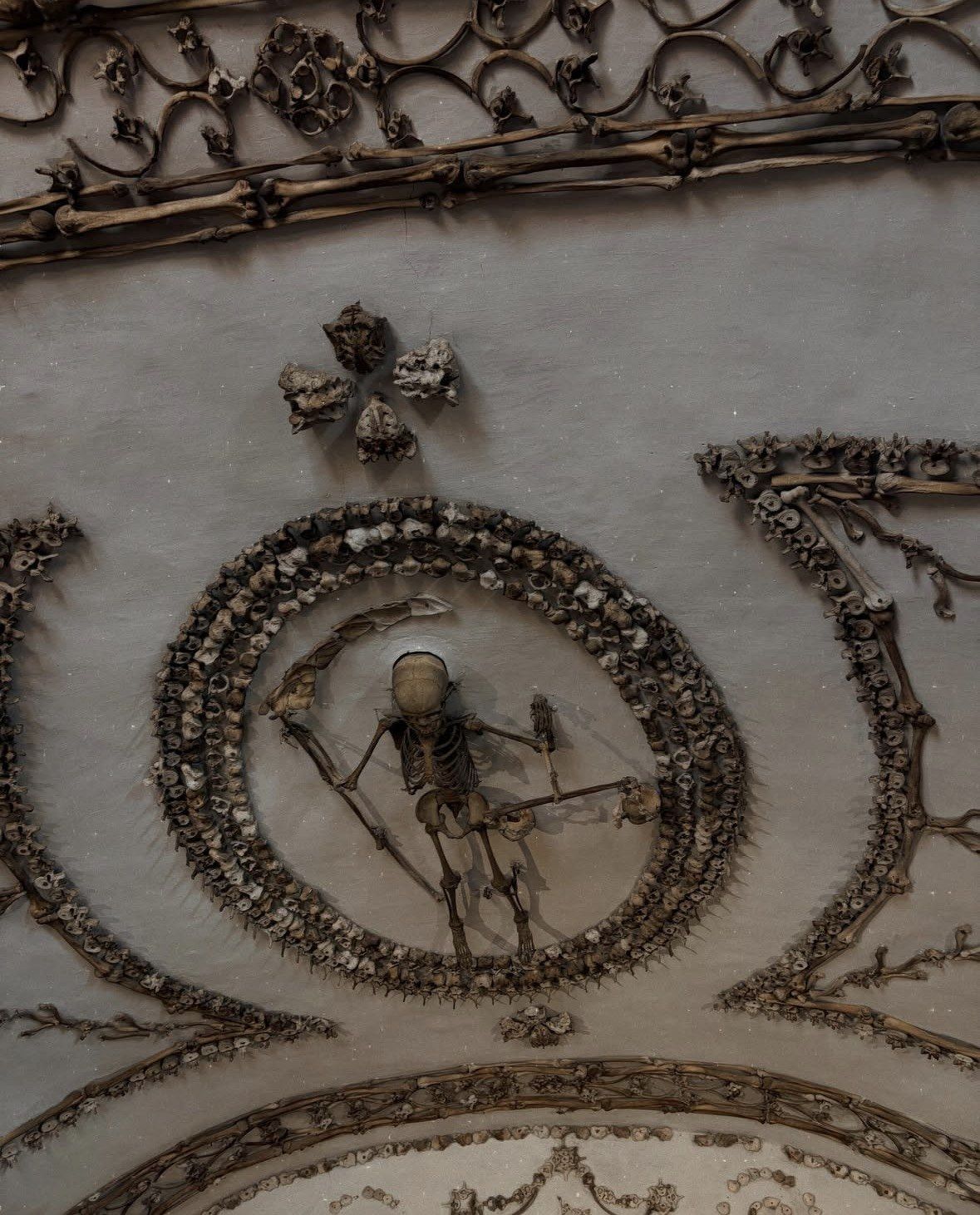
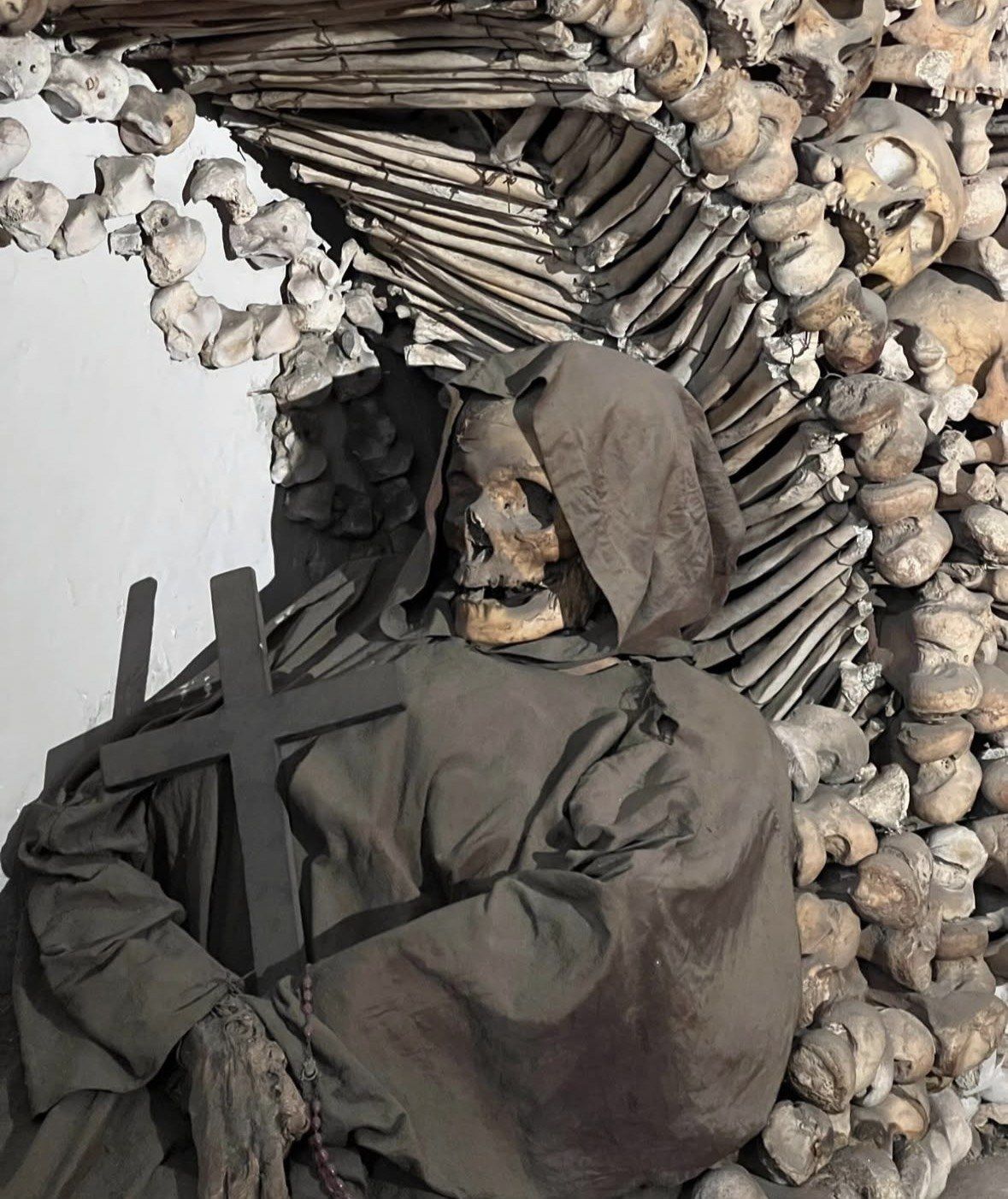
The Capuchin Crypt is not a catacomb, though it keeps turning up on the same lists. Under Santa Maria della Concezione on Via Vittorio Veneto, it is an ossuary of friars who lived between 1500 and 1800, their bones set as rosettes, stars, hourglasses and chandeliers through six chapels, with a St Francis attributed to Caravaggio in room five. It is central, at street level behind three low steps, and several accompanied outings pair it with a real catacomb in the same afternoon.
Choosing a site and an accompanied visit
Nobody walks a catacomb alone. Access is always with a guide from the site, in fixed departures, so the two decisions left to you are which of the seven to visit and how you get there and back. San Callisto is the default: the largest of the Appia complexes, with the Crypt of the Popes and then the Crypt of St Cecilia, where a copy of Maderno's statue of 1599 stands. Go to San Sebastiano if you are arriving in the middle of the day, since it is the one Appia site that runs straight through without a lunch break, and for the pilgrim graffiti. Domitilla is the one to pick if you need German, Spanish, French, Polish or Portuguese, since it publishes the widest language range. Priscilla gives you frescoes, two quiet levels and the image of the Virgin dated to about 230 to 240.
Formats differ in the surface programme they wrap around the same guided visit. On foot is the leanest if you can reach the Appia yourself; a coach transfer makes sense when you want a bone crypt in the same outing; bike and e-bike days turn the aqueducts and the Roman paving into the main event; a private vehicle with hotel pick-up suits small children or a tight schedule; the evening option is the only one that goes into Sant'Agnese after hours. The road itself sets a condition the gallery timetables do not: on public holidays private vehicles are kept off the Via Appia Antica altogether, while the opening stretch beyond the Maxentius complex goes free of ordinary traffic every Sunday as well as on those holidays, so a Sunday works better arriving by bike or on a booked transfer.
- San Callisto: four levels, the Crypt of the Popes, the Crypt of St Cecilia, the Trichorae at the entrance
- San Sebastiano: continuous daily opening, the triclia and the Memoria Apostolorum
- Domitilla: the semi-underground basilica, the Flavian Hypogeum, the widest range of visit languages
- Priscilla: Via Salaria, frescoes, the coolest air of the main sites
- Sant'Agnese: Via Nomentana, the shortest route, and the one site visited in the evening
- Location and transport: metro and bus lines to the Appia, driving and the parking in front of San Callisto
- Opening days and seasons: a different closing day at each site, plus winter and August closures
- What to expect underground: flights of irregular steps, no lift, cold damp air and a photography ban inside
- The Appian Way above ground: the basolato from the Ardeatina junction, Domine Quo Vadis, the Maxentius complex, Cecilia Metella
- Parco degli Acquedotti: about 240 hectares with six of Rome's eleven aqueducts, including the Aqua Claudia
Questions people ask
How deep do the catacombs of Rome go?
It varies by site. San Callisto reaches more than 20 metres below the surface on its fourth level, San Sebastiano goes down to about 18 metres, and the gallery where St Agnes was buried lies only around six metres under the modern road on Via Nomentana. Visitor routes stay on the levels that have been made safe and lit.
How long does a visit underground last?
About 40 minutes at San Callisto, where departures leave every 30 minutes and the last morning one goes at 12:00. San Sebastiano runs roughly 40 to 45 minutes, Priscilla about 45 minutes with each group capped at 25 people, and Sant'Agnese is the shortest at 30 minutes. Packaged half-day outings add transfers and a second stop on top of that.
Is it cold inside the catacombs?
Yes, all year. Rock several metres thick keeps the air steady: the readings published by the sites themselves give roughly 16 °C with high humidity in the galleries of San Callisto, and about 13 °C at Priscilla, which is colder than anywhere else among the main open catacombs. Nothing changes with the season, so carry a jacket or a sweater even on an August afternoon.
Can everyone go down, or are there limits?
Getting into a catacomb means stairs in both directions: roughly 50 uneven steps down at San Callisto and the same count coming back, with no lift and no bench on the way, while the San Sebastiano route works out at around 70. Both state that wheelchairs cannot be taken in because of architectural barriers, and both advise against the visit for anyone with serious mobility problems or claustrophobia. Bulky bags, luggage, strollers and banners are refused at the entrance. The Capuchin Crypt, with three low steps, is the easier substitute.
Can you visit the Jewish catacombs of Rome?
Not on a normal day. Roma Capitale's tourism listing states that Vigna Randanini on Via Appia Antica opens only on special occasions, and that the Jewish catacombs of Villa Torlonia on Via Nomentana cannot be visited at all. Neither belongs to the seven Christian catacombs the Pontifical Commission lists as open to the public.
Read also