In shortThe Catacombs of San Callisto, entered from Via Appia Antica 110, cover roughly 90 acres with about 19 km of galleries on four levels reaching more than 20 metres deep, and hold an estimated half a million burials, dozens of martyrs and 16 popes. Visits are accompanied, last about 40 minutes, leave every 30 minutes within two sessions, 09:00 to 12:00 and 14:00 to 17:00, and the site closes on Wednesdays.
About 19 kmof galleries, four levels
16popes recorded here
500,000Christian burials, estimated
About 40 minutesunderground per group
Why the catacombs of San Callisto are the largest site on the Appia
Digging started here in the middle of the second century, and a hundred years later this was the burial ground the Church of Rome used officially. The figures are what set it apart from its neighbours on the same road: around 90 acres of land on the surface, about 12 miles of galleries below, which is roughly 19 km, laid out on four levels that reach more than 20 metres down. An estimated half a million Christians were buried in it, dozens of martyrs among them and 16 popes.
Ownership sits with the Administration of the Patrimony of the Apostolic See, and the monument is governed and conserved by the Pontifical Commission for Sacred Archaeology. The Salesians of Don Bosco have staffed the reception and led the visits here since 1930, and the people who take you down are the site's own guides. At no point do you walk the galleries by yourself.
Private visit with hotel pick-up
The Private Tour of Catacombs and Ancient Appian Way runs 2.5 hours from your hotel and back, with private air-conditioned transport, tickets, an English-speaking driver and a guided group visit underground, from €158, rated 4.4 ★ (128 reviews).
★ 4.4/5 · 128 reviews
The chamber where nine popes were buried
Before the stairs, the route passes two small three-apsed basilicas known as the Trichorae, standing near the entrance. Pope Zephyrinus and the young martyr Tarcisius may have been buried in them, which is the first of several points on this visit where the official account says "probably" rather than "certainly".
The Crypt of the Popes is the first stop below ground and the reason most groups come. It served as the official burial place of nine popes, together with what the site records as probably eight dignitaries of the third-century Roman Church, and the density of papal tombs in one small chamber is why it picked up the nickname of the little Vatican.
Five original Greek inscriptions survive on the walls, naming Pontianus, Antherus, Fabian, Lucius and Eutychian, cut in letters you can still follow by eye. Pope Sixtus II, killed in Valerian's persecution, lies in the front wall of the same room. Stand still for a moment when the guide stops talking: the chamber is small, the ceiling is low and the inscriptions are close enough to read without leaning in.
The Crypt of St Cecilia and the painted chambers
The Crypt of St Cecilia comes immediately after the popes, and the two rooms are usually described as one stop. Her relics were moved to the basilica of Santa Cecilia in Trastevere in 821, so what stands in the crypt today is a copy of Stefano Maderno's statue of 1599, the figure lying on its side with the head turned away. The venerated chamber stayed in use as a place of devotion after the body left it.
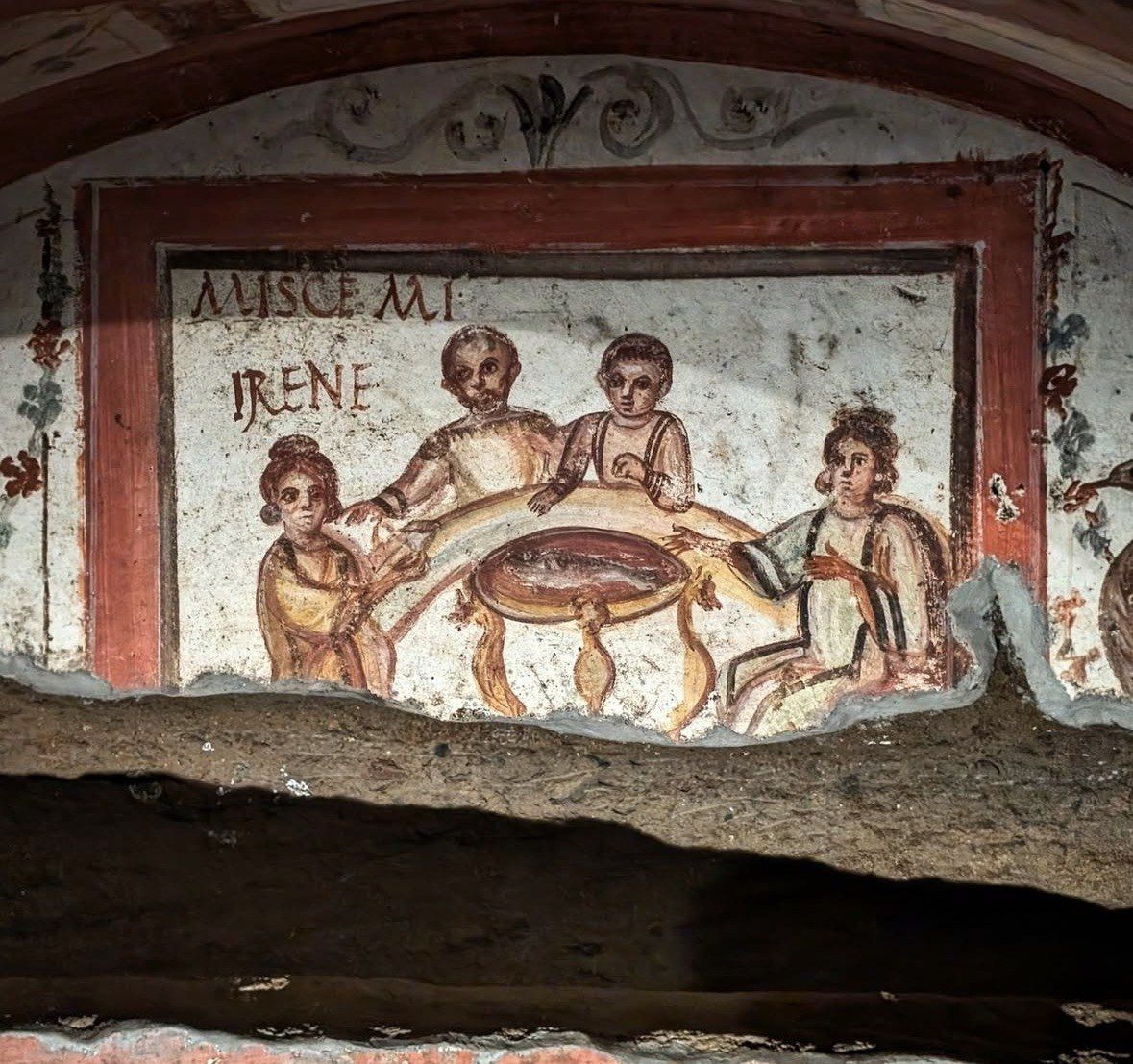
Further along, the galleries are lined with loculi, the long niches cut lengthwise into the walls and closed with marble slabs or bricks. Arcosolia and cubicula are the other tomb types you will have pointed out: the cubicula are the small rooms opening off the corridor, and several on this stretch keep their painted plaster. The chambers known as the sacramental chapels follow, and they are the part of the route where the painting rather than the structure holds the group.
The accompanied walk covers a short section of a complex that runs to four levels, and you stay on the level the guide takes you to. Expect a loop of galleries and chambers rather than a tour of the whole cemetery.
How long the visit lasts and when the groups leave
Groups set off every 30 minutes and each spends about 40 minutes underground. The last departure of the morning goes at 12:00, so turning up at a quarter past twelve means waiting for the 14:00 session, with the gate closed in between.
Take the 09:00 slot if your plans allow it. You are back at the gate well before ten, which leaves the surface monuments of the Appia for the rest of the day, and the morning session is the half of the timetable that gives you the choice of walking on to the next catacomb instead of killing two hours. The 14:00 start is the sensible fallback and works well in high summer, when 16 °C underground is a relief.
Hours, closures and the rules at the gate
You go in from Via Appia Antica 110, 00179 Rome. The open day is split into two sessions, 09:00 to 12:00 and 14:00 to 17:00, with a two-hour break in the middle. Wednesday is the weekly closing day, and that one line is behind more wasted journeys out to the Appia than anything else on the official pages.
Maintenance takes the whole complex out of service for four weeks, from 13 January to 10 February 2027, according to the hours page the site publishes itself. Add 1 January, Easter Day on 28 March 2027 and 25 December to the list of dates when nobody goes down these stairs. Worth looking at that page again a few days before you travel.
Reservation in advance is required according to the official site, so arrive with a place already held rather than hoping for a gap. The descent is about 50 irregular steps, with the same number to climb on the way back, and there is no lift. Underground the air holds at around 16 °C with high humidity throughout the year, so bring a layer in August as readily as in February. Wheelchairs cannot be taken in, because of the monument's architectural barriers.
Photography and video are not allowed inside, and staff may remove anyone who ignores the rule. Bulky items are refused at the entrance, including luggage, strollers, musical instruments and banners. Once you are below, you stay with your group for the whole 40 minutes; independent wandering is not permitted anywhere in the galleries.
| Point | What the official site publishes |
|---|
| Entrance | Via Appia Antica 110, 00179 Rome |
|---|
| Sessions | 09:00 to 12:00 and 14:00 to 17:00, closed between |
|---|
| Weekly closing day | Wednesday |
|---|
| Annual and feast closures | 13 January to 10 February 2027; 1 January; Easter 28 March 2027; 25 December |
|---|
| Departures | Every 30 minutes, last morning group at 12:00 |
|---|
| Visit length | About 40 minutes |
|---|
| Steps | About 50 irregular steps down and 50 back up, with no lift |
|---|
| Temperature | Around 16 °C with high humidity |
|---|
| Wheelchairs | Not permitted because of architectural barriers |
|---|
| Inside the galleries | No photography or video, no bulky items, stay with the group |
|---|
| Reservation | Required in advance |
|---|
Book the accompanied visit, alone or with a second catacomb
There is no version of this visit where you go down on your own, so the real decisions are how you reach the gate and whether you add a second stop. For a first time in the Roman catacombs, San Callisto on its own is plenty. The scale, the Crypt of the Popes and the painted chambers are what people come out here for, and forty minutes standing in damp air at 16 °C is as long as most visitors want underground.
If you do want two sites in a day, the midday break sets the order. San Sebastiano, further along the same road, takes visitors straight through the middle of the day, Tuesday to Sunday from 09:15 to 17:15 with last admission at 16:45, so a morning here and a walk down the Appia fills the hours when the Salesians' gate is shut. Domitilla runs the same two sessions as San Callisto, which drops a two-hour hole into the middle of your plan.
Keep in mind that going underground here settles nothing above ground. The Mausoleum of Cecilia Metella and the other Archaeological Park sites are ticketed separately, run Tuesday to Sunday on seasonal hours and close on Mondays, with last entry 30 minutes before the gates.
Questions people ask
How do I reach the entrance without a car?
One metro leg and one bus does it: line B to Colosseo or Circo Massimo, then bus 118 in the Appia and Villa dei Quintili direction, getting off at the stop named Catacombe di San Callisto. The fallback from line A is San Giovanni and bus 218 towards Ardeatina as far as Fosse Ardeatine. There is bus 714 as well, though it stops at Navigatori and leaves you about a kilometre to cover on foot along Via delle Sette Chiese before you reach this gate.
Can a solo traveller go down?
A visit needs a minimum of two people accompanied by staff, according to the official hours page. Travelling as a pair or more avoids the problem, and so does joining an organised group that arrives with its own numbers. If you are on your own and your date is tight, build in the possibility of taking a later departure.
Which language will the visit be in?
Languages are not published on the site's hours and tickets pages, so the honest answer is that you cannot plan this from the official information. If a specific language matters, Domitilla a few minutes further along the same road publishes Italian, English, German, Spanish and French, with Polish and Portuguese on request. For San Callisto, ask when you reserve.
What should I wear for the galleries?
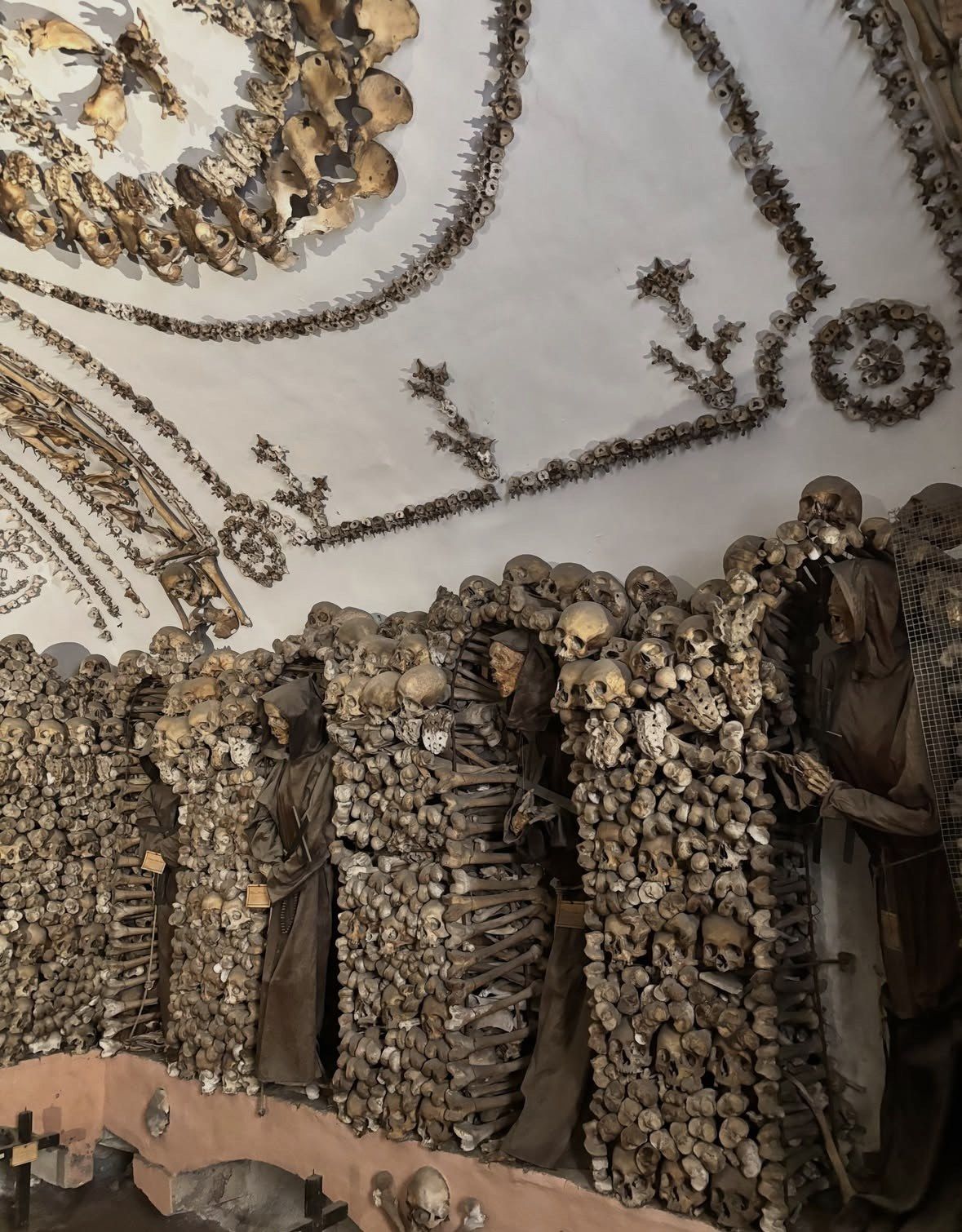
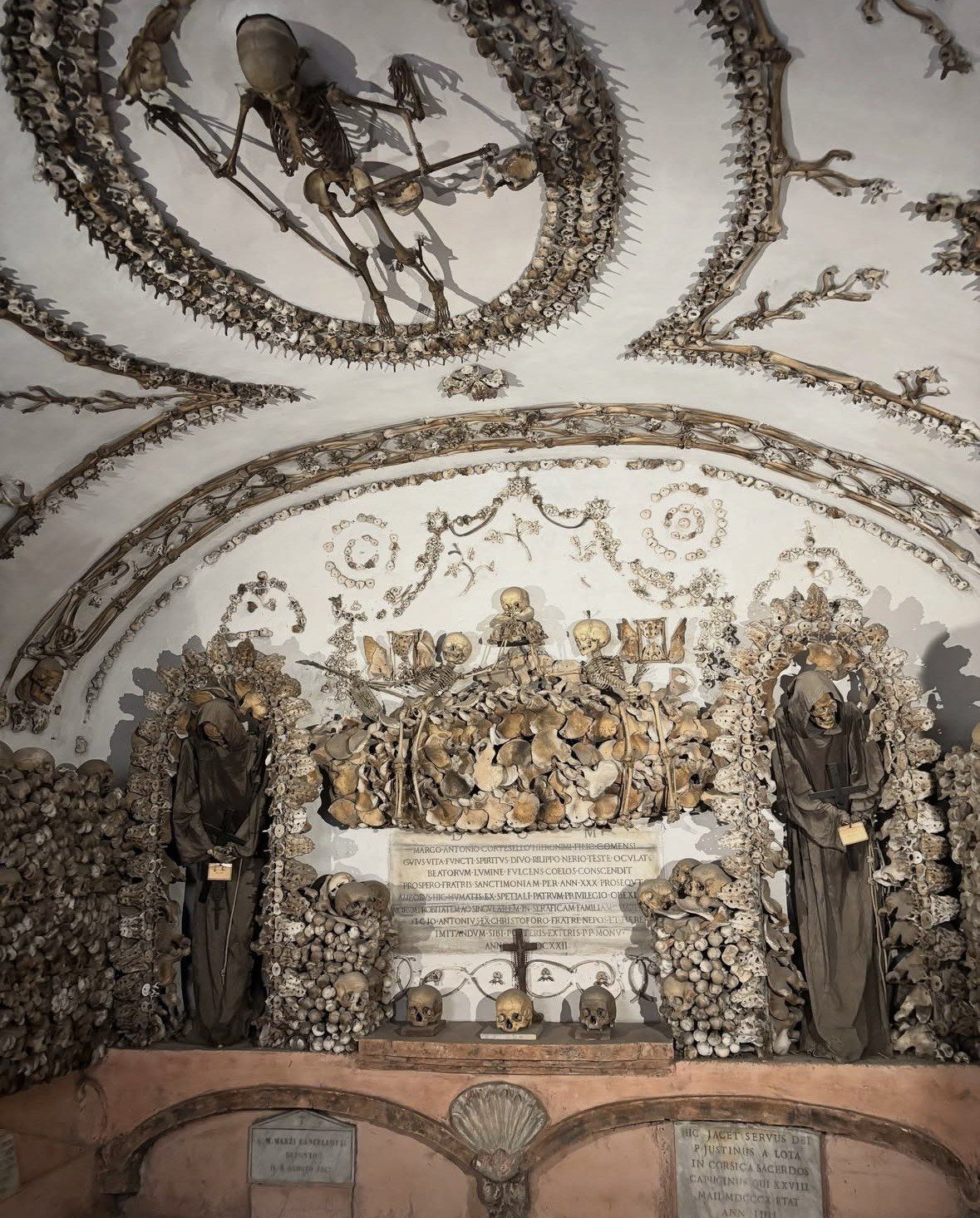
Clothing suited to a cold, damp environment is what the regulations ask for, and they set no formal shoulders-and-knees requirement, unlike the Capuchin Crypt in the centre. A light jacket plus shoes you can take 50 irregular steps in covers it. There is nowhere to sit on the route, so count on standing for the full 40 minutes.
Is San Callisto the only catacomb open on this road?
Seven Roman catacombs appear on the Pontifical Commission for Sacred Archaeology's list of sites open to the public: San Pancrazio, Priscilla, San Sebastiano, Domitilla, Sant'Agnese, San Callisto and Santi Marcellino e Pietro. San Callisto shares the Appia Antica with two of them, San Sebastiano and Domitilla, and those three are the ones you can string together on a single trip out here. The others are scattered across the city, Priscilla on Via Salaria to the north and Sant'Agnese on Via Nomentana among them.
Read also