Catacombs of Rome Tours: Underground Visits on the Appia
Nine tours, from a two-hour walk at Domitilla to a six-hour ride along the Appian Way and a night visit to Sant'Agnese. This page sets out which catacomb each one enters, how the days and hours work, and how physical the descent is.
Nine guided options are listed on this site, from a two-hour walk at Domitilla to e-bike rides along the Appian Way and evening visits with a chauffeur.
Seven catacombs in the city are open to the public, and they are not in one place. Three of them sit on the Via Appia Antica strip, the rest are scattered north, east and across the river.
Rome's seven publicly open catacombs are the ones listed by the Pontifical Commission for Sacred Archaeology: San Pancrazio, Priscilla, San Sebastiano, Domitilla, Sant'Agnese, San Callisto and Santi Marcellino e Pietro. Only San Callisto, San Sebastiano and Domitilla stand on the Appia Antica strip, within walking distance of each other. Priscilla is on Via Salaria, north of the centre. Sant'Agnese is on Via Nomentana, San Pancrazio on the Janiculum, Santi Marcellino e Pietro out on Via Casilina. The Jewish catacombs of Vigna Randanini at Via Appia Antica 119 open only on special occasions, and those of Villa Torlonia cannot be visited.
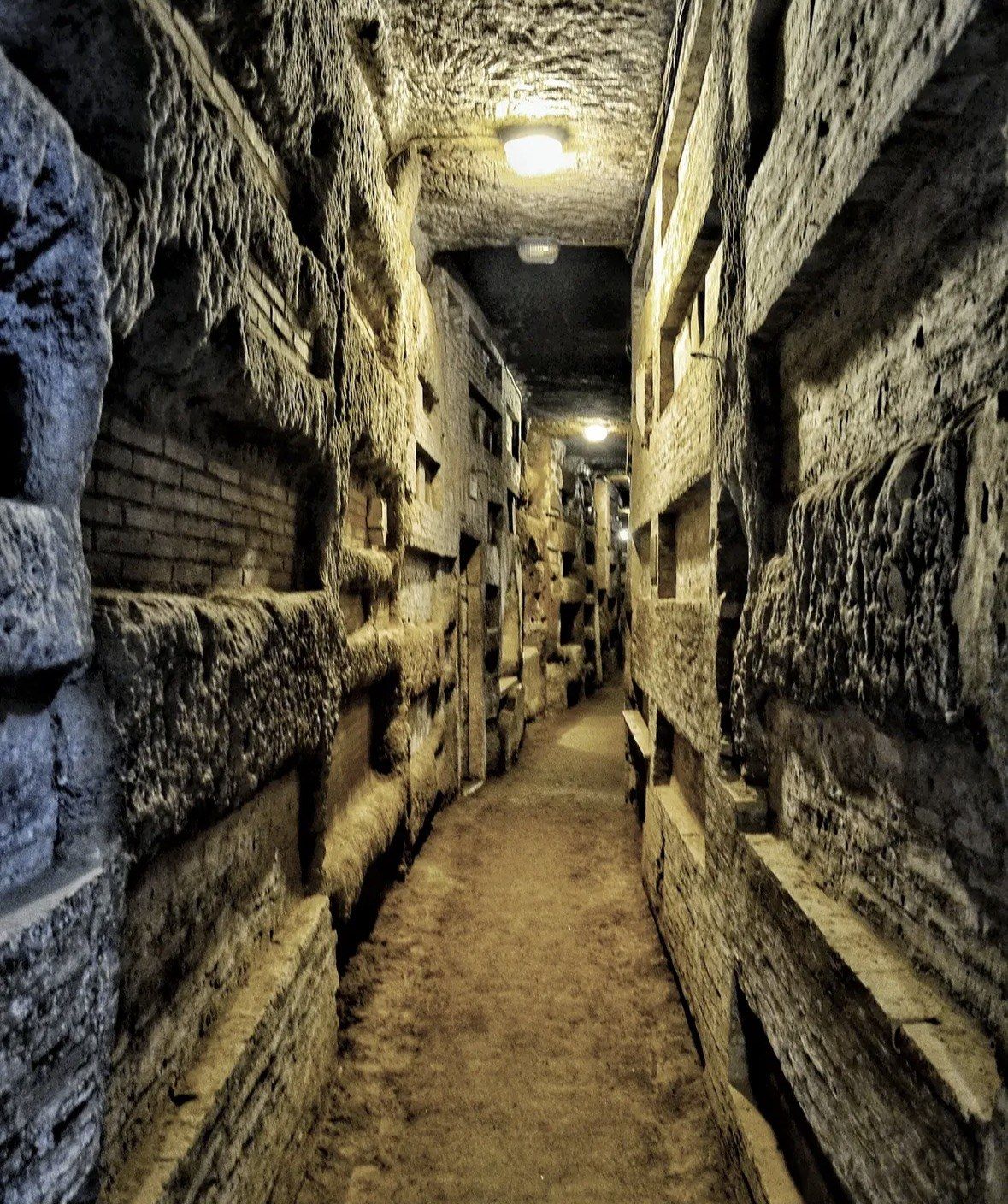
Work at San Callisto began in the middle of the second century, and by the third it was the official cemetery of the Church of Rome, with an estimated half a million burials, dozens of martyrs and 16 popes. Nine popes were laid in the Crypt of the Popes, nicknamed the little Vatican, where Greek inscriptions of Pontianus, Antherus, Fabian, Lucius and Eutychian are still on the walls. Domitilla dates from 120 AD. San Sebastiano grew around a pozzolana quarry called 'ad catacumbas', which is how the word reached every other language, and Priscilla holds an image of the Virgin dated to about 230 to 240.
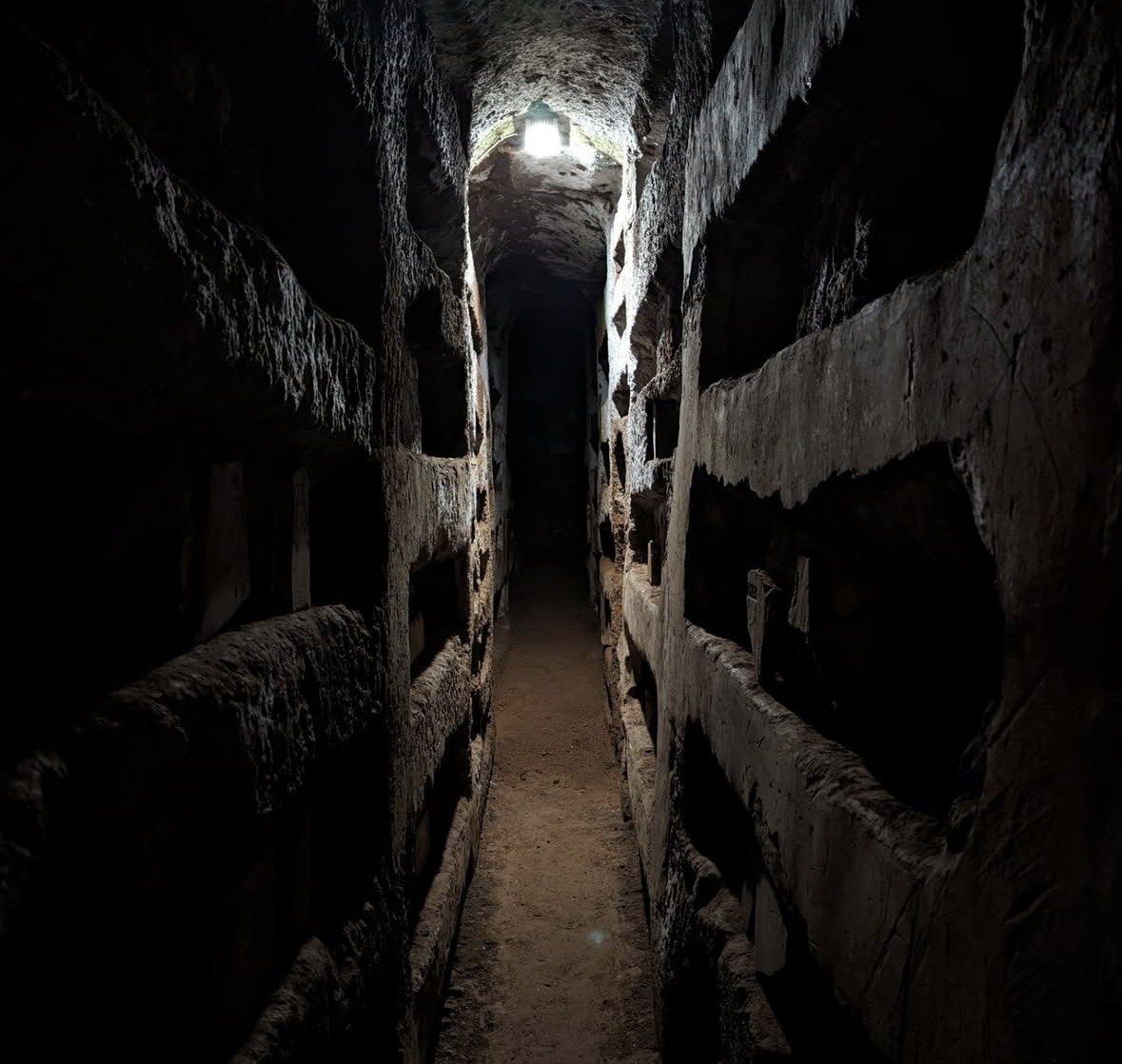
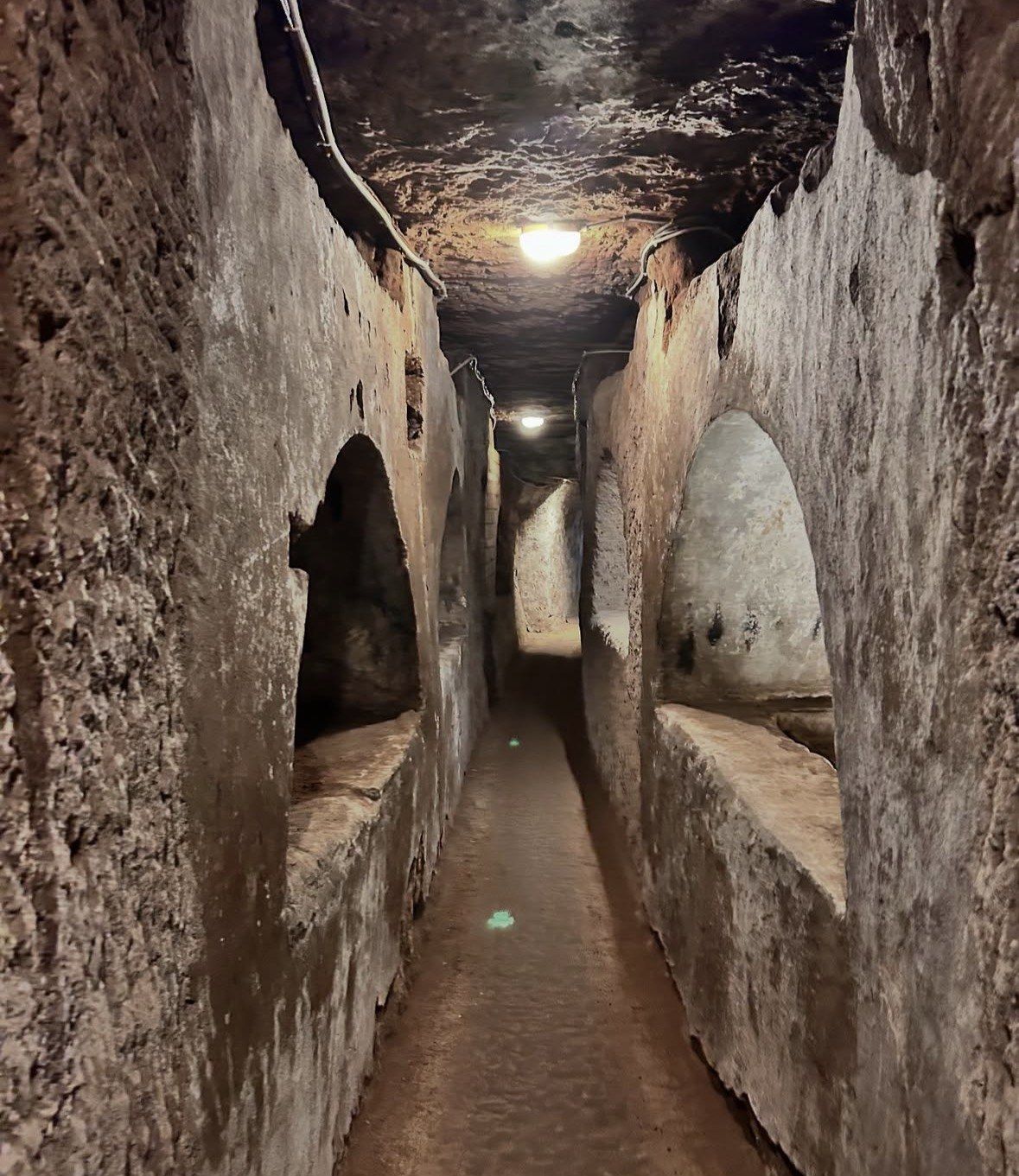
Staff of the site accompany every visit, so the route is fixed and the pace is set for you. At San Callisto groups leave every 30 minutes and walk for about 40 minutes; San Sebastiano runs about 40 to 45 minutes, with the last English tour at 16:45; Priscilla lasts about 45 minutes and is capped at 25 people; Sant'Agnese is the shortest at 30 minutes. You see loculi cut lengthwise into the walls, arcosolia and cubicula. Photography and video are banned inside San Callisto and San Sebastiano, and San Callisto staff may remove anyone who ignores that.
sites
Catacombs open to the publicSeven
galleries
San Callisto galleriesAbout 19 km on four levels
depth
San Callisto depthMore than 20 metres
temperature
Underground temperatureAround 16 C; about 13 C at Priscilla
duration
Guided visit lengthAbout 40 to 45 minutes
steps
Steps at San SebastianoAbout 70 down and the same back up
crypt
16 popes
San Callisto and the Crypt of the Popes
Nine popes and probably eight dignitaries of the third-century Roman Church were buried in one small chamber, which earned it the nickname of the little Vatican. Pope Sixtus II, killed under Valerian, lies in the front wall. The Crypt of St Cecilia follows, holding a copy of Stefano Maderno's statue of 1599.
graffiti
12 km
Where the word catacomb comes from
About 12 km of galleries on three levels, down to 18 metres, run under San Sebastiano, which took its name from the pozzolana quarry known as 'ad catacumbas'. The route keeps the triclia, a covered hall with benches, and the Memoria Apostolorum, scratched with pilgrim invocations including 'Paule et Petre petite pro Victore'.
basilica
120 AD
Domitilla and its semi-underground basilica
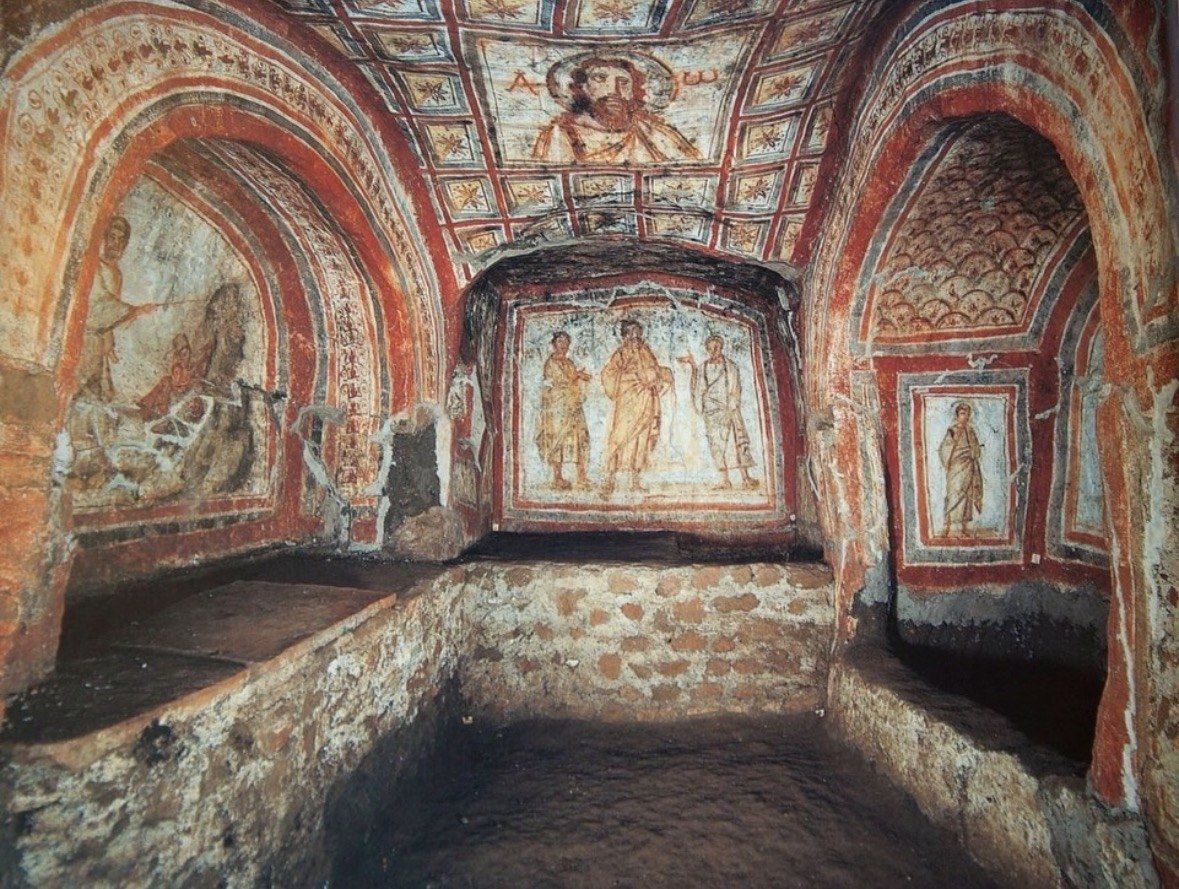
Domitilla is the only site in Rome built around a semi-underground three-nave basilica, dedicated to the soldier-martyrs Nereus and Achilleus and to St Petronilla. The complex runs 17 km of tunnels on four levels. The standard route takes in the Flavian Hypogeum, the cubicle of Veneranda, the arcosolium of the Little Apostles and the cubicle of the gravedigger Diogenes.
fresco
230 to 240
The earliest known image of the Virgin
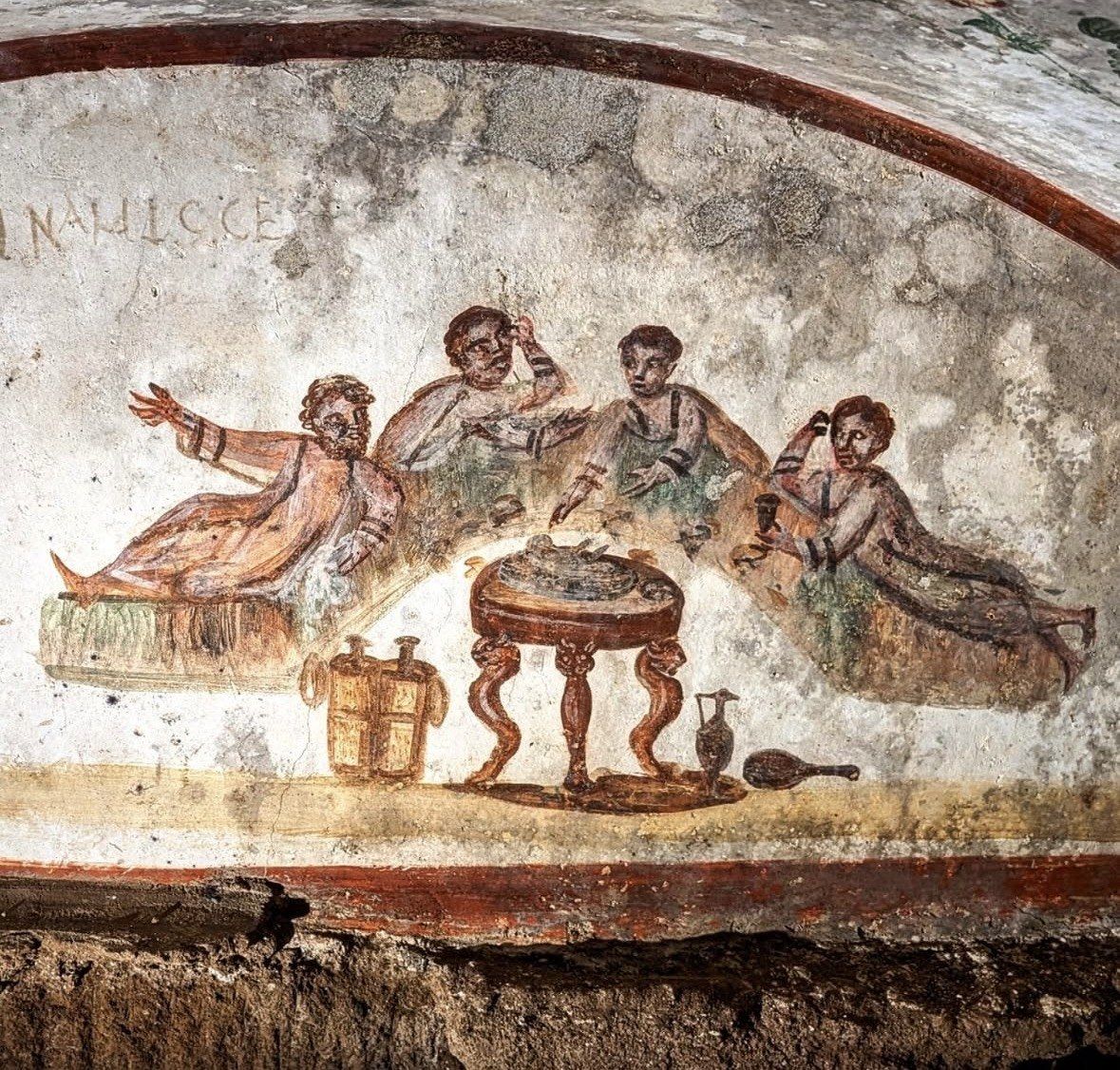
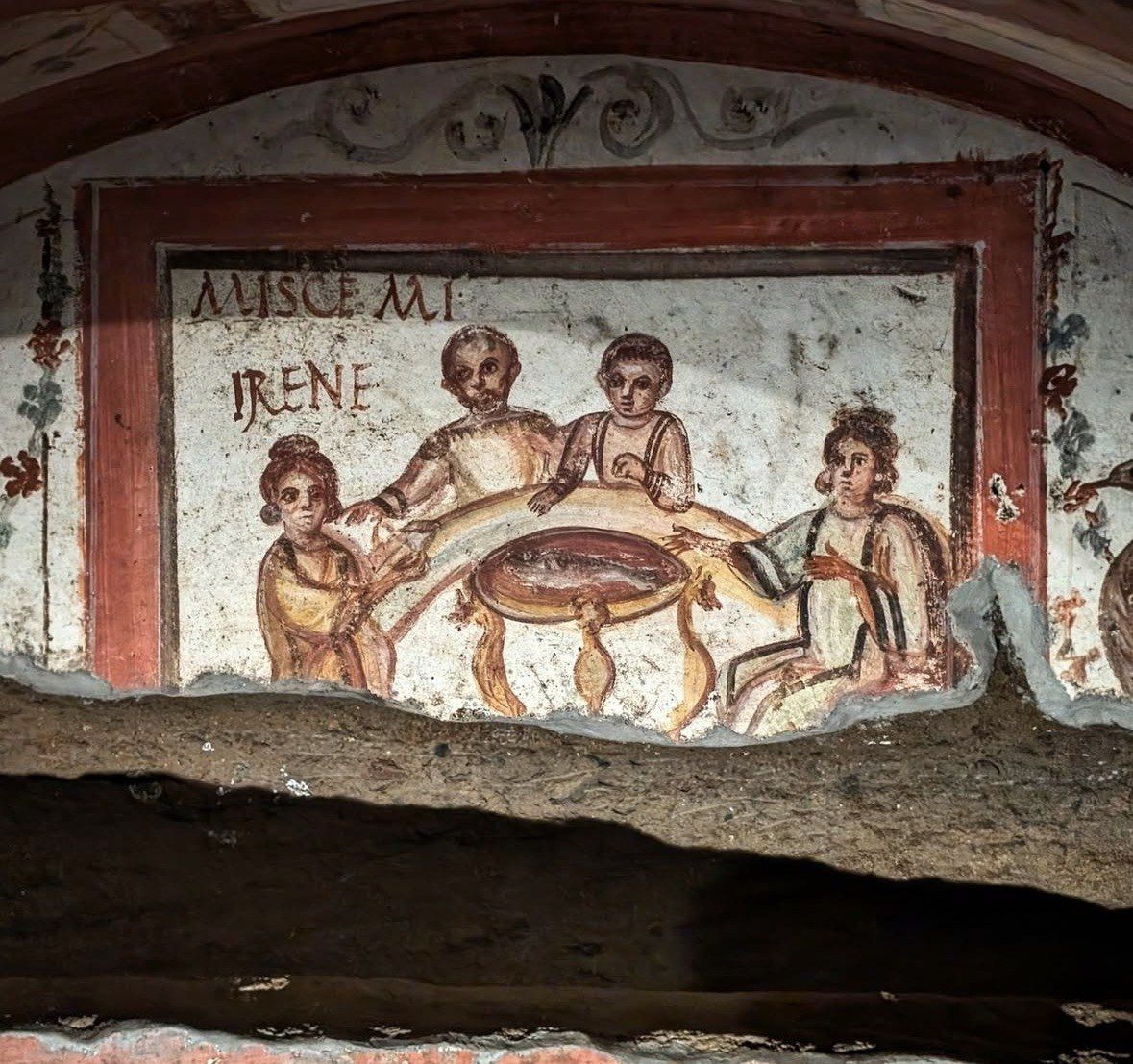
Priscilla, on Via Salaria, has over 13 km of galleries on two levels and holds seven popes, among them Sylvester, elected in 314. The route points out the Cubicolo della Velata, the cryptoporticus and the Greek Chapel with its Susanna, Adoration of the Magi and Fractio panis panels. Visits are capped at 25 people.
bones
almost 4,000
The Capuchin Crypt is not a catacomb
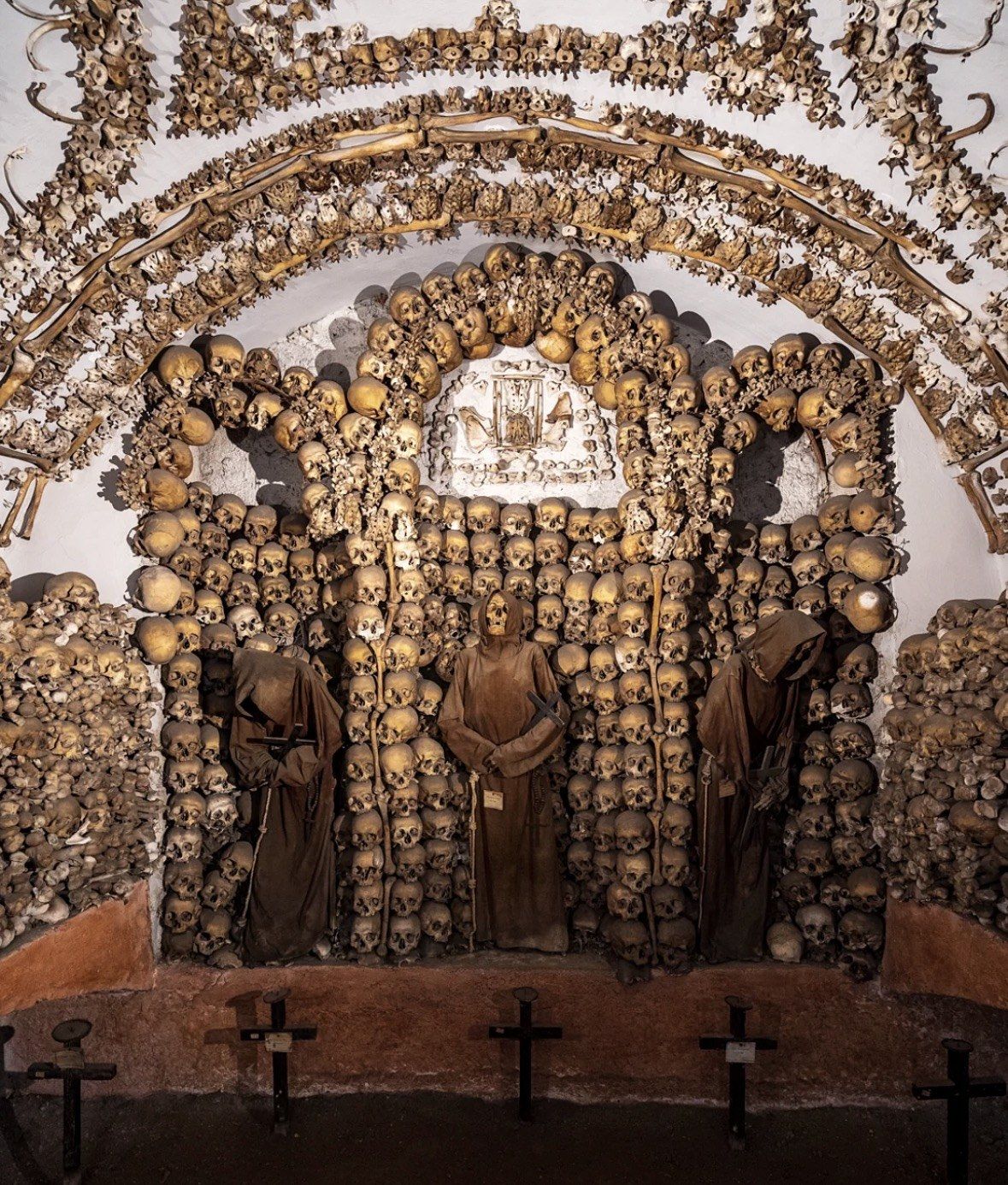
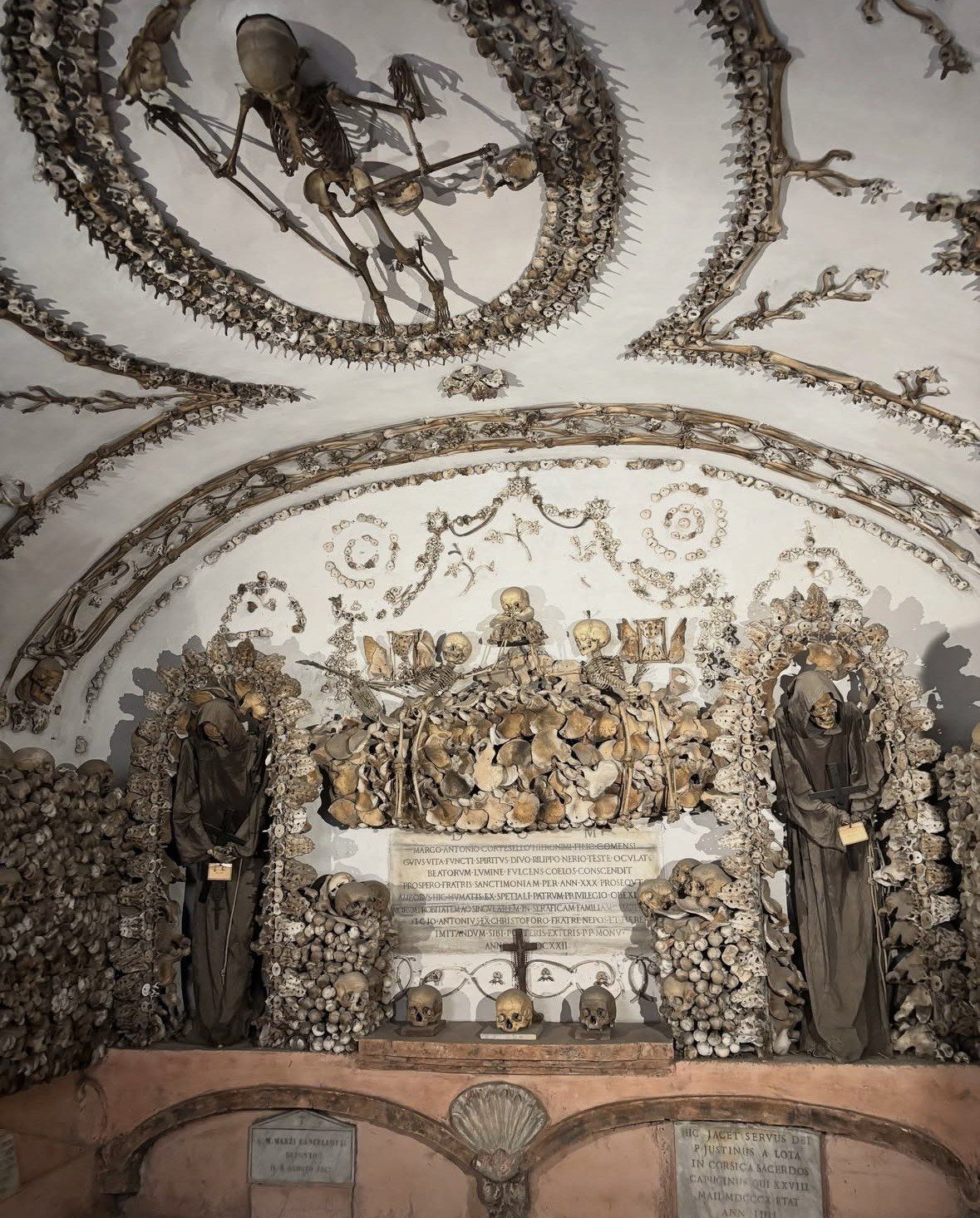
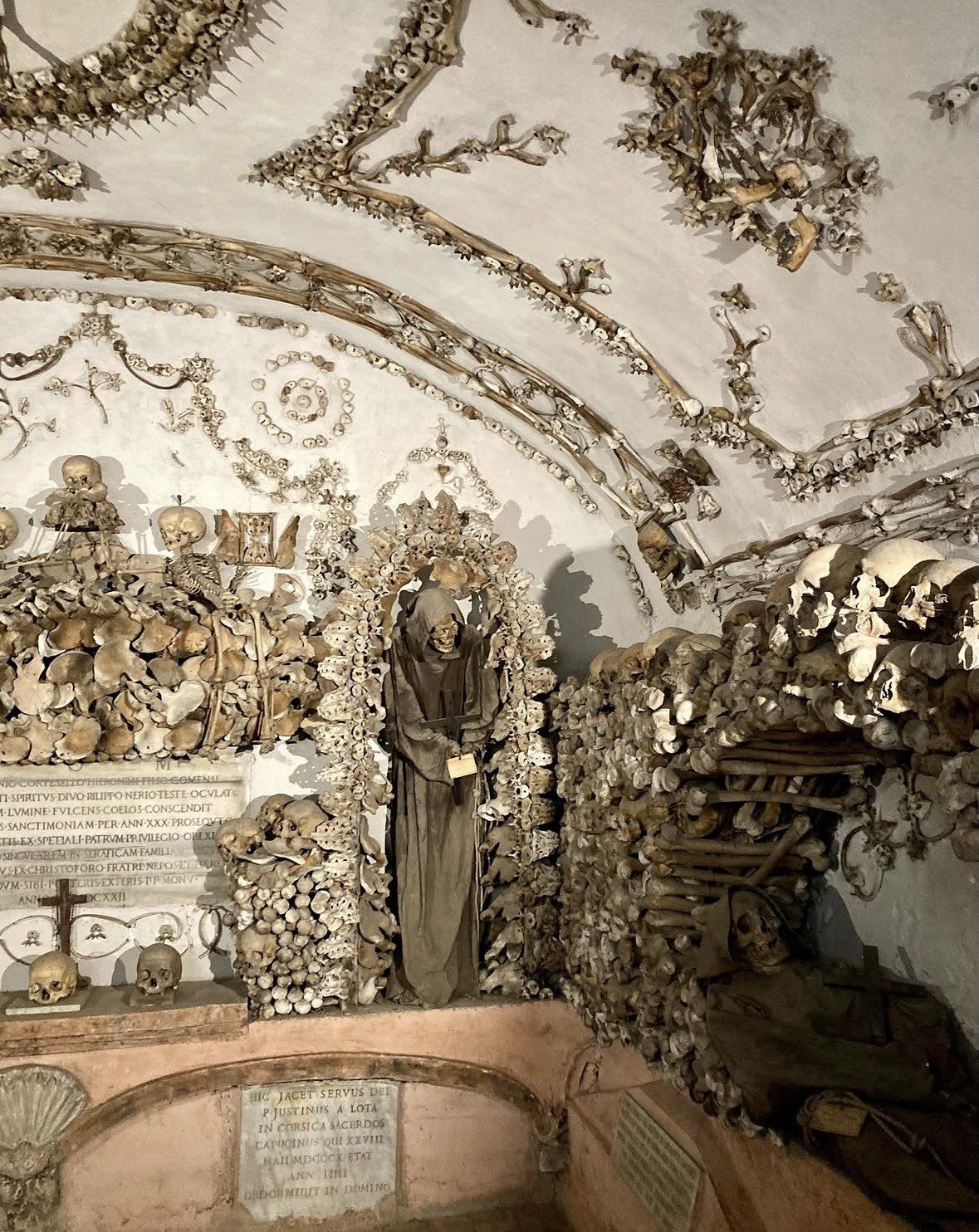
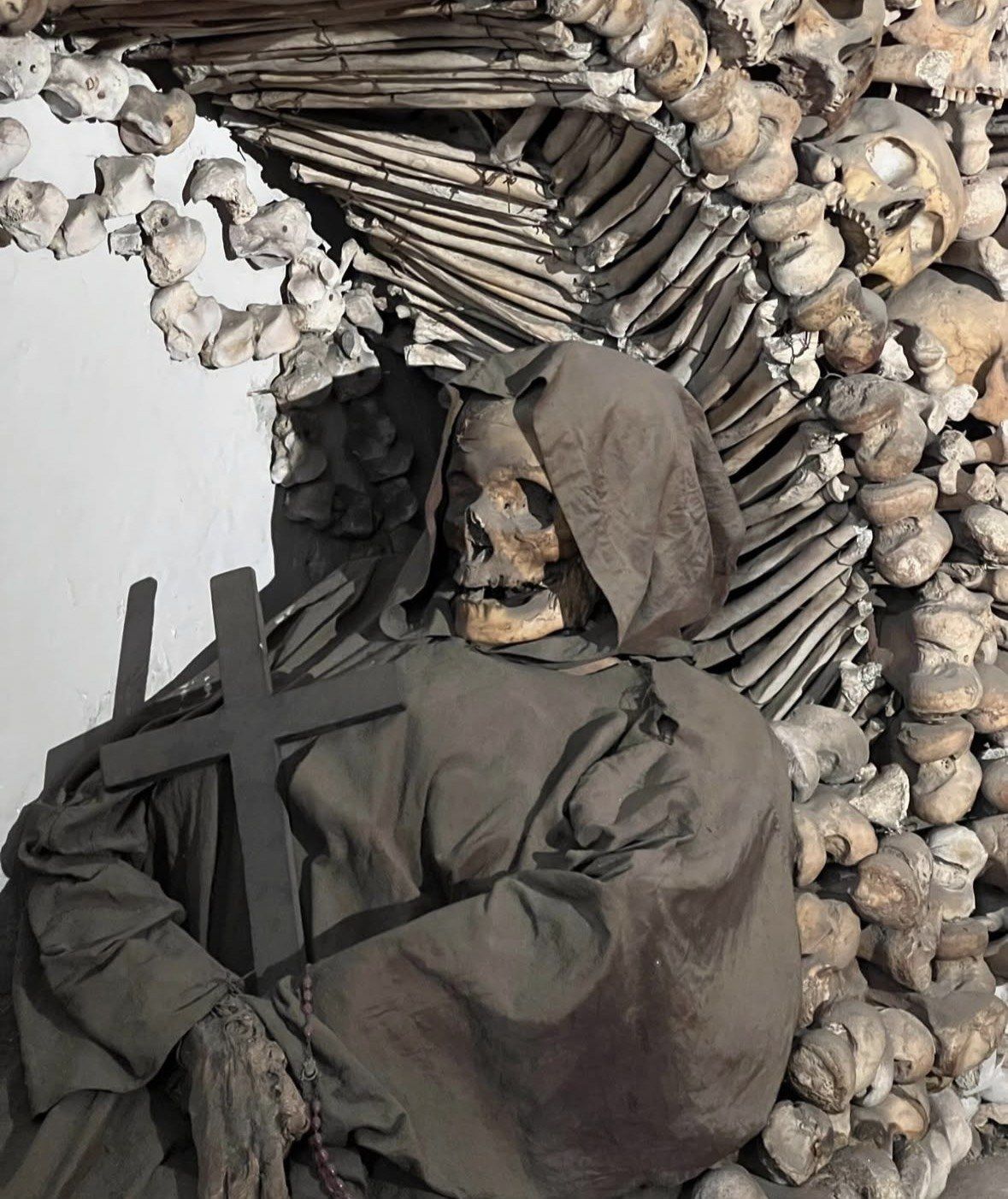
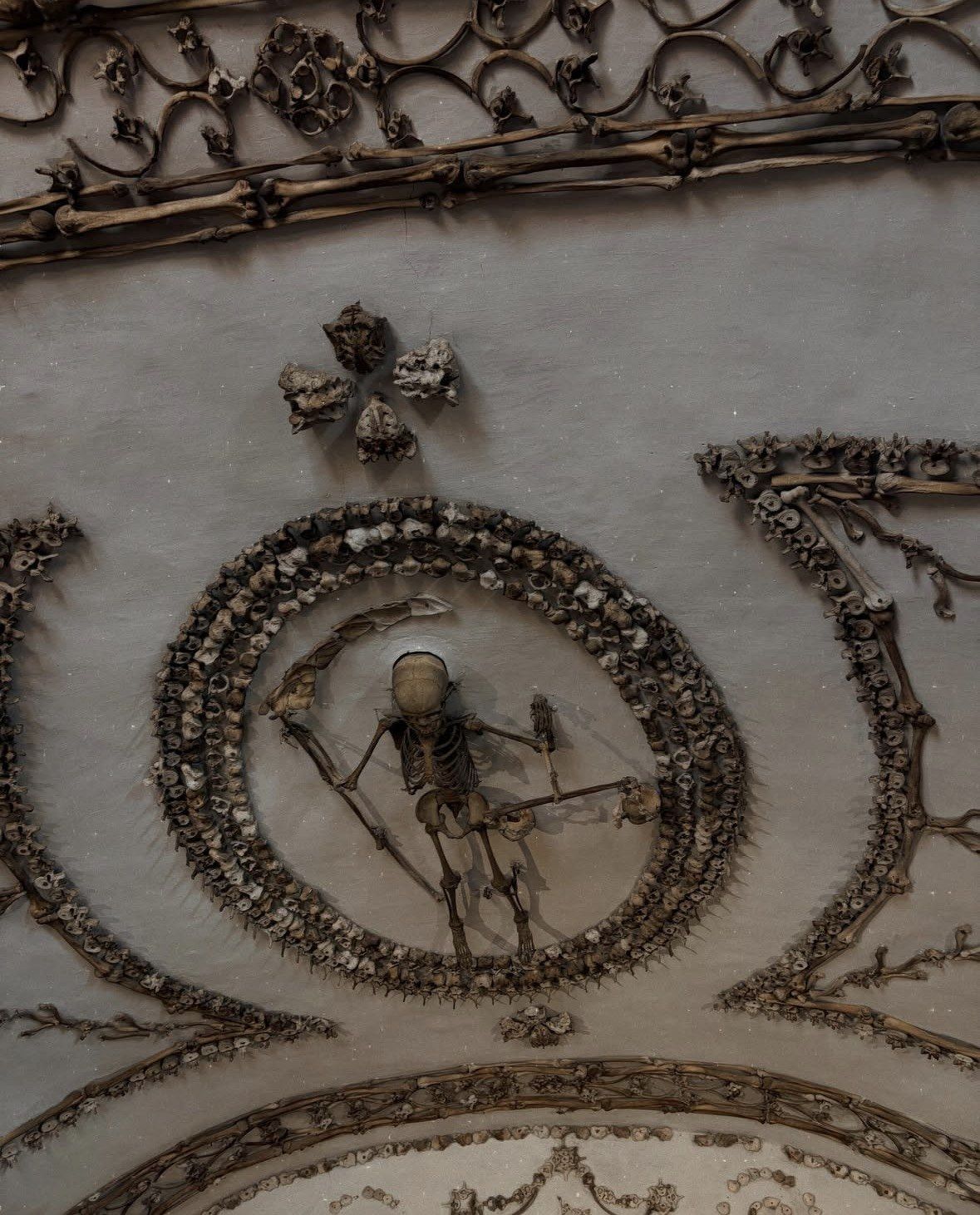
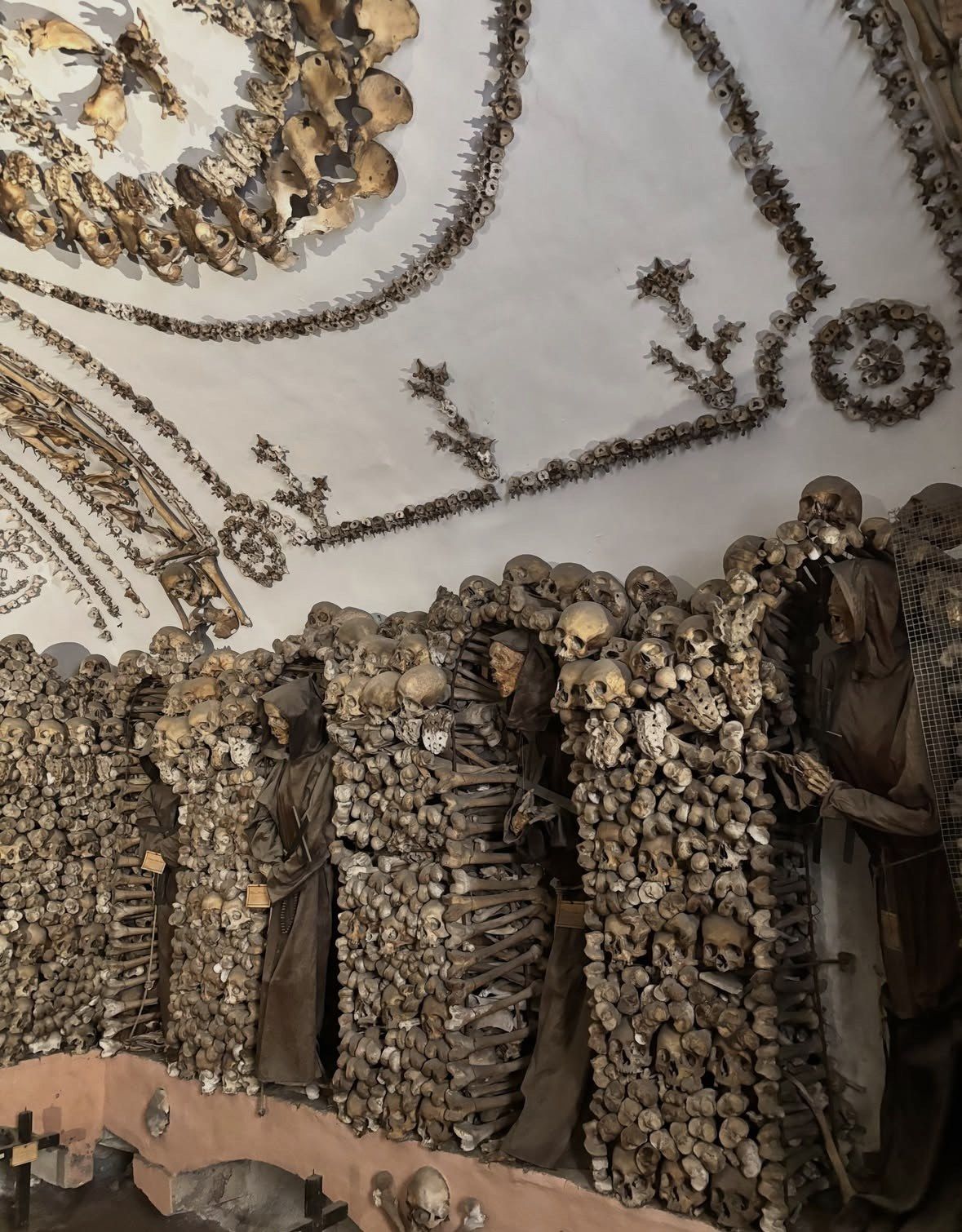
Under Santa Maria della Concezione at Via Vittorio Veneto 27 lie the remains of almost 4,000 friars who lived between 1500 and 1800, arranged as rosettes, stars, hourglasses, clocks and chandeliers. The sequence runs from the Crypt of the Three Skeletons to the Crypt of the Resurrection. It opens every day, 09:30 to 13:30 and 14:30 to 18:30, last entries 12:30 and 17:30.
access
about 50 steps
What the descent at San Callisto involves
According to the official site there are about 50 irregular steps down and the same number back up, with no lift and nowhere to sit. Wheelchairs cannot be taken in because of the monument's architectural barriers, and the visit is not recommended for people with serious mobility problems or claustrophobia. Strollers, luggage, musical instruments and banners are refused.
walking
Walking visit at Domitilla, 2 hours
Shortest and simplest of the nine, from €48, rated 5.0 (529 reviews), with skip-the-line entry tickets. You make your own way out to the Appia and meet at the picnic tables in the garden, past the bus parking lot for San Domitilla.
ebike
Appian Way and aqueducts by e-bike, 4-5 hours
A high-quality e-bike, helmet, phone and handlebar holders and a child seat up to 25 kg come with this one, from €69, rated 4.8 (1176 reviews). The guided catacombs visit and the lunch or afternoon aperitif are in the five-hour version only. Meeting point is Roma STARBIKE next to the Carrefour supermarket, a step from Colosseo metro on line B.
coach
Crypts and catacombs with transfers, 3.5 hours
Most reviewed option here, from €49, rated 4.6 (5439 reviews). A private air-conditioned coach, an English-speaking guide, catacombs entry and the Capuchin Crypt and Museum, plus the Basilica of San Martino ai Monti except on the after-hours version. Meets in Piazza Barberini at the Tritone fountain.
landscape
Catacombs, aqueducts and Appian Way, 3.5 hours
Groups of 18 people or fewer travel by private air-conditioned transport, from €55, rated 4.8 (1691 reviews). Entry is to San Sebastiano or Domitilla depending on the day, with the Roman aqueducts, a walking stretch of the Appia and the exterior of the Mausoleum of Cecilia Metella. The guide waits in front of Piramide metro station with a yellow sign.
night
After-hours visit to Sant'Agnese, 2 hours 45 minutes
Only evening option on this site, and the only one that goes to Sant'Agnese, from €209, rated 4.9 (133 reviews), with the Basilica of St Agnes, the Mausoleum of Costanza and a night visit to Santa Maria Maggiore. Group of maximum 6 guaranteed, chauffeured, with a private option. Meets in Piazza Repubblica in front of the Anantara Palazzo Naiadi Hotel.
modular
Modular visit with transfer, 2-5 hours
A local guide, a skip-the-line catacombs ticket according to the catacombs calendar and a return transfer from the Touristation Aracoeli office, from €45, rated 4.5 (954 reviews). The Capuchin Crypt ticket, the Trevi district underground walk and the one-hour golf cart round are optional, and the transfers to the Capuchin Crypt and the Trevi tour are not part of the package. Report to Piazza Ara Coeli 16, where there are signs and orange flags outside.
How the Appia catacombs line up against the Capuchin Crypt, Priscilla and the monuments above ground.
Travellers planning a half day underground usually weigh three or four things at once: how deep they want to go, how many steps their knees will take, and whether they want frescoes, bone decoration or Roman road. The Catacombs of Rome on the Appia answer the first question, the Capuchin Crypt answers the second, Priscilla the third and the state park sites the fourth. The table sets each one against the others so the choice is made before you are standing at a gate.
Crowds
Price
Best For
What Sets It Apart
★ Catacombs of Rome
Fixed guided departures, every 30 minutes at San Callisto
Tours on this site from €45
Popes, martyr crypts and early Christian galleries
About 19 km of galleries on four levels, more than 20 metres down at San Callisto
Capuchin Crypt, Via Veneto
Guided groups capped at ten, earpieces compulsory
Bundled into three tours listed here, from €45
Anyone avoiding stairs: three low steps, lift to the museum
Remains of almost 4,000 friars set as rosettes, stars, hourglasses and chandeliers
Catacombs of Priscilla, Via Salaria
Visits capped at 25 people, booking required for everyone
Not on the route of the tours listed here
Frescoes, and the coolest interior at about 13 C
Over 13 km on two levels, seven popes and an image of the Virgin dated about 230 to 240
Appia park sites above ground
Open-air monuments you walk round at your own pace
Entry runs on the separate state park ticket for the Appia
Daylight walking on the Roman basolato
Cecilia Metella, built between 30 and 10 BC, with its ox-skull frieze and the 14th-century Castrum Caetani
Of these four, only the Catacombs of Rome put you on four levels of third-century burial galleries with the Crypt of the Popes at the centre. The Capuchin Crypt is easier on the legs and visually stranger, Priscilla is quieter and richer in frescoes, and the park monuments are above ground in daylight. Pair one catacomb with the Capuchin Crypt if you want both kinds of underground in a single half day.
Practical info
Rome catacombs tour: everything you need to know
Getting out there, the days to avoid, what to carry and how the visits are run.
How to Reach the Appia Catacombs
Metro B to Colosseo or Circo Massimo, then bus 118 towards Appia and Villa dei Quintili to the stop called Catacombe di San Callisto, is the simplest public route. Metro A to San Giovanni plus bus 218 towards Ardeatina to the Fosse Ardeatine stop is the backup. Bus 714 to Navigatori leaves about 1 km on foot along Via delle Sette Chiese. The entrance and ticket office are at Via Appia Antica 110.
Drivers leave the GRA at exit 24, signposted Roma centro and Fosse Ardeatine, which leads to a public parking area in front of the catacombs at Via Ardeatina 174. Private vehicles are banned from the Via Appia Antica on public holidays, so that plan fails on exactly the dates many visitors are free. Priscilla is a different trip: bus 310, 92 or 63 to the Priscilla stop, or Metro B1 to S. Agnese and Annibaliano plus a 15-minute walk along Via Lago di Lesina.
Metro B to Circo Massimo or Colosseo, then bus 118 to the Catacombe di San Callisto stop
Metro A to San Giovanni, then bus 218 towards Ardeatina to Fosse Ardeatine
Bus 714 to Navigatori, then about 1 km on foot along Via delle Sette Chiese
By car: GRA exit 24 to the public parking in front of the catacombs at Via Ardeatina 174
Private vehicles are not allowed on the Via Appia Antica on public holidays
Appia park access points: Porta San Sebastiano on buses 118 and 218, Metro C Porta Metronia, bus 660 for Via di Cecilia Metella
For Priscilla: bus 310, 92 or 63 to the Priscilla stop, or Metro B1 plus a 15-minute walk
Days and Months That Work, and the Ones That Do Not
Pick the day first, because the weekly closures do not line up. San Callisto closes every Wednesday, Domitilla every Tuesday, San Sebastiano and Priscilla every Monday, Santi Marcellino e Pietro on Thursdays, and San Pancrazio is shut from Friday to Monday. Sant'Agnese runs its 30-minute tours Monday to Saturday only. The state park sites above ground also close on Monday. Thursday to Saturday is the window when everything on the strip is working.
Midday is the other trap. San Callisto runs 09:00 to 12:00 and 14:00 to 17:00, with the last morning departure at 12:00, and Domitilla keeps the same two sessions with the last tour of each starting 20 minutes before it closes. Priscilla runs 9:30 to 13:00 and 14:00 to 17:00, opening only at 11:30 on Sunday mornings. San Sebastiano is the one with continuous hours, Tuesday to Sunday 09:15 to 17:15, last entry 16:45. Hours can change, so check on the day.
Closed weekly: San Callisto on Wednesday, Domitilla on Tuesday, San Sebastiano and Priscilla on Monday
San Callisto and Domitilla both break for lunch, reopening at 14:00
San Sebastiano runs straight through, 09:15 to 17:15 with last entry at 16:45
San Callisto is closed 13 January to 10 February 2027, plus 1 January, Easter on 28 March 2027 and 25 December
San Sebastiano closes 7 to 27 December 2026; Priscilla closes 11 January to 1 February 2027 and 16 to 23 August 2027
San Pancrazio closes for the whole of August; the Sant'Agnese catacomb office closes 10 to 17 August and 16 November to 6 December 2026
Park sites above ground: 9:00 to 19:15 from 1 April to 30 September, 9:00 to 18:30 in March and October, 9:00 to 16:30 from 1 November to the end of February
What to Carry Underground
Take a layer whatever the month. San Callisto stays around 16 C with high humidity all year and Priscilla sits at about 13 C, so in a Roman July the galleries feel genuinely cold after ten minutes. Shoes with grip matter more than anything else, because the descent at San Callisto is about 50 irregular steps and San Sebastiano about 70, with no lift and nowhere to sit along the way.
Travel light. Bulky items, luggage, strollers, musical instruments and banners are refused at the catacombs, and the official rules mention no cloakroom, so arriving straight from a station with a wheeled case does not work. Food and drink stay outside. At the Capuchin Crypt shoulders and knees must be covered, large bags go into free lockers, and guided groups wear compulsory earpieces. Leave the camera in your bag inside San Callisto and San Sebastiano, where photography and video are not allowed.
A jacket or sweater, even in August: around 16 C at San Callisto, about 13 C at Priscilla
Closed shoes with grip for roughly 50 steps at San Callisto and about 70 at San Sebastiano
A small bag only; luggage, strollers, instruments and banners are refused inside
Clothing appropriate to the place; shoulders and knees covered for the Capuchin Crypt
No photography or video inside San Callisto and San Sebastiano, so plan on looking rather than shooting
Water for the walk above ground; food and drink are not allowed in the galleries
On the bike tours a helmet is mandatory and supplied, along with a handlebar bag
Sun protection for the Appia stretch, which is open and unshaded in parts
How the Visits Are Run, and Local Etiquette
These are Christian burial places looked after by religious communities, and the tone inside follows from that. The Salesians of Don Bosco have handled reception and guided visits at San Callisto since 1930, on a site that belongs to the Administration of the Patrimony of the Apostolic See and is conserved by the Pontifical Commission for Sacred Archaeology. Domitilla is cared for by the Missionaries of the Society of the Divine Word, Priscilla by the Associazione Pro Deo et Fratribus, and San Sebastiano marks 200 years of Franciscan presence.
Language is worth checking before you pick a site. Domitilla publishes the widest range, with tours in Italian, English, German, Spanish and French, and Polish or Portuguese on request, while at San Sebastiano the last English tour starts at 16:45. Nobody walks off alone: you stay with the group for the whole route. San Callisto requires a minimum of two people with a member of staff, and San Sebastiano warns that a visit for fewer than two may be postponed.
Guided entry only, with the site's own staff; independent wandering is not permitted
San Callisto departures every 30 minutes, about 40 minutes long, last morning departure at 12:00
Domitilla runs Italian, English, German, Spanish and French, with Polish and Portuguese on request
Priscilla caps each visit at 25 people and asks everyone to book
Sant'Agnese tours are hourly and 30 minutes long, 10:00 to 12:00 and 15:00 to 17:00
Cyclists must dismount and push on the basolato or use the dirt paths beside it
The first stretch past the Maxentius complex is closed to ordinary traffic every Sunday and public holiday, which is why Sunday suits walkers and riders
Health, Access and Safety Underground
Steps are the main physical consideration. San Callisto means about 50 uneven steps down and 50 back up with no lift and no seating, San Sebastiano about 70, and both sites state that wheelchairs cannot enter because of architectural barriers and advise against the visit for people with serious mobility problems or claustrophobia. The air is cold and damp year round, around 16 C at San Callisto, which is worth knowing if you have a chest condition.
Anyone who should stay above ground has a real alternative in the Capuchin Crypt, with only three low steps and a lift up to the step-free museum rooms. Plan the day so you are not rushing: the last entries are early, and the park sites above ground stop admitting 30 minutes before closing, 75 minutes at Villa dei Quintili. For questions about a specific visit, San Callisto publishes a telephone line, +39 06 513 01 51.
About 50 irregular steps down and up at San Callisto, about 70 at San Sebastiano, with no lift
Wheelchairs cannot be taken into San Callisto or San Sebastiano; Sant'Agnese is also not accessible
Both Appia sites advise against the visit for claustrophobia or serious mobility problems
No seating along the route, so the walk is continuous for about 40 to 45 minutes
Cold, damp air at around 16 C, and about 13 C at Priscilla
The Capuchin Crypt has three low steps and no ramps, with lift access to the museum above
San Callisto contact line for queries before you travel: +39 06 513 01 51
Location
Rome catacombs tour map: finding the catacombs
The San Callisto entrance and ticket office are at Via Appia Antica 110, 00179 Rome, Italy.
Plan your visit
Practical information for a Rome catacombs tour
Opening days, underground conditions, access along the Via Appia Antica and the sights that sit beside the catacombs.
Straight answers on opening days, underground conditions, access and which tour fits, for the Catacombs of Rome and the sites along the Via Appia Antica.
Exactly seven are listed by the Pontifical Commission for Sacred Archaeology: San Pancrazio, Priscilla, San Sebastiano, Domitilla, Sant'Agnese, San Callisto and Santi Marcellino e Pietro. Only San Callisto, San Sebastiano and Domitilla sit on the Via Appia Antica strip, which is why most guided outings head out that way; Priscilla is on Via Salaria north of the centre and Sant'Agnese on Via Nomentana. The Jewish catacombs of Vigna Randanini at Via Appia Antica 119 open only on special occasions, and those of Villa Torlonia at Via Nomentana 70 cannot be visited at all. Several tours state the site as San Callisto, San Sebastiano or Domitilla depending on the day, so the exact complex is decided by the calendar rather than by you.
Closing days deliberately do not line up, and this is the classic wasted trip. San Callisto closes every Wednesday, San Sebastiano and Priscilla every Monday, Domitilla every Tuesday, Santi Marcellino e Pietro on Thursdays, and San Pancrazio is shut Friday to Monday. Sant'Agnese runs tours Monday to Saturday with nothing on Sunday, and the Ministry of Culture's above-ground sites on the Appia, including the Mausoleum of Cecilia Metella and Villa dei Quintili, are also closed Monday. Thursday to Saturday is the one stretch when everything on the strip is working; it is worth checking the operator's page on the day, since site rotations change.
Start at opening or at the beginning of the afternoon session, and do not plan to arrive between 12:00 and 14:00. San Callisto opens 09:00 to 12:00 and 14:00 to 17:00, with guided departures every 30 minutes and the last morning one at 12:00; Domitilla runs 9:00 to 12:00 and 14:00 to 17:00, with the last tour of each session starting 20 minutes before closing. San Sebastiano is the exception, open Tuesday to Sunday 09:15 to 17:15 with last entry at 16:45, which makes it the site that still works for a midday arrival. Priscilla opens 9:30 to 13:00 and 14:00 to 17:00 Tuesday to Saturday, but only from 11:30 on Sunday mornings, with the last tours at 12:00 and 16:00.
No. Entry everywhere is on a guided visit with the site's own staff, and you stay with the group for the whole route. San Callisto lasts about 40 minutes and needs a minimum of two people, San Sebastiano about 40 to 45 minutes with the last English departure at 16:45, Priscilla about 45 minutes with groups capped at 25, and Sant'Agnese is the shortest at 30 minutes. Domitilla publishes the widest language range on the Appia, with Italian, English, German, Spanish and French, plus Polish and Portuguese on request, so it is the one to aim for if English is not your language.
Underground, San Callisto stays around 16°C with high humidity all year and Priscilla sits at about 13°C, the coolest of the main sites, so a layer is needed even in August when the city is baking. The official San Callisto rules ask for clothing suited to a cold, damp environment, and photography and video are banned inside both San Callisto and San Sebastiano, where staff may remove anyone who ignores it. Bulky items, luggage, musical instruments and banners are refused, strollers too at San Callisto, and neither site offers a cloakroom. Food and drink stay outside.
Not realistically. San Callisto means about 50 irregular steps down and 50 back up with no lift and nowhere to sit, San Sebastiano about 70, and both sites state that wheelchairs cannot enter because of the monument's architectural barriers. Both also advise against the visit for people with serious mobility problems or claustrophobia, and Sant'Agnese cannot take wheelchair users either, although its martyr's gallery lies only about six metres below the modern road. The Capuchin Crypt on Via Vittorio Veneto is the opposite case, with three low steps and no ramps, and the museum above reached by lift with step-free rooms, so the tours that bundle it give part of your group a street-level option.
No, although it appears on several of the tours here. It lies under the church of Santa Maria della Concezione at Via Vittorio Veneto 27 and holds the remains of almost 4,000 friars who lived between 1500 and 1800, arranged through the Crypt of the Three Skeletons, the Tibias and Femurs, the Pelvises, the Skulls, the Mass chapel and the Crypt of the Resurrection, with bone rosettes, stars, hourglasses, clocks and chandeliers. It opens every day 09:30 to 13:30 and 14:30 to 18:30, last entries 12:30 and 17:30, closed Easter Sunday, 25 December and 1 January; a full visit including the eight museum rooms takes about 60 minutes. Shoulders and knees must be covered, large bags go in lockers, guided groups are capped at ten with compulsory earpieces, and room five holds 'San Francesco in meditazione', attributed to Caravaggio.
Yes, and they catch out anyone following generic advice about quiet months. San Callisto is closed 13 January to 10 February 2027, plus 1 January, Easter on 28 March 2027 and 25 December; Priscilla is closed 11 January to 1 February 2027 and again 16 to 23 August 2027, as well as 1 November, 8 December, 24 to 26 December, 1 and 6 January. San Sebastiano has an annual closure from 7 to 27 December 2026, which removes most of the pre-Christmas window, and San Pancrazio shuts for the whole of August. Domitilla has had a winter closure running 24 December to 21 January in the past, so confirm the current dates on the official site before you commit to a mid-winter date.
Metro B to Colosseo or Circo Massimo and then bus 118 towards Appia/Villa dei Quintili, to the stop called 'Catacombe di San Callisto', is the simplest route. As a backup, Metro A to San Giovanni plus bus 218 towards Ardeatina reaches the Fosse Ardeatine stop, while bus 714 to Navigatori leaves a walk of about 1 km along Via delle Sette Chiese. Drivers leave the GRA at exit 24, Roma centro Fosse Ardeatine, for the public parking area in front of the entrance at Via Ardeatina 174, but private vehicles are banned from the Via Appia Antica on public holidays, and the first stretch past the Maxentius complex is closed to ordinary traffic every Sunday and public holiday, which is exactly why the guided transfers and the bike itineraries make sense on those dates.
If you can get out to the Appia yourself and want the underground and nothing else, the walking option is 2 hours, from €48, rated 5.0 (529 reviews), meeting at the picnic tables in the garden past the bus parking for San Domitilla. For the landscape as well, the half day with transfers runs 3.5 hours, from €55, with groups of 18 people or fewer and entry to San Sebastiano or Domitilla depending on the day, while the bike and e-bike day is 4-6 hours, from €59, with the guided visit of San Callisto or San Sebastiano included in the 6-hour version only. Pick the private tour with hotel pick-up, 2.5 hours, from €158, if door-to-door comfort matters, the Piazza Barberini coach pairing with the Capuchin Crypt, 3.5 hours, from €49 and rated 4.6 (5439 reviews), if you want both underground sites in one outing, or the evening option at 2 hours 45 minutes, from €209, which is the only one that visits Sant'Agnese after hours in a group of maximum 6. Check availability for your date before fixing the rest of the day, since the catacomb on the route depends on the weekday.
Each tour below sets out which catacomb the route actually enters.
The history behind every Rome catacombs tour: from a second-century cemetery to seven open sites
By the third century San Callisto was the official cemetery of the Church of Rome, grown out of a mid-second-century burial ground, and it holds an estimated half a million burials, dozens of martyrs and 16 popes. Along the same road the Via Appia Antica, about 2,300 years old, was turned into an open-air museum under Pius IX.